
Due to the local limitations of Kepware and the current uncertainties following the Kepware acquisition from PTC by TPG, more and more companies are evaluating a Kepware alternative. At the same time, industrial IT/OT integration is shifting away from isolated gateway setups toward scalable, modular Unified Namespace (UNS) architectures. While traditional systems such as Kepware rely on local data aggregation and point-to-point connections, modern architectures aim to establish a company-wide, semantically structured data layer. The Unified Namespace acts as a single source of truth, providing context-rich data consistently and in real time—from the PLC level to cloud-based systems.
Against this background, this article outlines the key similarities and differences between Kepware and i-flow Edge as a modern Kepware alternative.
What is Kepware?
Kepware is an industrial connectivity software used to connect PLCs, machines, and automation systems to higher-level IT systems. It primarily functions as a local gateway, integrating a wide range of industrial protocols (e.g., Modbus, Siemens S7, EtherNet/IP) and exposing OT data centrally via an OPC UA server. This data can then be consumed by SCADA, MES, or IoT platforms. Kepware is typically deployed in classic, site-specific automation architectures and is well established in traditional OT environments.

What is i-flow Edge?
i-flow Edge is an edge runtime for high-performance OT/IT data processing and serves as a data gateway within a Unified Namespace architecture. It operates close to data sources in the production network and connects machines, controllers, sensors, as well as historian and MES systems using protocols such as OPC UA, Modbus, Siemens S7, or HTTP. Data is harmonized using open standards (e.g., ISO 22400 or OPC UA Companion Specifications), processed in real time, and published in an event-driven manner via modern protocols such as MQTT into the Unified Namespace.
Central management, configuration, and rollout of distributed Edge instances are handled via the i-flow Hub, which provides governance, monitoring, security, and versioning. Since i-flow combines Edge, Hub, and Broker into a complete UNS architecture, i-flow Edge (including the Hub) is compared directly with Kepware as a Kepware alternative.

Kepware & i-flow Edge: Key Similarities
Despite their different architectural philosophies, Kepware and i-flow Edge address several common requirements in industrial data integration.
1. Shared Role as Data Gateway
Both Kepware and i-flow Edge can function as industrial data gateways. Each solution connects machines, controllers, and OT systems via industrial protocols and makes their data available to higher-level systems. While Kepware is typically used as a classic OPC UA gateway, i-flow Edge can also fulfill this role — within a broader UNS-capable Edge architecture.
2. Redundancy and High Availability
Both solutions support high-availability concepts to mitigate component failures. Although the architectural implementation differs, Kepware and i-flow Edge both aim to ensure continuous data flows in production environments.
3. Write-back and Closed-loop Scenarios
Both platforms support bidirectional data exchange between IT and OT layers. In addition to data acquisition, write operations back to PLCs or machines are possible, enabling closed-loop scenarios where analytics or optimization results are fed back into operational processes.
Summary of Similarities
| Similarities | Kepware | i-flow Edge |
|---|---|---|
| Role as data gateway | Yes – classic gateway (especially OPC UA) | Yes – gateway role in the edge/UNS context |
| Redundancy & high availability | Yes – via HA/failover concepts | Yes – via distributed instances & orchestration |
| Write-back / bidirectional communication | Yes – Write operations towards OT possible | Yes – Write-back & closed-loop scenarios possible |
Kepware vs. i-flow Edge: Key Differences
Although Kepware and i-flow Edge fulfill similar basic functions, they differ fundamentally in architecture, communication model, scalability, and operational concepts. For IT/OT architects evaluating a Kepware alternative in the context of UNS, the following aspects are critical.
1. Kepware vs. i-flow Edge: Local Gateway vs. Distributed Edge Architecture
Kepware follows a centralized gateway model, typically deploying one gateway instance per site or production line, configured locally. While proven in many factories, this approach often results in isolated data silos when multiple gateways are used, limiting organization-wide context.
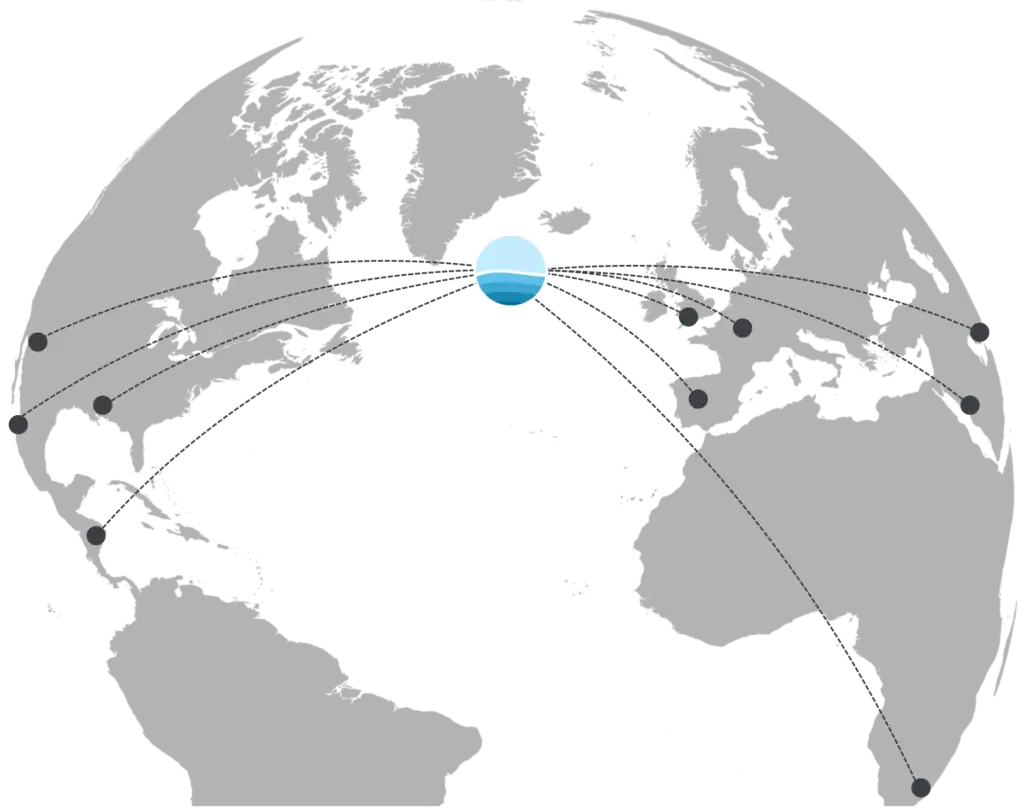
i-flow Edge extends this model with a distributed, centrally managed Edge architecture. Each Edge instance processes data locally and publishes it to the global Unified Namespace. The i-flow Hub orchestrates all Edge instances, ensuring consistent configuration and governance. This enables scalable, semantically harmonized data sharing across the enterprise — a defining characteristic of a modern Kepware alternative.
2. Communication Patterns: Polling vs. Event-based Protocols
Kepware primarily relies on the OPC UA client/server model, where clients (e.g., MES or SCADA systems) periodically poll data. This approach is reliable but leads to increasing complexity and network load as the number of consumers grows.
i-flow Edge uses event-driven, publish/subscribe communication (e.g., MQTT). Data is published once and distributed by the broker to any number of subscribers without additional load on the source system. This enables real-time, asynchronous communication across sites and systems — a key advantage for scaling IIoT and UNS architectures.
3. Governance and Operation
Kepware instances are usually configured and maintained individually. In multi-site environments, this often results in inconsistent tag models, naming conventions, and increased operational effort.
The i-flow Hub introduces a central governance layer: data models, namespaces, security policies, and configurations are defined once and rolled out automatically to all Edge instances. Versioned deployments, monitoring, certificate management, and role-based access control are handled centrally, enabling standardized and reproducible operations.
This shifts the focus from local gateway management to standardized, reproducible operation – a crucial prerequisite for scalable UNS and IIoT architectures.
4. Kepware vs. i-flow Edge: Security Model
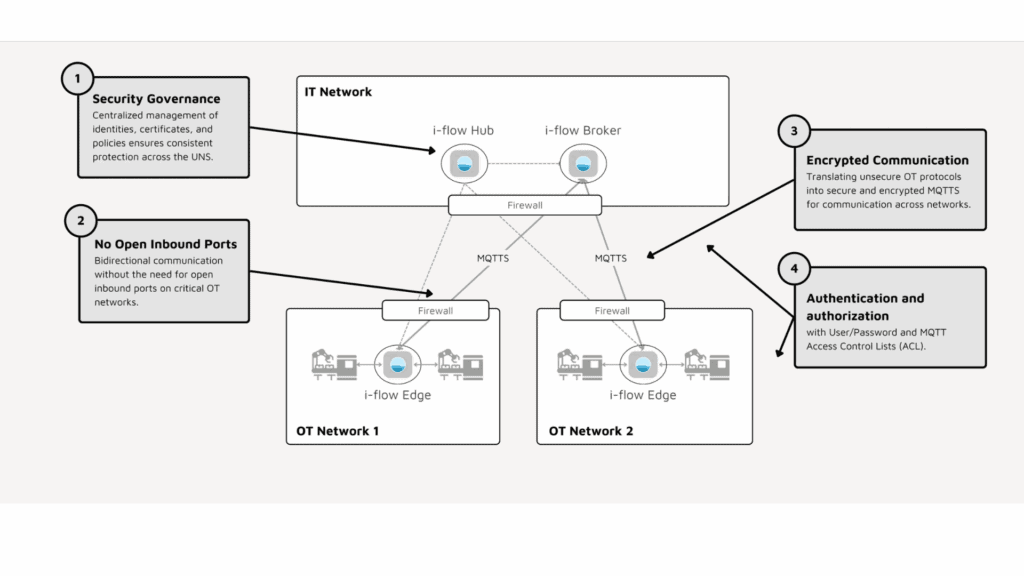
Traditional OPC UA servers like Kepware often require incoming connections from IT or MES systems. User accounts, roles, and certificates are typically managed locally per instance, increasing administrative effort and attack surfaces.
i-flow Edge follows a zero-trust-friendly approach: Edge instances establish outgoing, secured connections only, even for bidirectional communication. Identity, certificates, and access rights are managed centrally via the i-flow Hub and can integrate with enterprise identity providers such as Microsoft Entra ID. This significantly improves security, consistency, and auditability in distributed OT/IT architectures. You can find more information here.
5. i-flow as Kepware Alternative for Data Processing and Semantics
Kepware focuses on reliable data acquisition and forwarding, delivering mostly raw tag data that must be contextualized downstream.
i-flow Edge enables data processing pipelines directly at the Edge: data can be transformed, normalized, enriched with context or master data, and mapped to standardized semantic models before entering the UNS. This results in consistent information objects (e.g., plant → line → machine → parameter) and significantly reduces integration effort in MES, historian, BI, and cloud analytics systems.
6. Scalability and Lifecycle Management
In practice, Kepware typically scales vertically, by allocating more powerful hardware or larger virtual machines to existing instances. While multiple instances can be deployed, each must be configured and operated independently, without centralized orchestration.
i-flow Edge, on the other hand, is designed for horizontal scaling. New Edge instances can be deployed easily and orchestrated centrally via the i-flow Hub. Template-based configurations, versioning, and reusable data flows enable consistent rollouts and updates. This brings DevOps-style lifecycle management into industrial data integration.
7. i-flow Edge: Kepware Alternative for Virtualization
Modern IT/OT environments increasingly rely on virtualized and containerized infrastructures to achieve scalability, reliability, standardized deployments and tight integration into IT operating models (e.g. cloud, edge, DevOps). Virtualization is therefore a central component of modern IT/OT architectures.
i-flow Edge is fully container-based and can be operated flexibly in virtualized environments, Kubernetes clusters or cloud edge setups. This enables automated deployment, simple scaling and clean integration into existing IT lifecycle and operating processes.
Kepware, on the other hand, is not designed for containerized or cloud-native environments. It is typically operated in the traditional way on dedicated Windows systems, which means that virtualization, automated scaling and modern operating models are only supported to a limited extent.
8. Development Cycles
Both solutions are actively maintained, but with different release cadences. Kepware follows a traditional release model with several releases per year. i-flow Edge adopts shorter development and release cycles, enabling faster feature delivery and closer alignment with evolving UNS and IIoT requirements — an important advantage of a modern Kepware alternative.
9 Kepware vs. i-flow Edge: Available Connectors
Kepware offers a very wide range of OT connectors and device drivers for classic automation protocols and controllers. The focus is clearly on the reliable connection of field devices and PLCs. Extensions are mainly made via manufacturer-specific drivers; an open, generally available SDK strategy for rapid in-house development of connectors is only available to a limited extent.
i-flow Edge also supports key OT protocols but extends further into IT and enterprise integration, including REST APIs, batch processing, file-based integration. This facilitates the connection of MES, ERP, data lakes or cloud services. The i-flow SDK can be used to develop your own connectors and data pipelines and integrate them seamlessly into the platform – a clear advantage for heterogeneous IT/OT landscapes and individual integration requirements.
You can find an overview of all available connectors here.
10. Commercial Model and Planning Security
Predictable costs, stable license models and transparent price structures are crucial for IT/OT architectures, as integration platforms are typically used on a long-term and business-critical basis.
i-flow Edge follows a transparent subscription model designed for scaling and long-term planning without disruptive license changes.
Kepware customers are currently in the process of switching licenses to subscriptions. As part of this process, price adjustments and increases have already been communicated, leading to uncertainty among existing customers regarding future costs and investment security. This can be a relevant decision factor for companies with a growing or distributed gateway landscape.
11. Data Buffering and Offline Capability
Kepware has limited, protocol-related buffering as part of the OPC UA standard. Short-term connection interruptions can be partially cushioned via internal caches or OPC UA session mechanisms. However, a persistent, systematic store-and-forward concept for loss-free data acquisition over longer offline periods is not included.
i-flow Edge, on the other hand, is explicitly designed for unstable networks and distributed architectures. The Edge runtime saves data locally and persistently during outages and automatically forwarded once connectivity is restored. Once the connection is re-established, the events are delivered loss-free and automatically. This is a decisive advantage for cloud, hybrid and cross-site UNS architectures.
12. Traceability and Audit Trail
Kepware provides basic diagnostic and event logs that can be used to trace connection statuses or server events. However, complete, end-to-end traceability of all data operations – i.e. when, how and why a data point was read, changed, discarded or forwarded – is not part of the standard architecture. Logs are predominantly instance-local, not semantically correlated and only suitable for audit-proof audits or root cause analyses to a limited extent.
i-flow Edge, on the other hand, is designed from the ground up for complete transparency and traceability. Every data operation – from capture to processing, buffering, transformation and publication in the Unified Namespace – is made deterministically and seamlessly traceable. In combination with the i-flow Hub, central audit trails are created that correlate configuration changes, versions, error states and data flows across all edge instances.
This end-to-end traceability is a key prerequisite for compliance, regulatory requirements, root cause analyses and the stable operation of scalable UNS architectures – and goes far beyond traditional gateway logging approaches.
Summary of Differences
| Differences | Kepware | i-flow Edge |
|---|---|---|
| Architecture | Central, local gateway per line/location | Distributed edge architecture with central orchestration |
| Communication model | Polling (OPC UA client/server) | Event-based (publish/subscribe, e.g. MQTT) |
| Governance & operation | Local configuration per instance | Central governance via i-flow Hub |
| Security model | Inbound connections, local users & certificates | Outgoing connections only, central identity & policies |
| Data processing & semantics | Forwarding of raw data (tags) | Edge-based processing & semantic harmonization |
| Scaling | Vertical (stronger hardware) | Horizontal (more edge instances) |
| Virtualization | Classic Windows operation | Container- & cloud-native |
| Further development cycles | Classic releases (several times a year) | Short cycles (weeks/months) |
| Connectors | Very strong OT focus | OT + IT, batch, file & SDK extensions |
| Data buffering | Limited, near-protocol buffering | Persistent store-and-forward |
| Audit & traceability | Instance-local logs | Central, consistent audit trail |
i-flow in Combination with Kepware
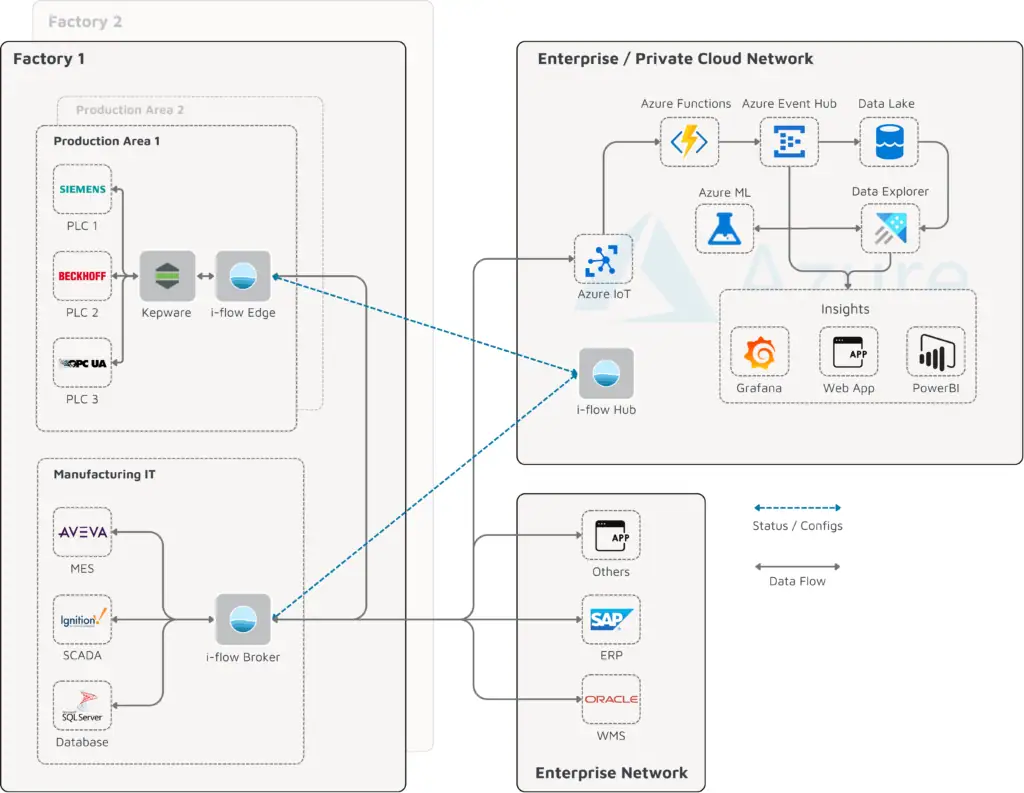
In brownfield environments, Kepware and i-flow Edge can also be used complementarily. Kepware acts as an OT protocol translator and OPC UA server, while i-flow Edge consumes the OPC UA data, processes and enriches it, and publishes it event-based into the Unified Namespace. This enables a gradual migration toward scalable UNS architectures without immediately replacing existing OT connectivity.
Conclusion
Kepware and i-flow Edge address similar foundational use cases in industrial data integration but follow fundamentally different architectural approaches. Kepware remains a proven local OPC UA gateway for traditional, site-centric automation setups.
As organizations move toward scalable Unified Namespace architectures, however, distributed Edge concepts, event-based communication, centralized governance, and semantic data models become essential. This is where i-flow Edge positions itself as a modern Kepware alternative — either as a replacement or as a complementary building block in future-ready IT/OT architectures.