
Munich, January 2026 – With Release 3.3, we deliberately strengthen our enterprise foundation and sharpen our focus on scalable automation and DevOps readiness. The new release extends the platform with powerful APIs for CI/CD deployments, enhanced debugging capabilities, and new file-based integration options. This directly addresses the demands of large-scale IT/OT integration landscapes with extreme scalability requirements (1,000+ machines). Industrial data flows can now be deployed, reproduced, and operated transparently and reliably at scale using CI/CD pipelines.
“Release 3.3 is a clear statement for automation at scale,” says Timo Vormweg, Managing Director of i-flow GmbH. “Our enterprise customers are increasingly operating i-flow as a global integration layer. With DevOps-ready APIs and improved traceability, we are laying the foundation for controlled, scalable rollouts across systems, plants, and regions.”
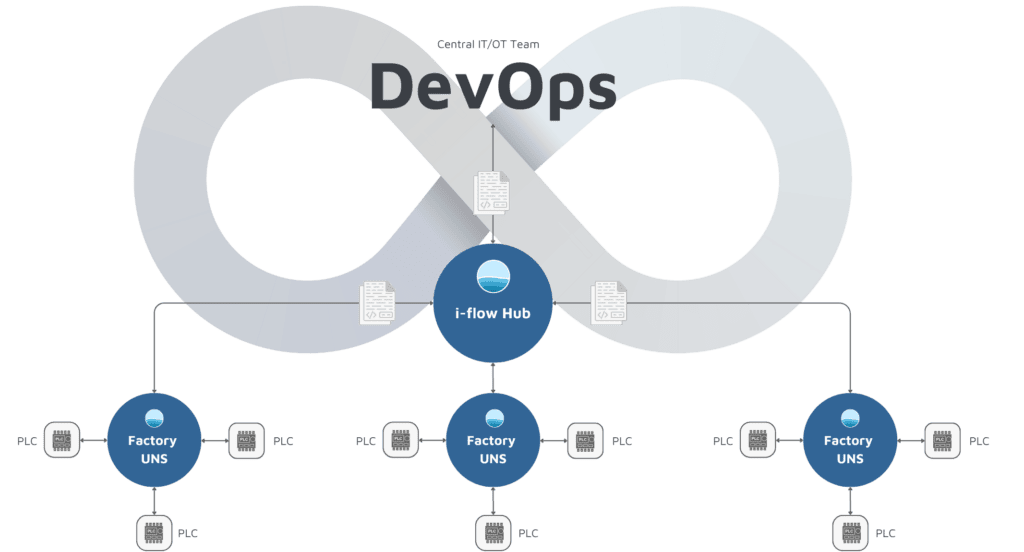
DevOps-ready: i-flow API for CI/CD-based Deployments
A central highlight of Release 3.3 is the new and extended i-flow API, which enables resources such as connections, assets, and flows to be fully configured, monitored, and controlled from external systems. This allows i-flow installations to be seamlessly integrated into CI/CD pipelines. Configurations can be rolled out in a versioned manner, changes can be tested automatically, and deployments can be reproduced consistently across development, test, and production environments. This marks a decisive step toward DevOps-driven operating models.
Full Transparency and Faster Troubleshooting in Live Operations
Release 3.3 also delivers a wide range of improvements for day-to-day operations:
- Enterprise-grade SMB integration for file-based workflows and secure access to Windows and NAS shares using classic SMB/CIFS authentication
- Significant enhancements for machine and edge scalability, including improved performance of the Heidenhain DNC Agent—even when connecting large numbers of machines in parallel
- Extended run details providing full processor configurations for maximum runtime traceability
- Numerous UX, stability, and templating improvements that simplify large-scale and complex integration scenarios
Together, these improvements increase operational transparency, significantly reduce debugging times, and enhance overall system reliability — particularly in large, highly scalable integration and edge deployments. Further details are available in the full release notes.