
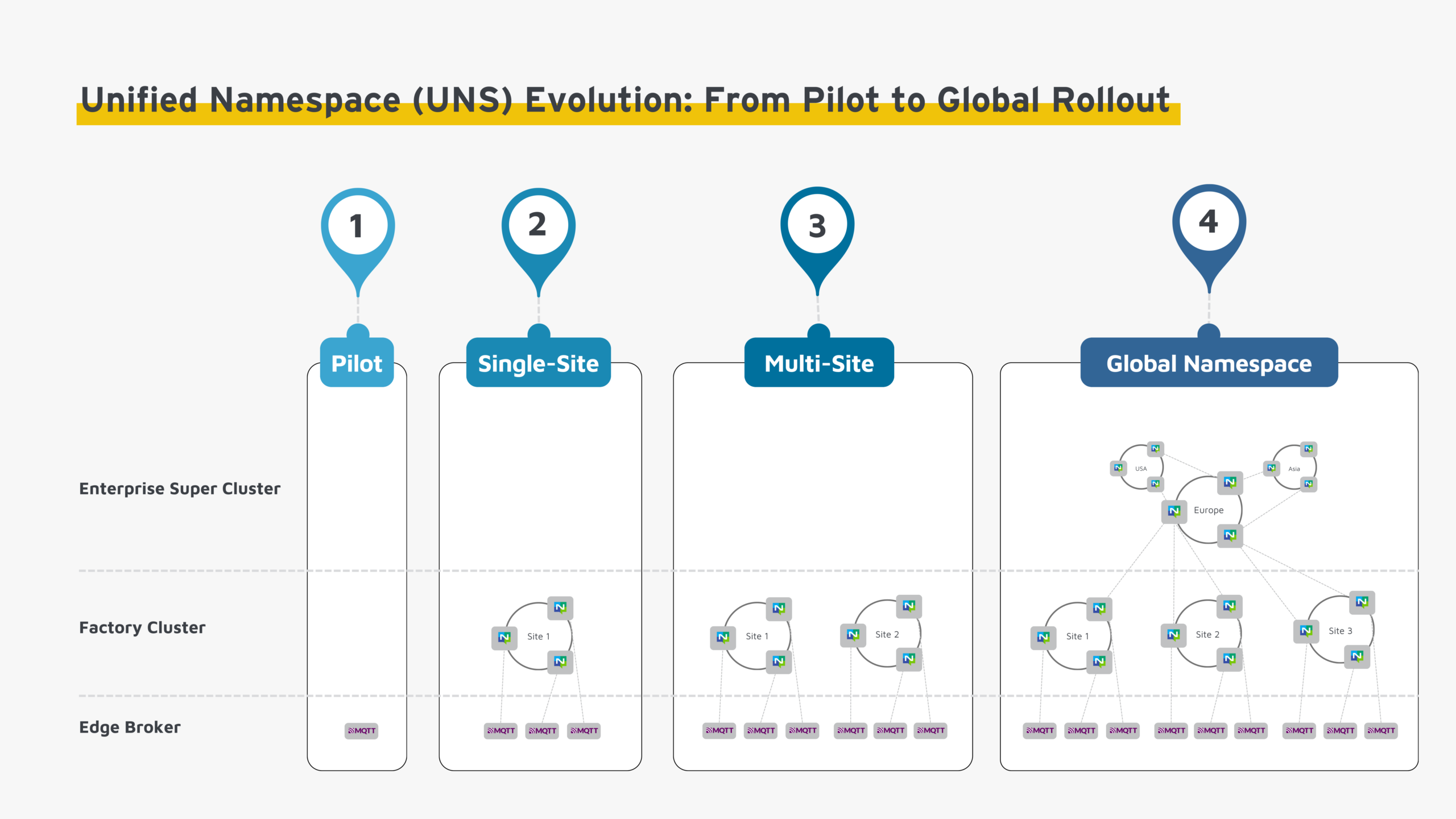
Unified Namespace (UNS) implementations rarely begin as global enterprise projects. The typical path progresses from a pilot project with 20 machines on a single production line through site-wide rollouts to globally distributed multi-site architectures. The evolution of the Unified Namespace (UNS) unfolds in clearly definable stages – each with specific technical characteristics, scaling properties, and use cases. IT/OT architects face critical questions: Which architecture fits my current requirements? When is migration to the next stage necessary? This article describes the four core evolution stages of the Unified Namespace – from single-broker setups to NATS Superclusters – and provides clear decision frameworks for architecture selection.
Evolution Stages of the Unified Namespace (UNS): 4 Phases
Selecting the right UNS architecture is not purely a technical decision, but a strategic inflection point. Over-engineering – such as starting with a broker cluster for 30 machines – creates unnecessary complexity and binds resources. Under-engineering – a single-broker setup for 500 machines across three sites – leads to performance bottlenecks, lack of redundancy, and limited scalability.
Note: A Unified Namespace (UNS) comprises more than just a message broker – including edge gateways, governance, and data harmonization layers (see details). This article focuses on broker architecture evolution – peripheral components scale accordingly at each stage.
Identifying Evolution Drivers
The evolution of the Unified Namespace (UNS) is driven by concrete requirements:
- Scale: Number of connected machines, edge gateways, and data streams
- Availability: Tolerance for broker failures (High Availability)
- Sites: Number of geographic production locations
- WAN Availability: Stability and bandwidth of inter-site network connections
- IT Analytics: Need for global data visibility across multi-site operations
These drivers define which of the four evolution stages is appropriate for an organization. Guiding principle: As simple as possible (lower stages), as complex as necessary (higher stages). Complexity is not an end in itself, but a response to concrete, validated requirements.
Stage 1: Pilot (Local Single-Broker)
The first stage of Unified Namespace (UNS) evolution is the single-broker setup: A single message broker – NATS or MQTT – aggregates all data from a site. All edge gateways connect to this single broker. Typical deployment: VM, edge server, or industrial PC directly at the plant.
Architecture and Structure
- Single Broker Node: No cluster configuration, no failover
- Local Data Processing: All messages remain within the plant, no WAN transfer
- Simple Deployment: Installation on a single host, no distributed configuration
- Direct Connections: Edge gateways connect directly to broker IP
Characteristics
- Simplicity: Minimal configuration, no cluster orchestration
- Single Point of Failure (SPOF): Broker failure halts data flow
- Performance Limits: Single node limits throughput to ~200,000 messages/sec (depending on broker/hardware)
- Site Autonomy: Plant operates independently of WAN connectivity
- Architectural Complexity: Low
Use Case
- Pilot projects evaluating UNS architecture
- Single production lines with <50 machines
- Dedicated shop floor network infrastructure without HA requirements
- Proof-of-concept deployments before production rollout
Evolution Drivers: When to Move to Next Stage?
- High Availability Required: Production downtime due to broker failure is not tolerable
- Performance Limits Reached: Broker processing >200,000 messages/sec, latency increasing
- Criticality Increasing: UNS transitions from pilot to production-critical system
Stage 2: Single-Site (Local Broker Cluster)
Stage 2 of UNS evolution introduces clustering: Instead of a single broker, three or more NATS servers form a cluster. Each node in the cluster connects to every other node – a full-mesh topology. Edge gateways connect to the cluster, not to individual nodes. When a broker node fails, remaining nodes absorb the load.
Architecture and Structure
- NATS Cluster: Minimum 3 nodes (recommended: odd number for quorum)
- Full Mesh: Every NATS server connects to every other server
- Data Replication: Messages distributed across all cluster nodes
Characteristics
- High Availability (HA): No single point of failure – cluster continues operating during individual node failures
- Horizontal Scaling: Performance improvement through adding additional nodes
- Site Autonomy: Cluster remains local within plant, no WAN required
- Automatic Failover: Clients automatically reconnect to available nodes
- Architectural Complexity: Medium
Use Case
- Production UNS deployments with >50 machines
- Critical production systems where downtime causes production stoppages
- Plants with 24/7 operations and HA requirements
Evolution Drivers: When to Move to Next Stage?
- Multi-Site Rollout: Additional plants or geographic sites being connected
- Site Isolation: Each plant should operate autonomously
- Cross-Site Governance: Centralized namespace management with local execution
Stage 3: Distributed Multi-Site (Multi-Site Cluster)
Stage 3 of the Unified Namespace (UNS) evolution is the distributed multi-cluster architecture: Each site – such as Berlin plant, Shanghai plant, Chicago plant – operates an independent local NATS cluster (3+ nodes). The clusters are not interconnected. Each plant operates completely autonomously with its own isolated namespace.
Architecture and Structure
- Isolated Clusters: Each site maintains an independent NATS cluster (3+ nodes)
- No Inter-Cluster Communication: Clusters do not see each other
- Local Namespaces: Each plant defines its own ISA-95 hierarchy (e.g.,
plant01.line01.robot01,plant02.line01.robot01) - Centralized Governance: Namespace standards managed centrally via i-flow Hub
Characteristics
- Complete Site Autonomy: Each plant operates autonomously during WAN failures – local pub/sub communication remains unaffected
- Minimal Latency: Local shop floor communication <5 ms (no WAN round-trip)
- No Global Data Visibility: IT systems can only query cross-site via respective cluster connections
- Architectural Complexity: Medium
Use Case
- Multi-site production networks with <5 locations
- Plants operating independently (no global data aggregation required)
- Organizations with unstable or expensive WAN infrastructure
- Initial rollouts in multi-site environments
Evolution Drivers: When to Move to Next Stage?
- Global IT Analytics: Production comparison across plants, multi-site OEE dashboards
- Multi-Site ML Models: Machine learning algorithms require data from all sites
- Centralized Data Visibility: Executive dashboards for global production KPIs
- Hybrid Cloud Strategy: Edge remains local, IT analytics runs in cloud with global access
Stage 4: Global Namespace (NATS Supercluster)
Stage 4 is the highest evolution stage of the Unified Namespace (UNS): The NATS Supercluster federates multiple regional NATS clusters into a globally addressable namespace. Each site continues to operate its local 3-node cluster, but these clusters are networked via gateway connections. The result: Site autonomy is maintained, but IT systems can globally subscribe to data from all sites.
Architecture and Structure
- NATS Supercluster: Federation of multiple regional clusters via gateway connections
- Local Cluster per Site: Each plant continues to operate its independent 3-node cluster
- Gateway Connections: NATS feature for interconnecting separate clusters
- Globally Addressable Namespace: ISA-95 hierarchy is globally unique (
berlin.plant01.line01.robot01,shanghai.plant02.line01.robot01)
Operation: Subject Interest Propagation
The NATS Supercluster operates via intelligent, interest-based routing:
- Local Pub/Sub Stays Local: Messages within a cluster (e.g.,
berlin.plant01.line01.robot01.temperature) remain in the Berlin cluster – no WAN transfer - Subject Interest Propagation: When a subscriber in Shanghai subscribes to
berlin.plant01.>, NATS propagates this interest via gateway connection to Berlin - On-Demand Routing: Only messages with active remote subscribers are routed over WAN – conserves bandwidth
- Global Subscriptions: IT systems can aggregate data from all sites with a single wildcard subscribe (
*.plant*.line01.>)
Characteristics
- Site Autonomy During WAN Failures: Local pub/sub communication continues – only remote subscriptions are affected
- Latency-Optimized for Edge: Shop floor communication remains local (<5 ms), no WAN-induced latency
- Global Scalability: New sites add their own cluster – no central broker load
- Bandwidth Efficiency: Subject-interest-based routing – only required data over WAN
- Globally Federated Namespace: Unified ISA-95 hierarchy across all sites
- Architectural Complexity: High
Use Case
- Global multi-site production networks with >5 locations
- IT analytics requiring global data visibility (multi-site OEE dashboards, cross-plant production comparison)
- WAN connections available but failures possible (e.g., transcontinental links)
- Hybrid cloud strategy: Shop floor real-time local, IT analytics global in cloud
- Enterprises with centralized data science teams requiring global production data
Comparison Table: All Stages at a Glance
The following table summarizes the four evolution stages of the Unified Namespace (UNS) and enables direct comparison:
| Stage | Architecture | Structure | Autonomy & Latency | Scaling & HA | Typical Use Case | Complexity |
|---|---|---|---|---|---|---|
| 1 | Single-Broker (Local UNS) | Single broker at plant (VM/Edge PC), no clustering | Fully local, WAN-independent | No HA, SPOF, limited performance | Pilot project, <50 machines, no HA requirement | Low |
| 2 | Local Broker Cluster (HA UNS) | Local cluster (3+ nodes), full mesh at plant | Local, WAN-independent | High availability, horizontal scaling at plant | Production rollout >50 machines, failure not tolerable | Medium |
| 3 | Distributed Multi-Cluster (Multi-Site UNS) | Multiple plants, each with own cluster, not connected | Autonomous per site, <5 ms local | HA per plant, no global data visibility | Multi-site (<5 locations), plants operate independently | Medium |
| 4 | NATS Supercluster (Global UNS) | Multiple local clusters federated via gateways, globally addressable namespace | Autonomous during WAN failure, local <5 ms, global subscriptions possible | Global scalability, no central bottleneck, WAN-efficient routing (interest-based) | Global production network (>5 sites), global analytics & OEE | High |
Decision Framework: Which Stage is Right?
Selecting the right evolution stage of the Unified Namespace (UNS) depends on clearly measurable criteria. The following decision logic aids in selection:
Evaluation Criteria
- Number of Machines/Edge Gateways: <50 → Stage 1, >50 → Stage 2+
- High Availability Requirement: Yes → minimum Stage 2
- Number of Sites: 1 → Stage 1/2, 2-5 → Stage 3, >5 → Stage 4
- WAN Availability: Unstable/expensive → Stage 3, stable → Stage 4 possible
- Global IT Analytics: No → Stage 3, Yes → Stage 4
- Team Competency: Basic → Stage 1/2, advanced → Stage 3/4
Decision Flow
- Is this a pilot project or <50 machines?
- Yes → Stage 1 (Single-Broker)
- No → Continue to 2
- Is High Availability required?
- Yes, but only 1 site → Stage 2 (Local Cluster)
- No, but 1 site → Stage 1
- Yes, multiple sites → Continue to 3
- Does IT analytics require global data visibility across all sites?
- No → Stage 3 (Distributed Multi-Cluster)
- Yes → Stage 4 (NATS Supercluster)
Common Decision Mistakes
- Over-Engineering: Supercluster for 30 machines at one plant – unnecessary complexity
- Under-Engineering: Single-broker for 500 machines across three sites – performance and HA problems guaranteed
- Stage Skipping: From Stage 1 directly to Stage 4 without clustering experience – high risk
Best Practices for the Evolution Path
The evolution of the Unified Namespace (UNS) should proceed incrementally. The following best practices have proven effective:
1. Start Small, Scale Smart
- Begin with Stage 1 (Single-Broker) for pilot projects
- Gain experience with topic design, data modeling, and pub/sub patterns
- Scale to the next stage only when need is validated
2. Monitor Evolution Drivers
- Monitor performance metrics (messages/sec, latency, broker CPU/RAM)
- Document downtime incidents as triggers for HA requirements
- Track number of connected machines and sites
3. Migrate Stage by Stage
- Do not skip stages – each introduces new complexity
- Migrate from Stage 1 → 2 by building cluster with additional nodes
- From Stage 2 → 3 by rolling out additional local clusters at new sites
- From Stage 3 → 4 by activating gateway connections between clusters
4. Governance from the Start
- Define topic naming conventions already in Stage 1
- Use ISA-95-compliant hierarchies:
enterprise/site/area/line/cell/signal - Document data dictionary centrally (e.g., via i-flow Hub)
- Maintain namespace consistency across all sites
5. Establish Monitoring
- Implement broker monitoring from Stage 1 (e.g., Prometheus + Grafana)
- Track: Messages/sec, topic count, connection count, memory usage
- Use metrics as decision basis for scaling
Conclusion
The evolution of the Unified Namespace (UNS) unfolds in four clearly definable stages – from single-broker setups for pilot projects to globally federated NATS Superclusters for enterprises with dozens of production sites. Each stage has specific technical characteristics, scaling properties, and use cases. The right architectural choice is critical: Over-engineering creates unnecessary complexity, under-engineering leads to performance problems and lack of redundancy.
Three Key Insights
- Think Evolutionarily, Not Revolutionarily: Start with the simplest architecture (Stage 1) that meets your current requirements. Scale incrementally when need is validated.
- Balance Autonomy and Scalability: Stage 3 (Distributed Multi-Cluster) offers maximum site autonomy, Stage 4 (Supercluster) maximum flexibility for IT analytics. Choice depends on WAN availability and analytics requirements.
- Governance Before Technology: Consistent topic namespaces and ISA-95-compliant hierarchies are more important than evolution stage selection. Establish standards in Stage 1 – they carry through all subsequent stages.