
Many digitalization projects do not fail because tools are missing. They fail because structure is missing. Sensors produce data, machines produce data, ERP and MES produce data. Yet without a solid concept these data streams stay isolated. This is exactly where a data architecture unified namespace comes in: it describes how data is created, flows, is stored and is served. This article first explains what a data architecture is in classic terms. It then shows why the Unified Namespace (UNS) is the fitting pattern for Industrial IoT.
The article follows a clear structure. First it clarifies the definition and the building blocks. Next it frames the requirements of manufacturing. Finally it describes best practices and the roles for building a scalable data architecture.

What is a data architecture?
A data architecture is the structural blueprint for handling data. It defines which sources exist and how data is integrated. It also governs storage, provisioning and governance. In short, it describes the path from raw signal to usable data product.
The distinction from the data model matters. A data model defines the concrete structure of individual records. The data architecture, by contrast, describes the bigger picture. It is the discipline that connects all building blocks into a consistent system.
Why does this matter? Because data only becomes valuable through structure. An isolated measurement stays a number without meaning. Only context makes it usable. A good data architecture provides exactly this context. It ensures that every application uses the same reliable data foundation.
The building blocks of a data architecture
Every data architecture consists of recurring layers. These building blocks build on one another:
- Sources: This is where data is created. It includes sensors, PLCs, machines as well as MES and ERP systems.
- Integration and ingestion: This layer collects and normalizes the data. Gateways and connectors turn raw data into a uniform format.
- Storage: Data lands in databases, historians or data lakes. The choice depends on the access pattern.
- Provisioning and analytics: Applications, dashboards and models access the data. Visible value emerges only here.
- Governance and security: This cross-cutting layer clarifies access, quality and naming conventions. It spans all levels.
Governance is not an optional layer. It decides whether an industrial data architecture stays consistent long term. Without clear rules, names and formats quickly drift apart.
Classic patterns at a glance
Several patterns have become established in IT for these building blocks. Each pattern sets different priorities:
- Data warehouse: Highly structured data for reporting and BI. Schema and quality come first.
- Data lake: A central store for raw data in any format. Flexible, but without inherent structure.
- Data mesh: Decentralized ownership. Domains deliver data as standalone products.
- Data fabric: An integration layer over distributed sources. Metadata connects the systems logically.
These patterns stem from classic IT. They address data warehouses, analytics and cloud storage. The context of production, however, is largely missing from them.
This is not a criticism of the patterns themselves. For their purpose they are mature and proven. But they were built for business data and reporting. Machine data in real time makes different demands. We look at exactly this gap in the next section.
Data architecture in Industrial IoT
Different rules apply on the factory floor than in the data center. Data is created in real time and at high frequency. It must be processed close to the machine. This is exactly where classic IT patterns often fail.
Why classic IT data architectures fail
Classic approaches were designed for batch analytics. In manufacturing they hit three limits. First, latency: a controller cannot wait for a cloud round trip. Second, structure: the classic ISA-95 pyramid forces data upward level by level. This costs time and creates silos.
Third, coupling. Without a central pattern, teams connect systems directly to each other. This creates many point-to-point connections. Every new application needs its own interface. The number of connections then grows quadratically. A scalable data architecture looks different.
An example illustrates the problem. A historian, a dashboard and an MES all want the same machine value. Without a central layer, each system queries the controller directly. The controller then carries the load of all queries alone. Every new consumer increases this load further. The source system becomes the bottleneck.
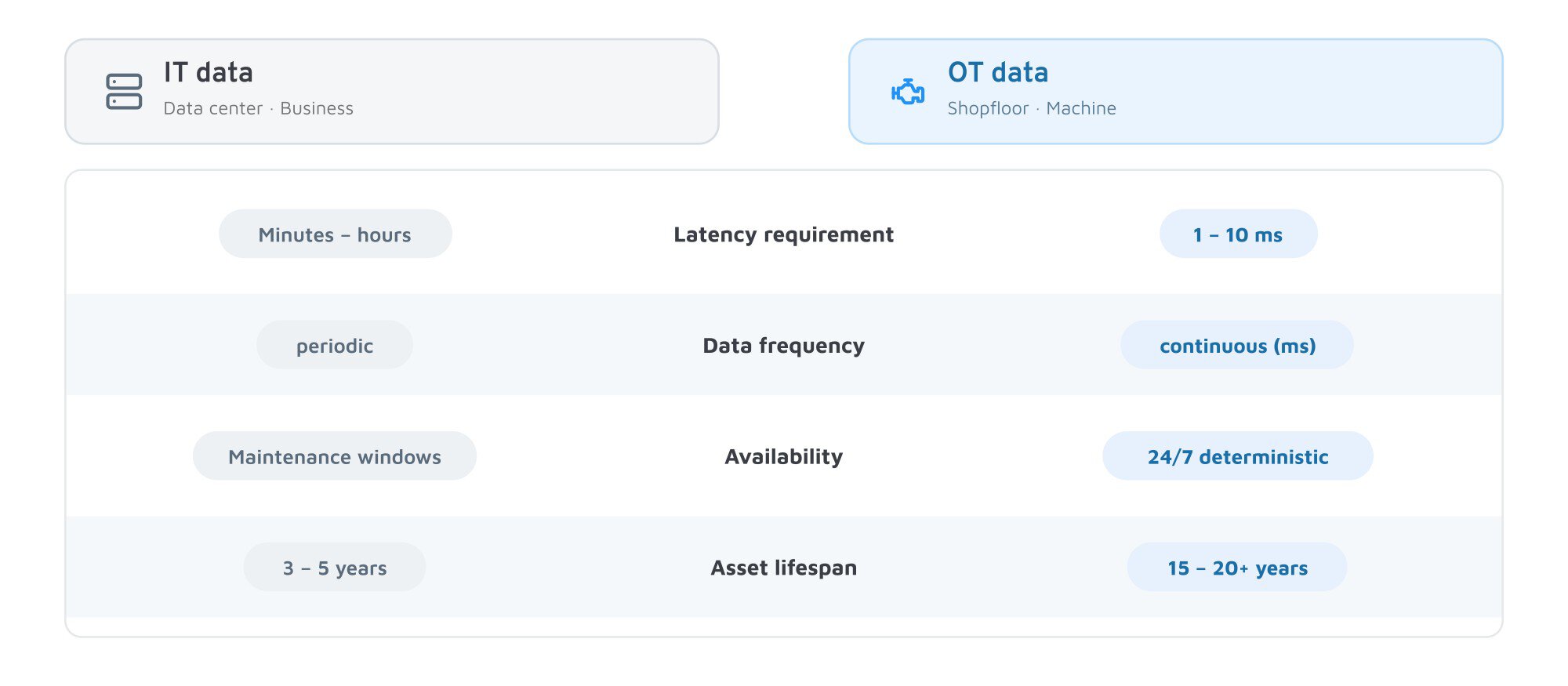
The requirements of manufacturing
An industrial data architecture must meet four core requirements. They clearly separate manufacturing from pure IT:
- Real time: Data must be available with minimal delay.
- Edge proximity: Processing happens close to the machine, not only centrally.
- Context: A measurement alone is not enough. Semantics and origin belong to it.
- IT/OT convergence: Production and IT must use the same data.
The last point is decisive. Without a shared data foundation, IT and OT stay separate worlds. How this convergence succeeds is described in detail in our article on IT/OT convergence.
Data architecture unified namespace: the OT-native pattern
The Unified Namespace answers exactly these requirements. It is not a product, but an architectural pattern. A data architecture unified namespace provides all data in one central, contextualized layer. Every system publishes and subscribes to data through this layer. What a UNS is exactly is explained in our article What is the Unified Namespace.
From the ISA-95 pyramid to the publish/subscribe layer
The core of the change is easy to describe. A rigid hierarchy becomes a flat data layer. In the ISA-95 pyramid, data climbs level by level. In the UNS, every level accesses a shared layer directly. This layer is the single source of truth (SSOT).
Every level becomes an equal participant. An MES reads the same value as a dashboard. New consumers join without changing the source. This is exactly what makes the architecture scalable. How the data is structured in doing so is shown in our technical guide to data modeling.
The transport of this data runs over a messaging protocol. Most often MQTT or NATS are used. Both cleanly decouple sender and receiver. Which protocol fits better depends on the use case. The details are compared in our article on NATS vs. MQTT in the Unified Namespace.
UNS compared to data lake and data mesh
The UNS does not reinvent data architecture. It transfers proven ideas into the OT context. From the data mesh it adopts loose coupling and decentralized ownership. From the data lake it differs clearly. A data lake collects raw data passively. The UNS provides contextualized data actively and in real time.
This difference is important. A pure data lake without structure quickly becomes a data swamp. What lessons can be drawn from this is described in our article on the lessons from the data lake hype.
The UNS does not replace the data lake. It complements it sensibly. The layer distributes data in real time to all consumers. A historian or a time-series database stores it long term. Both levels serve different jobs. How historian and time-series DB differ is shown in our article on time-series DB vs. historian.
Best practices for a scalable data architecture
A pattern alone guarantees no success. Consistent execution is decisive. The following principles have proven themselves for a scalable data architecture.
Principles checklist
These five principles form the foundation. They apply regardless of the broker in use:
- Single source of truth: Each data point exists exactly once, centrally.
- Loose coupling: Systems do not know each other. They communicate only through the layer.
- Event-driven: Data is published on change, not queried repeatedly.
- Edge normalization: Context is created close to the source, not only in the cloud.
- Governance: Naming conventions and access rules are fixed from the start.
These principles interlock. Loose coupling without governance leads to sprawl. Governance without SSOT stays ineffective. Security belongs to this from the very beginning. Concrete measures are summarized in our article on secure UNS architectures.
The patterns in direct comparison
Which pattern fits which goal? The following graphic compares the five approaches. It rates them by the criteria of manufacturing.
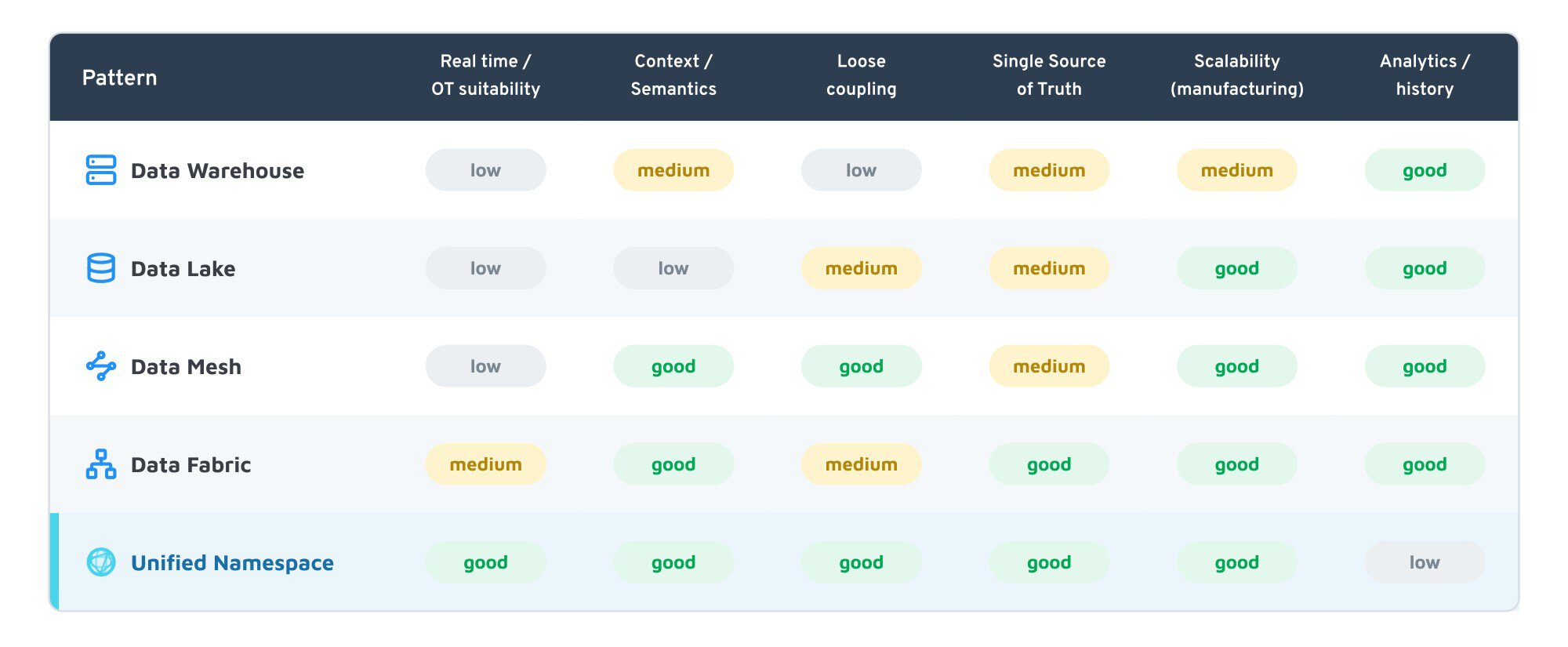
The comparison shows a clear picture. Warehouse and lake score on analytics. On real time and OT suitability they fall behind. The UNS combines context, loose coupling and real time. This makes it the OT-native pattern for manufacturing.
The patterns do not exclude each other. In practice they often complement each other. The UNS forms the real-time backbone for production. A data warehouse still handles reporting. The key is to assign each pattern the fitting job. This creates an industrial data architecture without needless breaks.
From pilot to rollout
A scalable data architecture rarely emerges all at once. A step-by-step approach has proven itself. Teams start with a clearly scoped pilot. They then extend the layer to more lines and sites. The individual maturity stages are described in our article on the evolution of the UNS from pilot to global rollout.
The order matters. Governance and naming conventions are created in the pilot, not only at rollout. This keeps the architecture consistent while it grows. A standard defined early saves a lot of effort later. Retroactive corrections across many sites are expensive.
Who supports building a scalable data architecture?
Building it is as much a team question as a technology question. Without clear roles, even the best pattern stays theory. It takes people, processes and a fitting platform.
Roles in the team and fitting partners
Internally, a project needs several roles. A data architect designs the structure. OT owners know the machines and protocols. IT owners secure operations and governance. These roles must work closely together.
Externally, partners and platforms help. They bring experience from many projects. They also provide the technical basis for the layer. Which roles interact in detail is described in our article on organization and roles in the UNS.
The right platform takes a lot of work off the team. It provides ready-made connectors for common protocols. It also ensures uniform governance across all sites. This lets the team focus on the actual value creation. It builds applications instead of maintaining interfaces.
i-flow as the foundation of your data architecture
i-flow delivers exactly this foundation. The platform cleanly separates configuration and execution. In the central i-flow Hub you configure the entire architecture in one place. The actual processing runs decentrally over i-flow Edges. These run close to the machine and normalize data directly at the source.
This principle fits a data architecture unified namespace exactly. Central configuration ensures governance and consistency. Decentralized execution ensures real time and edge proximity. This creates an industrial data architecture that grows with you. Those looking for a starting point find guidance in our guide to Industrial DataOps in the UNS.
Conclusion
A solid data architecture decides the success of digitalization. It connects sources, integration, storage, provisioning and governance into a system. Classic IT patterns hit their limits in manufacturing. The Unified Namespace closes this gap. It transfers proven ideas into the OT context and delivers the fitting pattern. Three key takeaways
- Structure beats tools: Data value comes from a clear data architecture, not from individual tools.
- The UNS is the OT-native pattern: A data architecture unified namespace combines context, loose coupling and real time.
- Configure centrally, execute decentrally: This principle is what makes a scalable data architecture possible.