
The same pattern appears in almost every plant. First a machine is connected to a dashboard. Then a second link goes to the MES. Later a direct line to the cloud is added. After a few months, a web of individual point-to-point interfaces has grown. Experts like to call this pattern “IoT spaghetti”. Anyone who wants to choose the right integration tools industrial IoT therefore needs a map first. Only this orientation makes the many tool classes comparable.
Data integration on the shopfloor follows different rules than classic IT integration. Machines speak OPC UA, Modbus or proprietary fieldbuses. Controllers need deterministic latency. Networks fail, so the edge must buffer data in between. And the number of connections grows quadratically once every system talks directly to every other one. This article sorts the tool classes. It helps decide which class fits which job, and links to the relevant deep-dive articles for the details.
What does Data Integration in the Industrial IoT mean?
Data integration in the Industrial IoT connects machines, controllers and IT systems so that data can flow. It covers three tasks: transporting data, transforming it into a common format and routing it to the right recipients. Sounds simple. In practice it rarely is.
The reason lies in the heterogeneity of the shopfloor. A single line often combines controllers from several vendors and several generations. Each speaks its own language. This is exactly where integration tools industrial IoT come in. They abstract this diversity and create a common data foundation.
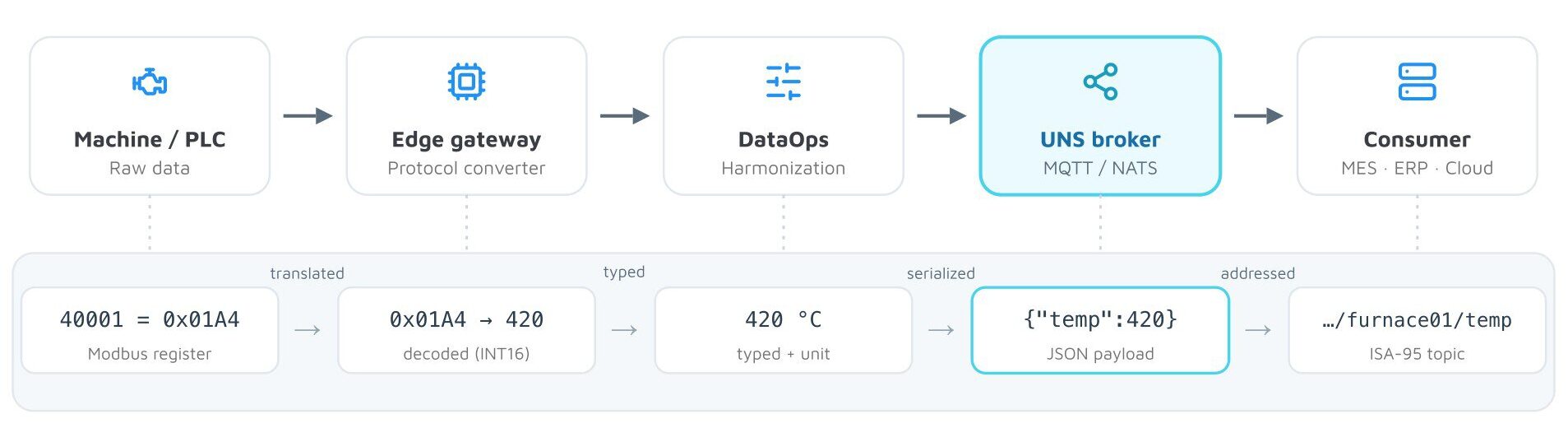
An example makes this tangible. A furnace reports its temperature as a raw Modbus register value. An MES, by contrast, expects a typed JSON object with a unit. A tool has to translate between these two worlds. This translation is the core of any data integration in the Industrial IoT.
IT data integration vs. OT data integration
In IT, integration is a solved problem. Systems speak REST or SQL. Latency in the range of seconds is acceptable. If a service drops out briefly, the request is simply retried.
In OT, tougher rules apply. Four requirements make IIoT integration demanding:
- Protocol diversity: OPC UA, Modbus, PROFINET, S7 and many more protocols exist in parallel. A tool has to translate them.
- Determinism: Control-near processes need reliable, low latency. Delays are critical here.
- Network failure: Connections break. The edge must buffer data locally and deliver it later.
- Scaling: Direct connections grow quadratically. Without a central layer, this ends in chaos.
These differences explain why pure IT tools often fail on the shopfloor. A cloud connector knows no OPC UA. An iPaaS does not buffer fieldbus data when the line breaks. Choosing the right data integration in the Industrial IoT therefore starts with these four requirements. Ignore them, and you buy a tool that shines in the lab and disappoints in production.
The Categories of Integration Tools in the Industrial IoT
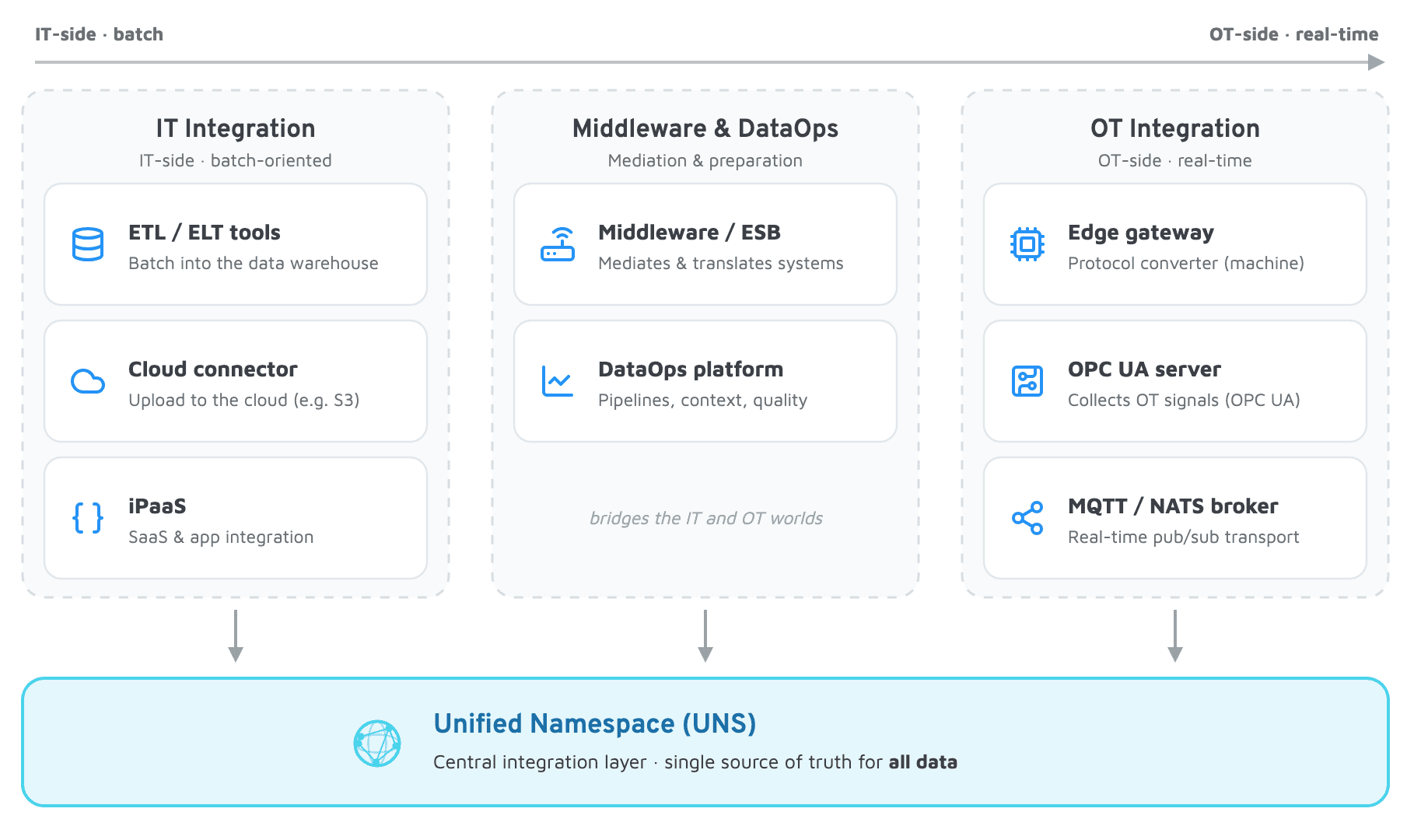
The market looks confusing. Hundreds of products compete for attention. In fact, most of them fit into a few classes. Each class solves one particular task especially well. The boundaries are fluid. Some products combine several classes. The following overview sorts the most important integration tools industrial IoT by their typical role. For each class there is a note on when it fits, plus a pointer to the matching deep-dive article.
ETL/ELT tools
ETL stands for Extract, Transform, Load. These tools pull data from source systems, transform it and load it into a data warehouse. They mostly work in batch mode, that is in scheduled intervals. ELT reverses the last two steps and loads first, then transforms inside the target database. Their home is IT and the analysis of large data volumes.
When does it fit? For the periodic analysis of historical data. ETL tools are not designed for real-time control on the shopfloor.
iPaaS (Integration Platform as a Service)
An iPaaS is a cloud-based platform for integrating applications. It mainly connects SaaS services and business systems through ready-made connectors. Operation lies with the provider. That noticeably lowers your own effort. In return, the dependency on the platform grows.
When does it fit? For connecting cloud applications and ERP systems. OT protocols and deterministic latency are rarely among its strengths.
Middleware & ESB
Middleware is the mediation layer between heterogeneous systems. An Enterprise Service Bus (ESB) is a classic form of it. Both transport, transform and route data. A dedicated article covers the subtypes and their role in the Unified Namespace in detail.
When does it fit? As a mediation layer in grown IT/OT landscapes. Read more in the article Middleware in the IIoT: Foundation of Modern IT/OT Architectures.
OPC UA connectivity server
A connectivity server collects data from many controllers and provides it through a single protocol. Usually that is OPC UA. Such servers are firmly rooted in OT and deliver close to real time. Well-known products, however, often tie you to a single vendor.
When does it fit? For connecting many heterogeneous controllers. On alternatives and their role in the UNS, see Kepware Alternative in the Context of the Unified Namespace (UNS).
MQTT and NATS message brokers
A message broker distributes messages on the publish/subscribe principle. A sender publishes to a topic. Any number of receivers read along. That decouples systems and scales well. MQTT and NATS are the most common options here. The broker itself knows no OT protocols. It needs an upstream gateway that translates the field level.
When does it fit? As the backbone for real-time data distribution to many consumers. A comparison of the brokers is in the article MQTT, Kafka, AMQP or NATS: Comparison of Message Brokers.
DataOps platforms
DataOps applies principles from DevOps to data processing. Such platforms model, harmonize and version data flows. They ensure data quality and traceability. This places them between OT and IT. Often they build on a broker and add a modelling layer. Raw messages thus become a cleanly structured data space.
When does it fit? When data quality and a unified model are the priority. A starting point is Industrial DataOps in the Unified Namespace: Getting Started.
Cloud connectors and edge gateways
Edge gateways sit right at the machine. They translate OT protocols and buffer during network outages. Cloud connectors then transport the data into a cloud environment. Together they form the bridge between shopfloor and cloud. The gateway is often the first building block of an IIoT integration. It decouples the field level from everything above it.
When does it fit? For connecting to cloud services and individual use cases. See AWS S3 Integration: How Machine Data Ends Up in the Cloud and i-flow SDK: Any-Connect Integration of Individual Use Cases.
Point-to-Point Integration vs. Central Integration Layer
Many projects collect tools instead of choosing an architecture. That solves individual tasks in the short term. In the long run, however, it worsens the actual problem. Because the number of connections grows faster than the number of systems.
With pure point-to-point integration, every system connects directly to every other one. The number of connections then follows the formula n·(n-1)/2. Ten systems already need 45 connections. With fifty systems it is 1,225. Every connection has to be built, tested and maintained. The growth is quadratic, that is O(n²).
The operating effort grows along with it. If the format of a source changes, several interfaces break at once. Each has to be adapted individually. This is exactly where many IIoT projects fail in the scaling phase. The technology works in the pilot but becomes unmanageable in the rollout.
A central integration layer reverses this pattern. Every system connects only once to the layer, usually a Unified Namespace. The number of connections then grows linearly, that is O(n). Ten systems need ten connections. New consumers simply read along without changing the source. What a Unified Namespace exactly is, is explained in the article What Is the Unified Namespace (UNS)? Explained in Simple Words.
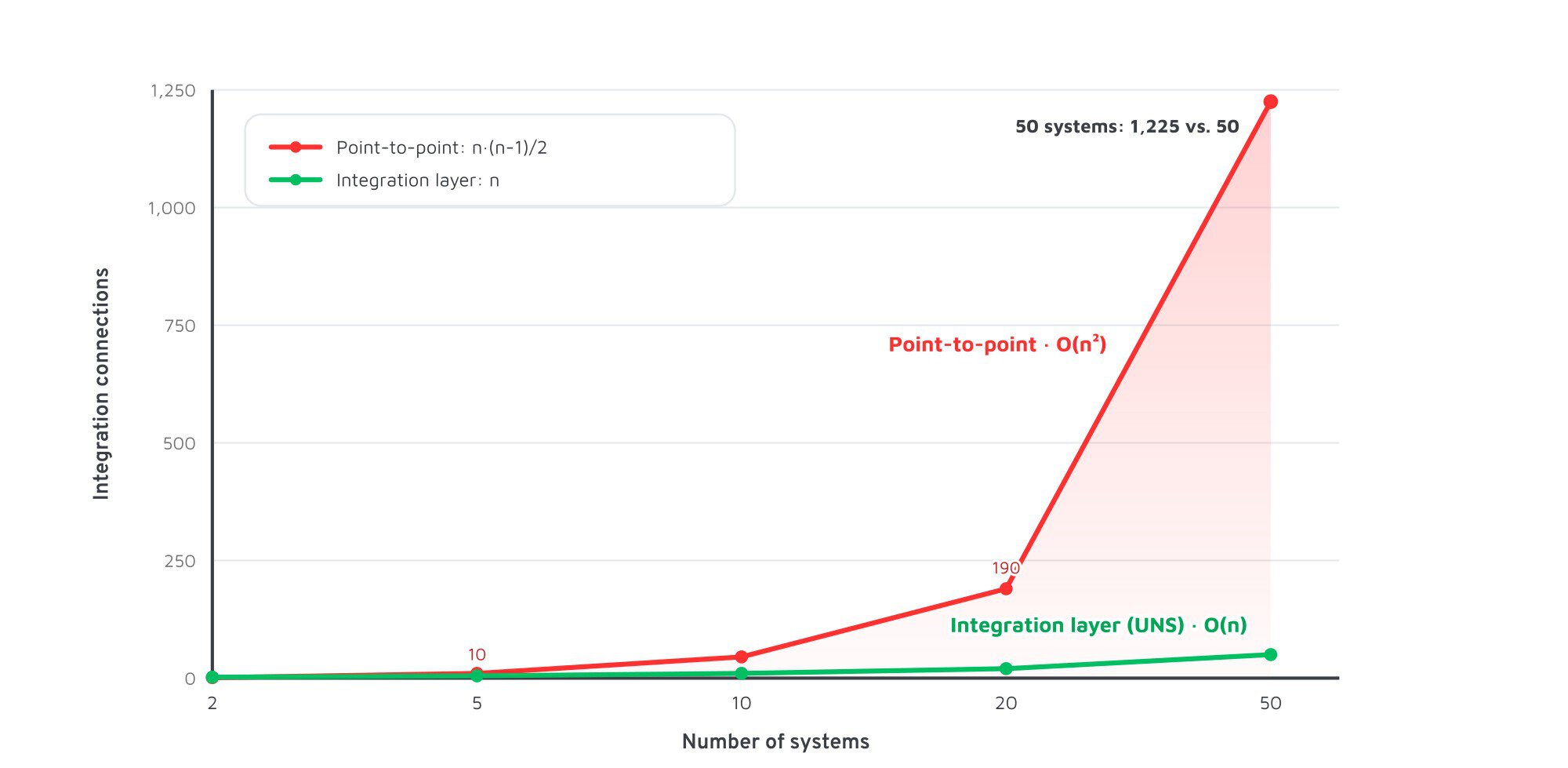
The lesson is clear. Collecting tools does not solve the scaling problem. It only shifts it. Only a central layer breaks the quadratic growth.
Which Tool for which Job? Selection Criteria
The right choice depends on the task. No tool is ideal for everything. Five criteria help with the classification. The following table compares the tool classes along these criteria:
| Tool class | OT protocols | Latency | Scaling 1:n | Vendor lock-in | Operating effort |
|---|---|---|---|---|---|
| ETL/ELT | weak | batch | low | medium | medium |
| iPaaS | weak | medium | medium | high | low |
| Middleware / ESB | medium | medium | medium | medium | high |
| OPC UA connectivity server | strong | near real time | medium | high | medium |
| MQTT / NATS broker | via gateway | near real time | very good | low | low |
| DataOps platform | medium | near real time | good | low | medium |
| Edge gateway | strong | real time | medium | low | low |
As a rule of thumb: the closer a task sits to the machine, the more OT protocols and low latency matter. The more consumers need the same data, the more important scaling 1:n becomes. And the more central a tool is, the harder vendor lock-in should be scrutinized.
An example clarifies the logic. The task is to connect twenty machines to a dashboard, an MES and the cloud. OT protocols are in high demand. Many consumers need the same data. The combination of edge gateway and broker covers these requirements. An ETL tool alone would fail here. It delivers neither real time nor a clean 1:n distribution. The criteria therefore lead straight to the right class.
i-flow as an Integration Layer in the Unified Namespace
The table shows a pattern. No single class covers all criteria. In practice, teams therefore often need several tools side by side. That is exactly what leads back to the spaghetti problem.
An edge-plus-UNS platform starts here. It bundles several tool classes into one layer. The edge translates OT protocols directly at the machine and buffers during network outages. The integrated broker distributes the data via publish/subscribe. A modelling layer harmonizes the data points in the Unified Namespace. Instead of four separate products, a team operates a single layer. That not only lowers effort. It also markedly reduces the number of error sources.
This is how i-flow consolidates the tasks of edge gateway, connectivity server, broker and DataOps into one approach. The advantage does not lie in a single feature. It lies in reducing the connections. Many point-to-point links turn into one central layer. That is the core of any viable IIoT integration.
Neutrality toward existing tools matters here. A UNS layer does not replace every tool you have. An ETL process into the cloud can remain. A historian keeps storing time series. The layer, however, becomes the central data source. All tools read from and write to it, instead of against each other. This creates order step by step rather than one big rupture.
Conclusion
Choosing the right integration tools industrial IoT is not a question of the single product. It is a question of architecture. Anyone who only collects tools pushes the spaghetti problem into the future. Anyone who chooses a central integration layer breaks the quadratic growth of connections. The tool classes are no contradiction here. They are building blocks that subordinate themselves to a shared layer. Three key takeaways:
- Classes before products: Sort the market by tool classes first. Only this map makes integration tools industrial IoT comparable.
- Architecture beats tooling: A central integration layer lowers the number of connections from O(n²) to O(n). That solves the actual scaling problem.
- Introduce step by step: Start with one use case on one line. Then extend the layer systematically to further systems.