
The convergence of Information Technology (IT) and Operational Technology (OT) presents organizations with a fundamental challenge: heterogeneous systems—from PLCs to SCADA to ERP systems—must communicate seamlessly. Traditionally, these systems speak different “languages”: Modbus, OPC UA, S7, REST, SQL. Middleware in IIoT forms the mediation layer that translates these protocols, routes data flows, and orchestrates transformations. From message brokers to edge gateways to API gateways: This article explains which middleware components are deployed in modern Industrial IoT architectures, how they are positioned within the Unified Namespace (UNS), and which architectural patterns have proven themselves in practice.
What is Middleware in IIoT?
The term middleware originates from classical IT and refers to software that mediates between operating systems and applications. Application servers, Enterprise Service Buses (ESB), and message queues are typical examples. Middleware in IIoT extends this concept with industrial-specific requirements: edge components for protocol-heterogeneous OT environments, real-time capability, and determinism.
Definition and Demarcation
Middleware in IIoT is communication infrastructure that transports, transforms, and routes data between heterogeneous systems. It is not business logic, not a database, and not an application itself—but the layer in between.
What middleware is:
- Communication Infrastructure: Message brokers (NATS, MQTT), API gateways, ESBs
- Data Transformation: Protocol converters (OPC UA → JSON), unit conversion, schema mapping
- Routing and Orchestration: Topic-based message routing, workflow engines
What middleware is not:
- Business logic (e.g., production planning, quality algorithms)
- Persistence layer (time-series databases, historians)
- End-user applications (dashboards, MES, ERP)
Why Middleware is Essential in IIoT
Four industrial-specific challenges make middleware the foundation of modern IIoT architectures:
- Heterogeneity: Over 200 industrial protocols exist in parallel—OPC UA, Modbus TCP, Modbus RTU, Profinet, EtherCAT, BACnet, S7, CIP. Each PLC generation introduces new variants. Middleware abstracts this diversity.
- Scale: A modern facility generates data from thousands of sensors, hundreds of machines, and dozens of IT systems. Without a central middleware layer, n*(n-1) point-to-point connections emerge. Example: With 50 systems, without middleware, n × (n − 1) = 50 × 49 = 2,450 direct point-to-point connections—an architectural catastrophe.
- Real-Time vs. Batch: OT systems require deterministic latency (< 100 ms), IT systems process batch data (minutely, hourly). Middleware decouples these different time domains.
- IT/OT Divide: OT engineers speak ladder logic and fieldbus, IT developers speak REST and SQL. Middleware translates not only protocols but also mindsets.
Middleware Types in IIoT
Middleware in IIoT is not a monolithic block but a spectrum of specialized components. Each fulfills specific functions in the data flow from PLC to ERP system.
1. Message Brokers (NATS/MQTT)
Message brokers are the central hub for asynchronous, publish/subscribe-based message routing.
Function: Producers publish messages to topics, consumers subscribe to topics. The broker decouples senders and receivers—they don’t need to know each other or be online simultaneously.
Examples:
NATS– Cloud-native message broker with JetStream persistence, optimized for high throughputMQTT (Eclipse Mosquitto)– Lightweight protocol for edge deployments, QoS levels, retained messagesApache Kafka– High-throughput streaming platform for big data pipelines
Use Case: NATS and MQTT form the core of the Unified Namespace (UNS)—all data flows through the broker. Kafka suits streaming analytics with extreme throughput requirements.
Properties: Asynchronous, loosely coupled, scalable (clustered), topic-based access control (ACLs).
2. Protocol Converters / Edge Gateways
Edge gateways translate proprietary OT protocols into standardized formats for the IT world.
Function: Read from PLCs (OPC UA, Modbus, S7), transform to JSON/Protobuf, publish via NATS or MQTT to the UNS.
Examples:
i-flow Edge– Edge gateway with multi-protocol support, data harmonization, container-basedKepware– Industrial connectivity serverIgnition Edge– SCADA gateway with edge historian
Use Case: Connecting legacy PLCs (Siemens S7-300, Allen-Bradley ControlLogix) to the UNS. Edge gateways typically run on industrial PCs directly on the shop floor.
Properties: Edge-deployed, low latency (< 50 ms), protocol expertise required, often with local buffering during network outages.
3. Data Harmonization Layer
Data harmonization normalizes, contextualizes, and enriches raw data before it flows into the UNS.
Function: Unit conversion (°F → °C), ISA-95 contextualization (Machine ID → Enterprise/Site/Area/Line/Cell), timestamp normalization (UTC), schema validation.
Examples:
i-flow Edge– Integrated data harmonization engine, globally scalable via i-flow HubNode-RED Flows– Local flow-based transformation pipelines
Use Case: A Siemens PLC delivers temperature in 0.1°C increments as INT16, a Rockwell PLC in °F as REAL. Data harmonization normalizes both to {"temperature": {"value": 87.3, "unit": "celsius"}}.
Properties: Stateless transformation, idempotent, fault-tolerant pipelines.
Middleware Architecture in the Unified Namespace (UNS)
The Unified Namespace (UNS) is not a single component but an architecture—and this architecture is itself middleware. The UNS concept centralizes all production data in a NATS or MQTT-based publish/subscribe structure. All OT and IT systems act as producers or consumers. The result: no more point-to-point connections, but a star architecture with the message broker at the center. The UNS is not a flat data bus but a layered model. Each layer fulfills specific middleware functions:
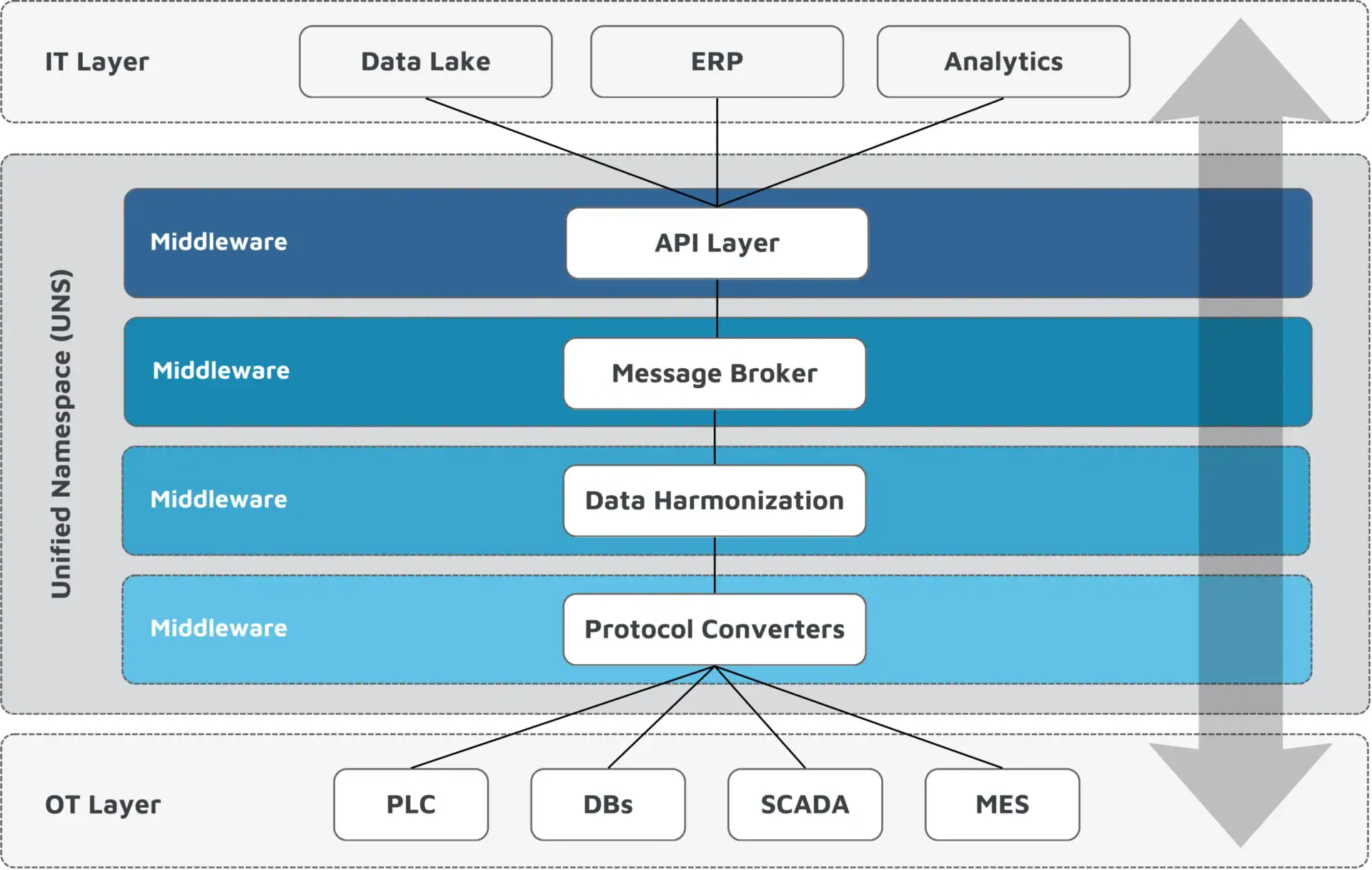
Layer-by-layer explanation:
- IT Layer: MES, ERP, analytics—the consumers. Use data for business logic, reporting, AI models.
- API Layer: Standardized, query-based pull access for it systems to historical and contextualized production data
- Message Broker (NATS/MQTT): Single Source of Truth (SSOT) for all real-time data.
- Data Harmonization Layer: Normalizes units, adds ISA-95 context, validates schemas.
- Protocol Converters (Edge Gateways): Translates OPC UA, Modbus, S7 → NATS/JSON or MQTT/JSON.
- OT Layer: PLCs, sensors, actuators—the data source. Speak proprietary protocols.
Evolution Stages in the Unified Namespace (UNS)
The Unified Namespace typically evolves through four stages—from a simple single-broker setup to a globally federated supercluster. The choice of the right stage depends on scale, availability requirements, number of sites, and WAN availability.
Stage 1: Single-Broker (Local UNS)
Structure: All edge gateways connect to a single message broker (NATS or MQTT) at the plant. The broker typically runs on a VM, edge server, or industrial PC.
Characteristics:
- Simple Setup: One broker, no cluster configuration
- No Redundancy: Single point of failure
- Single Site: All data remains local to the plant
- No Clustering: Broker runs as single instance
- Site Autonomy: Plant is independent of WAN connection
- Architectural Complexity: Low
Use Case: Entry into UNS architecture, pilot project with <50 machines, dedicated shop floor network infrastructure, no HA requirements.
Evolution Driver: Once High Availability (HA) becomes necessary or the broker reaches performance limits (>200,000 messages/sec), a cluster setup is required.
Stage 2: Local Broker Cluster (High-Availability UNS)
Structure: All edge gateways connect to a local NATS cluster (3+ nodes for high availability) at the plant. The cluster is configured as full mesh—each NATS server connects to every other server in the cluster.
Characteristics:
- High Availability: Cluster instead of single node—no single point of failure
- Horizontal Scaling: Performance increase by adding nodes
- Site Autonomy: Plant remains independent of WAN
- Architectural Complexity: Medium
Use Case: Production UNS deployment with rollout to >50 machines, HA requirements, production downtime during broker failure unacceptable.
Evolution Driver: Rollout to additional plants or geographic locations requires multi-site architecture.
Stage 3: Distributed Multi-Cluster (Multi-Site UNS)
Structure: Each site (e.g., Berlin plant, Shanghai plant, Chicago plant) operates an independent local NATS cluster (3+ nodes). The clusters are not connected—each site operates completely autonomously with its own namespace.
Characteristics:
- Site Autonomy: Each plant functions completely autonomously during WAN failure
- Reduced Latency: Local pub/sub communication without round-trip to external site (<5 ms)
- Isolated Namespaces: Each site has its own ISA-95 hierarchy (e.g.,
plant01.line01.robot01), central namespace governance via i-flow Hub - No Cross-Site Communication: Clusters do not see each other
- Architectural Complexity: Medium
Use Case: Initial rollouts in multi-site production networks with <5 locations, each plant operates independently, no global data view required.
Evolution Driver: Once IT analytics requires global data visibility (e.g., production comparison between plants, global OEE dashboards, multi-site ML models), federation of clusters via NATS Supercluster becomes necessary.
Stage 4: NATS Supercluster (Global UNS)
Structure: A NATS Supercluster federates multiple regional NATS clusters into a globally addressable namespace. Each site (e.g., Berlin plant, Shanghai plant, Chicago plant) continues to operate its local 3-node NATS cluster, but these clusters are networked via gateway connections.
Operation:
- Local Pub/Sub: Messages within a cluster remain local (e.g.,
berlin.plant01.line01.robot01.temperaturestays in Berlin cluster) - Subject Interest Propagation: When a subscriber in Shanghai subscribes to
berlin.plant01.>, NATS propagates this interest over the gateway connection to Berlin - On-Demand Routing: Only messages with active remote subscribers are routed over gateways (conserves WAN bandwidth)
- Globally Addressable Namespace: All clusters share a common topic namespace—IT systems can subscribe to data from all sites
Characteristics:
- Site Autonomy: Each plant functions autonomously during WAN failure (local pub/sub unaffected)
- Latency-Optimized for Edge: Shop floor communication remains local (<5 ms)
- Global Scalability: New sites add their own cluster, no central load
- Bandwidth Efficiency: Subject-interest-based routing—only required data over WAN
- Globally Federated Namespace: ISA-95 hierarchy is globally unique (
berlin.plant01,shanghai.plant02) - Architectural Complexity: High
Use Case: Global multi-site production network (>5 locations), IT analytics requires global data visibility (multi-site OEE dashboards, production comparison between plants), WAN failures possible but rare, hybrid cloud strategy (shop floor real-time local, IT analytics global).
Summary
| Stage | Architecture | Structure | Autonomy & Latency | Scaling & HA | Typical Use Case | Complexity |
|---|---|---|---|---|---|---|
| 1 | Single-Broker (Local UNS) | Single broker at plant (VM/Edge PC), no clustering | Fully local, WAN-independent | No HA, single point of failure, limited performance | Pilot project, <50 machines, no HA requirement | Low |
| 2 | Local Broker Cluster (HA UNS) | Local cluster (3+ nodes), full mesh at plant | Local, WAN-independent | High availability, horizontal scaling at plant | Production rollout >50 machines, failure not tolerable | Medium |
| 3 | Distributed Multi-Cluster (Multi-Site UNS) | Multiple plants, each with own local cluster, not connected | Autonomous per site, <5 ms local | HA per plant, no global data view | Multi-site (<5 locations), plants operate independently | Medium |
| 4 | NATS Supercluster (Global UNS) | Multiple local clusters federated via gateways, globally addressable namespace | Autonomous during WAN failure, local real-time stays local, global subscriptions possible | Global scalability, no central bottleneck, WAN-efficient routing (interest-based) | Global production network (>5 sites), global analytics & OEE | High |
Conclusion
Middleware in IIoT is more than a message broker—it is a layered model that seamlessly connects heterogeneous OT and IT systems. Each layer fulfills specific functions. The Unified Namespace (UNS) itself is a middleware architecture in which NATS and/or MQTT function as the central hub. Three key insights:
- UNS is Middleware Architecture: The Unified Namespace is not an application but a layered model of middleware components.
- Specialized Middleware for Specialized Requirements: Message brokers for pub/sub and gateways for protocol conversion
- Loose Coupling and Scalability are Key Principles: Middleware decouples producers and consumers. Pub/sub patterns enable horizontal scaling without architecture redesign.