
The Industrial Unified Namespace (UNS) is often perceived as a technical architecture built from message brokers and integration gateways. In practice, however, it is primarily an organizational operating model for industrial data. A Unified Namespace does not only govern data transport, but explicitly defines:
- who provides data,
- who structures and contextualizes it,
- who is allowed to use it,
- who is responsible for quality, safety and further development.
The UNS does not replace SCADA or MES. It is application-neutral, event-driven, and strategically designed, establishing a persistent, enterprise-wide industrial data space. For this reason, a clear organizational structure and well-defined roles in the Unified Namespace are critical success factors. This article is written for IT/OT architects and industrial data professionals and explains why organizational structure and roles are a fundamental prerequisite for building scalable industrial data architectures.
Traditional IT/OT Roles in Transition
In manufacturing organizations, the separation between IT and OT roles has evolved historically and remained separated for many years.
Corporate IT teams have traditionally been responsible for enterprise networks, servers, security, and compliance. Their primary focus is on scalability, standardization, and the secure operation of centralized IT platforms.
OT teams, typically organized decentrally at the plant level, are responsible for machines, production systems, controllers, operations, and maintenance. Their priorities are availability, production safety, and local optimization.
This strict role separation creates an inherent conflict of objectives. IT optimizes for standardization and long-term stability, while OT prioritizes pragmatic solutions close to production realities. Central security policies or new IT standards are often perceived by OT as potential risks to stable production processes. From the IT perspective, plant-specific OT solutions are seen as difficult to maintain and not scalable.
IT/OT Convergence Changes Team Structures
As IT/OT convergence accelerates, traditional IT and OT silos increasingly reach their limits. Modern Industry 4.0 environments require close integration of infrastructure, data architectures, and operational processes. In this context, centrally integrated IT/OT teams often play a key role. They define global standards and enable enterprise-wide use cases across sites and systems. These teams typically consist of both IT and OT experts, operate in a project-driven manner, and are intentionally separated from the day-to-day operational activities of individual plants. A detailed description of the team evolution can be found here.
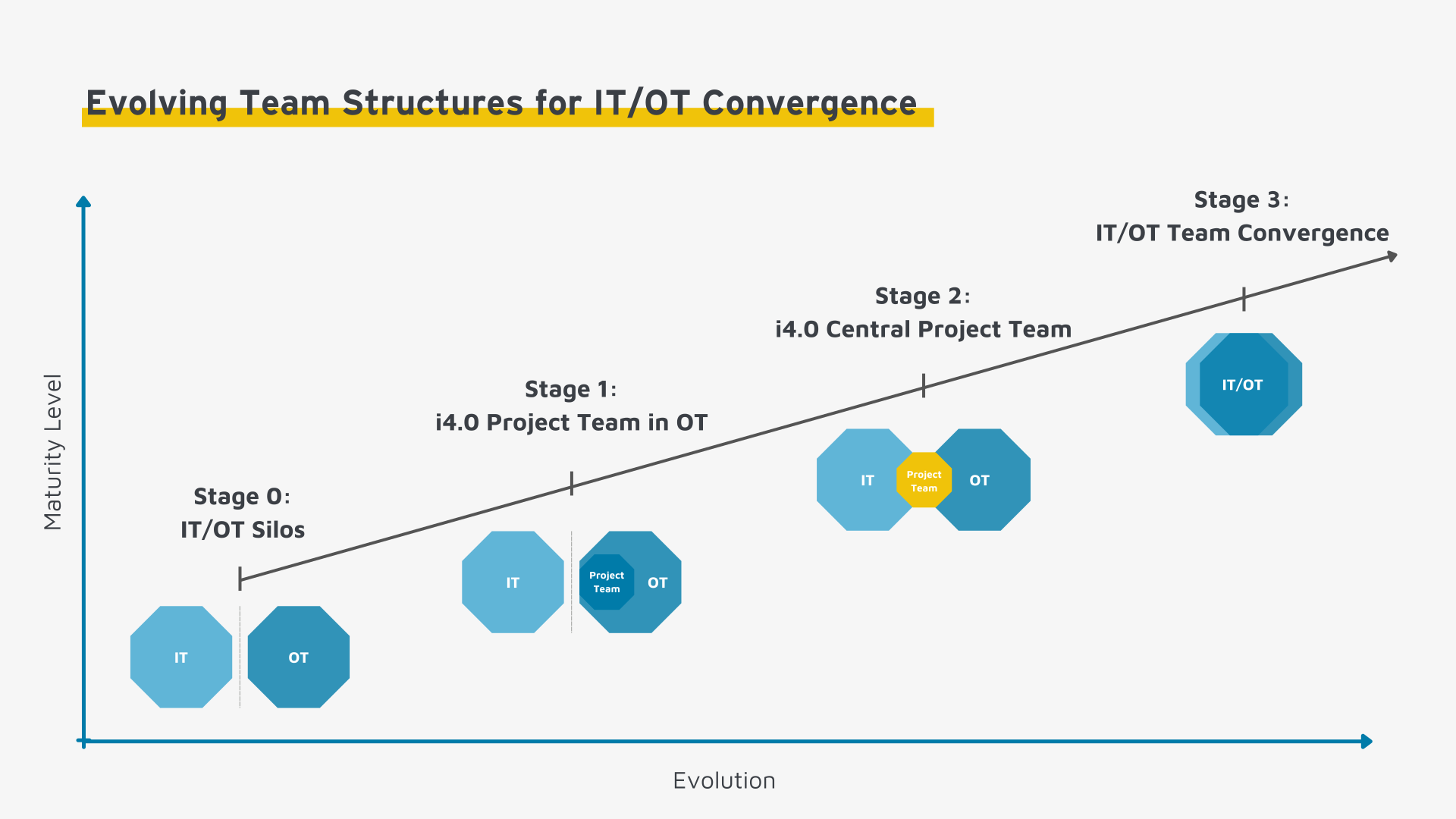
The Unified Namespace as a Catalyst for IT/OT Convergence
The Unified Namespace (UNS) acts as a catalyst for IT/OT convergence. As a central single source of truth for enterprise data, it unifies infrastructure, data, and operational aspects within a shared architectural model. By doing so, the UNS exposes organizational dependencies that were previously hidden within separate IT and OT silos. As a result, organizations are forced to redefine roles and responsibilities. Shifting away from isolated ownership toward coordinated, integrated operating models that support scalable industrial data architectures.
Organizational Structure and Roles in the Unified Namespace (UNS)
In practice, the role model in the Industrial Unified Namespace (UNS) is based on the existing organizational and responsibility structures. The decisive factor here is less the formal team assignment than the clear separation of infrastructure responsibility, governance and technical data sovereignty. A division into three clearly delineated roles has proven to be effective:
In practice, the Industrial Unified Namespace (UNS) role model is based on existing organizational structures. The key factor is not formal team assignment, but the clear separation of infrastructure responsibility, governance, and data ownership. A proven model distinguishes three roles:
- Corporate IT team as UNS enabler: Responsible for UNS infrastructure, platform operation and IT security.
- Central IT/OT team as global data owner: Responsible for architecture, governance, enterprise IT integration and the global enterprise namespace.
- Decentralized OT teams as local data owners: Responsible for OT integration, the local factory namespace and operational, plant-specific use cases.
These roles may be organizationally separate but must collaborate closely within a UNS platform such as i-flow. The UNS acts as the architectural backbone connecting global enterprise and local factory namespaces.
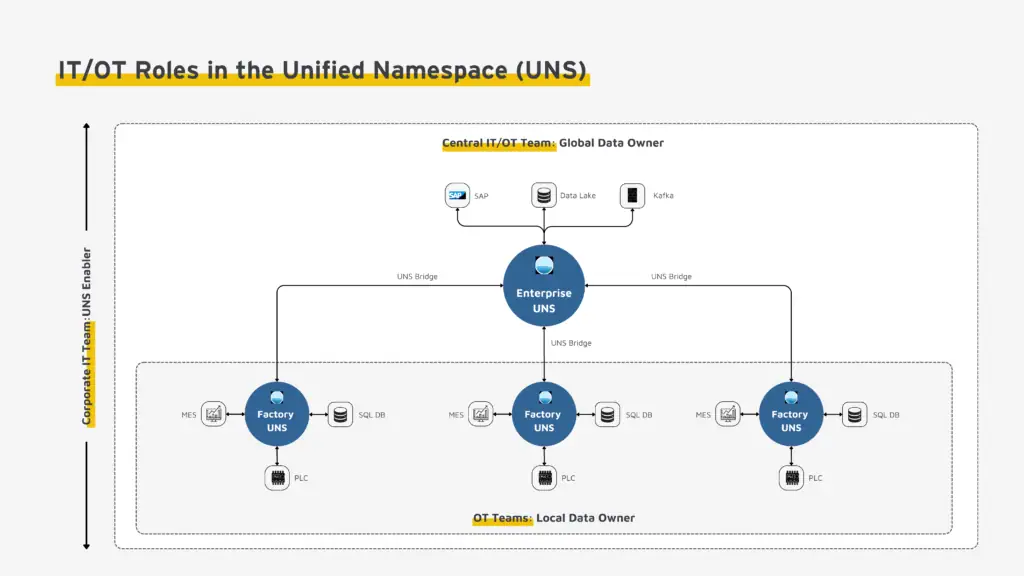
1. Corporate IT Team as UNS Enabler
In the Unified Namespace (UNS) role model, the Corporate IT team acts as the enabler and infrastructure provider. It delivers the technical foundation of the UNS and ensures secure, stable, and scalable operation. Core responsibilities include:
- Network architecture: Design and operation of centralized and decentralized plant networks, segmentation, secure site connections and WAN/DMZ concepts.
- Operation of the infrastructure: Cloud and on-prem infrastructure including virtualization, container and orchestration platforms (e.g. Kubernetes).
- IT security: specification and operation of security mechanisms such as zero-trust architectures, certificate and identity management, role-based access control and transport and data encryption.
- Monitoring and incident management: Centralized monitoring of the infrastructure and UNS platform components as well as structured incident and patch processes.
- Lifecycle management: maintenance, updates and security patching of all infrastructure and platform components.
Technical responsibility for production data is deliberately excluded: The corporate IT team is the UNS platform enabler, but does not own the data or define its structure, meaning or semantics.
2. Central IT/OT Team as Global Data Owner
The Central IT/OT team is the architectural and semantic authority of the Unified Namespace (UNS). It does not operate infrastructure, but ensures the logical, semantic, and governance integrity of the UNS at enterprise level. Core responsibilities include:
- Strategy and architecture
- Development of a company-wide UNS strategy in line with corporate business objectives
- Definition of the overall architecture (e.g. topology, responsibilities)
- Enterprise Namespace
- Standardized structures across plants, lines and facilities
- Naming conventions, topic hierarchies and payload structures
- Semantic models (e.g. along ISA-95, Companion Specifications)
- Governance
- Which topics are globally binding
- Which payloads and versions apply
- How changes, extensions and migrations are regulated
- Ensuring comparability and reusability of global use cases (e.g. OEE, energy, quality, traceability)
- Enablement and support
- Training of internal teams and stakeholders
- Support with architecture issues and standard compliance
- Further development and optimization of the overall UNS system
- Enterprise IT integration: integration of the UNS with central IT systems (e.g. ERP, MES, BI, data lakes)
Important: Governance is responsible for standards and rules, not the specific implementation at plant level. The goal is standardization in the global namespace without restricting local autonomy in factory namespaces.
3. Decentralized OT Teams as Local Data Owners
Decentralized OT teams own the local factory namespace and are responsible for accurately representing the physical production environment within the Unified Namespace (UNS). They are the owners of operational data and its technical meaning. Core responsibilities include:
- OT integration: Connection of machines, systems and PLCs (e.g. via OPC UA, Beckhoff TwinCat).
- Local mode implementation: Mapping globally defined namespaces and data models to real machines, signals and states.
- Data quality and semantics: Ensuring correct signal interpretation, event definitions and states.
- Local use cases: Implementation of plant-specific use cases within the local namespace such as line optimization, maintenance or local KPIs.
The local namespace enables plants to act quickly and autonomously without compromising the global enterprise namespace. This balance between local ownership and global consistency is a core success principle of the Unified Namespace.
Summary: Roles as the Foundation of the UNS
The following table summarizes the proven role model in the Unified Namespace (UNS) and the clearly defined responsibilities of each role.
| Role | Primary role in the UNS | Central responsibilities | Consciously excluded |
|---|---|---|---|
| Corporate IT team | Enabler & infrastructure provider | Operation of cloud and on-prem infrastructure Container and platform services Network architecture and segmentation IT security, IAM, certificates and encryption Monitoring, incident and lifecycle management |
No functional responsibility for US data No definition of data models or semantics No OT signal interpretation |
| Central IT/OT team | Global data owner & governance | Definition of the UNS strategy and architecture Design of the global enterprise namespace Naming, topics, payloads and semantics Governance and versioning Global use cases and enterprise integration |
No infrastructure operation No direct machine connection No local signal responsibility |
| Decentralized OT teams | Local data owner & operational implementation | Responsibility for the local factory namespace Connection of machines and systems Implementation of global models in a local context Ensuring data quality Local, plant-specific use cases |
No definition of global standards No company-wide governance No operation of central components |
Role Interfaces & Transfer of Responsibilities (RACI Level)
The defined roles form the organizational foundation of the Unified Namespace (UNS). For stable operation, responsibilities must be clearly managed across interfaces. The following RACI model provides an architectural guardrail for typical UNS activities and distinguishes a practical UNS operating model from a purely conceptual architecture.
| Activity | Corporate IT team | Central IT/OT team | Decentralized OT teams |
|---|---|---|---|
| Provision & operation of the UNS platform | R / A | C | I |
| Definition of global namespace structure | I | R / A | C |
| Introduction of a new global topic | I | R / A | C |
| Definition of Naming, Topics & Payloads | I | R / A | C |
| Versioning & migration of global data models | I | R / A | C |
| Mapping global models in the plant | I | C | R / A |
| Connection of machines & control systems | I | C | R / A |
| Ensuring local data quality | I | C | R / A |
| Use of UNS data for local use cases | I | C | R / A |
| Integration into central IT systems | C | R / A | I |
Legend: R = Responsible, A = Accountable, C = Consulted, I = Informed
Responsibility Transfer Along the Data Lifecycle
In the Unified Namespace (UNS), responsibilities follow the natural lifecycle of industrial data:
Infrastructure → Governance: After the platform is provided by IT, responsibility for namespace structure, topics, and semantics shifts to the central IT/OT team.
Governance → Plant: Once global models are released, responsibility for concrete implementation moves to the plants, where signal integration is handled locally.
Plant → Enterprise Use: When data is published in the defined format, responsibility for data quality remains with the plant, while enterprise consumers can use the data without detailed knowledge of its origin.
Why RACI Models are Indispensable in the UNS
Without explicit responsibility transfer, common issues arise:
- implicit ownership (“IT will handle it”)
- governance overload caused by operational topics
- local bypassing of global standards
- political conflicts between headquarters and plants
Change & Escalation Processes in the UNS
The Unified Namespace (UNS) is a permanent operating model. Therefore, and especially within the enterprise namespace, changes must be controlled, versioned, and conflict-free. Governance is enforced through operational change management, not policy documents.
Changes in the Enterprise Namespace are subject to clear responsibility:
- Topics, structures and payloads in the Enterprise Namespace may only be defined, changed or released by the central IT/OT team.
- Decentralized OT teams implement these specifications in the local factory namespace, but do not modify enterprise level definitions.
Versioning instead of breaking changes is central:
- Changes are introduced as new versions (e.g. v1, v2), without overwriting existing structures.
- Old and new versions may run in parallel until all consumers have been migrated.
- Breaking changes during operation are excluded in the Enterprise namespace.
Escalations follow clear paths:
- Deviations from the standard are made exclusively in the local namespace, without changing the enterprise namespace.
- Data quality issues remain a local (level 3) responsibility and are not corrected centrally.
- Performance or security conflicts between IT and OT are resolved at governance level.
Success Criteria in the Unified Namespace
A Unified Namespace (UNS) often fails due to organizational issues, not technical limitations. Success depends not only on the target architecture, but on the ability to identify early whether the UNS is working in practice.
Typical organizational anti-patterns are:
- The enterprise namespace is effectively controlled by IT.
- Governance becomes too detailed and shifts operational decisions to the enterprise level – local innovation is slowed down.
- Plants bypass the enterprise namespace because standards are perceived as too heavyweight.
- The UNS is being introduced as a project, not as a permanent operating model with clear ownership.
These patterns lead to a loss of acceptance, shadow solutions and, in the long term, to the erosion of the enterprise namespace.
Successful UNS architectures, on the other hand, can be clearly measured:
- Time-to-use case: How quickly new applications can be built on existing data
- Reuse rate: How often existing topics and data models are reused without modification?
- Local deviations: How frequently global standards are bypassed?
- Data quality: Stability, completeness and consistency of enterprise data.
A successful UNS is not defined by the number of rules, but by its ability to combine global consistency with local autonomy. The key factor for sustainable operation at scale.
Conclusion
The Unified Namespace (UNS) is not a technical integration project, but an organizational operating model for industrial data. Its success depends on clearly defined roles, explicit responsibility transfer, and stable governance. This organizational clarity is what turns the UNS into a scalable, enterprise-wide data backbone for modern IT and OT architectures.