
Anyone designing a Unified Namespace (UNS) architecture faces a fundamental decision at every interface. Should a system wait for a response before continuing? Or should it instead send data and move on, regardless of who processes it and when? This choice between synchronous and asynchronous communication largely determines how robust, scalable, and maintainable the resulting architecture turns out to be. However, there is no one-size-fits-all answer to the synchronous vs. asynchronous communication question. Instead, it depends entirely on the use case at hand — for instance, a production-critical control loop versus the distribution of data to dozens of consumers. This article therefore covers the fundamentals of both patterns and, in addition, provides concrete decision criteria for typical Industrial IoT scenarios. It also shows how teams implement synchronous and asynchronous communication in HTTP, MQTT, and NATS in practice, along with the trade-offs that each approach brings.
Synchronous vs. Asynchronous Communication: The Basics
The synchronous vs. asynchronous communication question actually spans two dimensions in a UNS context. In practice, the two often blend together: the timing behavior of the communication, and the distribution pattern. Even so, separating these two dimensions clearly is the prerequisite for a well-founded decision.
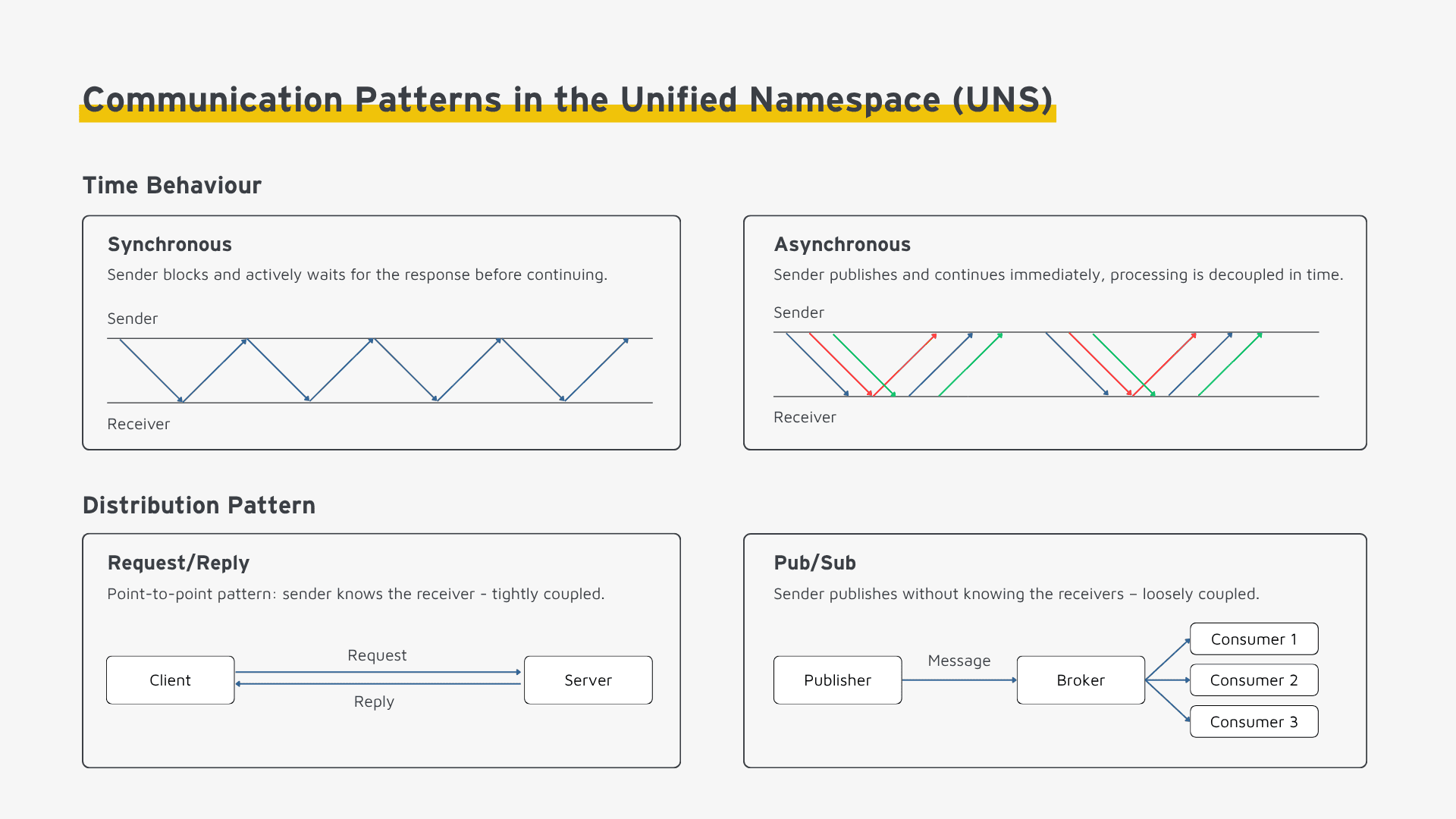
Synchronous communication means the sender blocks after issuing a request and actively waits for a response before continuing. As a result, the flow is linear and deterministic — but it also depends on the receiver responding in time.
Asynchronous communication, by contrast, means the sender publishes a message and immediately moves on, without waiting for a response. Processing and reaction are therefore decoupled in time. The sender simply has no way of knowing when, or even whether, anyone processes the message.
Orthogonal to this is a second dimension: Request/Reply (also called request/response) versus Pub/Sub. Request/Reply is a point-to-point pattern with an expected response to a specific request. Pub/Sub, on the other hand, is a decoupled distribution pattern in which a sender publishes to a topic or subject. It doesn’t know who, if anyone, is listening.
In practice, many architects equate synchronous communication with Request/Reply and asynchronous communication with Pub/Sub. That’s broadly accurate, but not entirely: asynchronous Request/Reply also exists. Here, the sender issues the request without blocking, yet still expects a specific, correlated response. The practical section further below shows exactly what that looks like in MQTT and NATS, and what trade-offs it involves.
Advantages and Disadvantages at a Glance
The table below compares the core characteristics of synchronous Request/Reply and asynchronous Pub/Sub, providing the factual basis for deciding between synchronous and asynchronous communication in your own architecture:
| Criterion | Synchronous / Request-Reply | Asynchronous / Pub-Sub |
|---|---|---|
| Coupling | tight – sender knows the receiver and must assume its availability | loose – sender doesn’t know the receiver, availability is irrelevant |
| Latency Behavior | sender blocks until the response arrives | sender doesn’t block, processing happens at a later point |
| Scalability (1:n) | limited – unsuitable for 1:n distribution | excellent – one sender, any number of consumers |
| Fault Tolerance | low – a receiver outage blocks or directly fails the call | high – a consumer outage has no direct impact on the sender |
| Response Traceability | high – success or failure is known immediately | low – no built-in feedback on whether or how the message was processed |
| Implementation Effort | low for simple requests | low for distribution, higher for correlation/response logic (depends on the protocol, see below) |
Neither tight nor loose coupling is inherently better. Both patterns serve different requirements and should therefore be applied deliberately, based on the specific use case. Synchronous communication with tight coupling fits scenarios that require an immediate, reliable acknowledgment. Control commands are a good example, since successful execution must be confirmed directly.
Tight coupling becomes problematic, however, wherever an architecture instead needs decoupling, scalability, and extensibility. A typical example is telemetry data distribution. When measurements must reach dashboards, databases, analytics platforms, and other consumers simultaneously, an asynchronous Publish/Subscribe model offers clear advantages. Consequently, new consumers can be added at any time without modifying the sender or affecting its availability.
Decision Criteria: Which Pattern for Which Use Case?
The decision between synchronous and asynchronous communication should therefore follow the requirements of the specific use case. The matrix below maps typical UNS scenarios onto the two dimensions:
| Request/Reply | Pub/Sub | |
|---|---|---|
| Synchronous | Production-critical control (real-time): releasing a safety circuit, where execution must be confirmed instantly. Deterministic behavior matters more than decoupling here. | Not a meaningful use case. A publisher that blocks until every subscriber has acknowledged receipt contradicts the entire point of Pub/Sub — loose coupling and an arbitrary number of consumers. This combination essentially never occurs in a UNS. |
| Asynchronous | Production-adjacent control processes / IT integration: setpoint changes, or MES (Manufacturing Execution System) / ERP (Enterprise Resource Planning) queries with timeout and retry logic — a correlated response, but without a blocking connection. | Distributing data to many consumers: telemetry data for dashboards, historians, MES, and analytics platforms. New consumers can be added without affecting the sender. |
As a rule of thumb: the more potential consumers need the same piece of information, the more clearly the answer points toward asynchronous communication via Pub/Sub. Conversely, the more immediately a consumer needs a single, correlated response, the more likely Request/Reply is the right choice.
In Practice: Implementation in Popular Protocols
HTTP, MQTT, and NATS each implement synchronous and asynchronous communication patterns quite differently.
HTTP/REST
HTTP is inherently synchronous Request/Reply: a client sends a request and waits for the response before continuing. That brings real advantages, including simplicity, universal tooling, and compatibility with virtually every firewall and proxy setup. These are exactly the properties that made HTTP the backbone of the internet.
In a UNS context, however, HTTP’s drawback lies in its architectural principle: the lack of a Single Source of Truth (SSOT). Suppose every consumer queries the same value directly from the source system over HTTP. The result is n individual point-to-point queries, instead of one central, distributed data point. HTTP has no push semantics, so the source system bears the load of every query itself. As a result, each additional consumer adds further direct load to the origin system. In a UNS, by contrast, data lives centrally. A Pub/Sub mechanism then distributes it to any number of consumers, regardless of how many there are.
MQTT
MQTT is designed primarily for Pub/Sub. A publisher sends to a topic, and any number of subscribers receive the message through the broker, without publisher and subscriber ever knowing each other. This is the foundation for asynchronous data distribution in a UNS: loosely coupled, highly scalable, and backed by QoS (Quality of Service) levels for controlled delivery guarantees. When it comes to synchronous vs. asynchronous communication, MQTT therefore covers both sides in principle. The default case is asynchronous Pub/Sub, complemented by an emulated Request/Reply pattern for specific, correlated responses.
Request/Reply over MQTT (Emulated)
Since version 5.0, MQTT has provided the response-topic and correlation-data properties. Developers use these to emulate a Request/Reply pattern on top of Pub/Sub. For example, a client might publish to machine/42/cmd/setSpeed with response-topic: machine/42/cmd/setSpeed/reply and correlation-data: <uuid>. The receiver then processes the request and publishes its response to the given response topic, using the same correlation data. That way, the original client can match the reply to its request.
The drawback of this approach is that there’s no native timeout or error handling. Instead, developers have to build it themselves at the application level. Concretely, that means the requesting client starts its own timer as soon as it publishes the request. If no response with matching correlation data arrives within that window, the application itself must raise and handle a timeout error. That’s because the broker has no concept of an “open request” and reports nothing.
For monitoring and alerting, this has a direct consequence: there is no broker-native view of pending or failed requests. Anyone who wants to detect that a request never received a response therefore has to maintain their own timeout table of open correlation IDs. Once a timeout expires, the application takes over instead. It either publishes its own alert message to a separate alert topic, or generates a metric or application log entry. In short, no built-in visibility exists at the UNS or broker level for this.
NATS
NATS supports Pub/Sub just like MQTT, but takes a decisive step further with its Request/Reply pattern. Here, Request/Reply is a native part of the protocol, rather than something bolted on through convention. For the synchronous vs. asynchronous communication question, that means both patterns run over the same infrastructure, with neither acting as a workaround. A client simply calls nc.Request(subject, data, timeout). NATS then automatically generates a one-time inbox subject (_INBOX.<random>) for the response, and the timeout itself is a built-in parameter of the call:
msg, err := nc.Request("machine.42.cmd.setSpeed", payload, 2*time.Second)
The advantage over MQTT lies precisely in the areas developers would otherwise have to build themselves. NATS requires no manual correlation ID management, no response-topic conventions, and comes with built-in timeout and error handling. If nobody is listening on the requested subject, NATS returns an explicit error signal: no responders available. MQTT has no equivalent signal. There, a request without a response simply times out silently, and the client can’t tell whether nobody was responsible or the response is merely delayed. On top of that, Pub/Sub and Request/Reply run over the same infrastructure without any protocol break.
Comparison: Request/Reply in HTTP, MQTT, and NATS
| Criterion | HTTP | MQTT (emulated) | NATS (native) |
|---|---|---|---|
| Timeout Handling | built in (client-side timeout) | must be built at the application level | built-in parameter |
| Correlation | implicit (single TCP connection) | manual, via correlation-data |
automatic, via inbox subject |
| Error Signal on Missing Receiver | HTTP status code (e.g., 404/503) | none – silent timeout | explicit (no responders) |
| Infrastructure Overhead | low, but separate from the UNS backbone | low, same infrastructure as Pub/Sub | low, same infrastructure as Pub/Sub |
| Implementation Effort | low – natively supported | high – correlation, timeouts, and error handling must be implemented individually | low – Request/Reply is part of the protocol |
| Recommendation for Request/Reply | ✅ recommended | ❌ not recommended | ✅ recommended |
Best Practices for Choosing a Communication Pattern in the UNS
The following recommendations help make this decision consistently across a UNS, rather than case by case.
Do
- Make Pub/Sub the default: across the UNS backbone, Pub/Sub should be the default setting. Systems publish data centrally, and all consumers access it without being coupled to any single recipient.
- Use Request/Reply deliberately: apply it for IT queries, control commands, and acknowledgments that need a specific, correlated response. In practice, that means synchronously over HTTP across system boundaries, or asynchronously over MQTT/NATS within the UNS.
- Define timeouts explicitly: every Request/Reply implementation needs a deliberately chosen timeout strategy, regardless of protocol.
Avoid
- Synchronous coupling for real-time telemetry: continuous measurements or status data should never run through blocking Request/Reply calls. Doing so increases the failure surface and needlessly ties sender and receiver together.
- MQTT Request/Reply without timeout logic: anyone using correlation data without implementing their own timeout and alerting logic risks silently hanging requests with zero visibility.
In practice, a hybrid pattern works well. MQTT or NATS Pub/Sub handles continuous data distribution to all consumers, while targeted Request/Reply bridges fill in wherever IT systems or control logic need a specific, correlated response.
Conclusion
The synchronous vs. asynchronous communication question has no universal answer. It depends on how many consumers need a given piece of information, and on how immediately a use case requires a correlated response. For distributing data to many consumers, asynchronous Pub/Sub is the right choice. For production-critical control commands and IT queries, Request/Reply fits better instead — whether implemented synchronously or emulated asynchronously. What matters most is assigning the pattern deliberately to the use case. Otherwise, forcing a single pattern across the entire architecture only creates unnecessary friction. Do that, however, and synchronous vs. asynchronous communication stops being a fundamental question. Instead, it becomes a repeatable architectural decision.
Three Key Takeaways
- Two orthogonal dimensions: synchronous/asynchronous describes timing behavior, while Request-Reply/Pub-Sub describes the distribution pattern — architects should therefore consider both dimensions separately.
- Pub/Sub is the UNS default: for distributing data to many consumers, asynchronous Pub/Sub is the right foundation, thanks to its loose coupling and strong scalability.
- NATS reduces the implementation effort for Request/Reply: where MQTT requires application-level timeout and correlation logic, NATS provides the same functionality natively, fully integrated into the protocol.