
Investment decisions in manufacturing require a sound ROI figure (return on investment). For the Unified Namespace (UNS), that requirement leads into a methodological dead end. A UNS is an architecture, not an end-to-end use case with a revenue contribution of its own. Evaluated in isolation, it shows nothing but cost. The return is generated one layer up, by the use cases built on that architecture. Some UNS initiatives therefore fail in the evaluation phase rather than in the technical implementation. The cause is a unit of analysis that has been drawn incorrectly. This article explains why unified namespace ROI can only be assessed together with the use cases. It sets out the evaluation framework this requires. A worked example then quantifies the point at which the investment undercuts the alternative.
Why architecture is not a standalone unit of ROI analysis
The structure of the problem becomes clear in the construction of a hotel. Before the first room is let, the foundation and the structural frame are built – the architecture of the building. It generates no return of its own. Yet it determines how many rooms are possible. It also sets how fast an additional floor opens up and what every later expansion costs. What is evaluated, therefore, is not the architecture but the overall asset consisting of architecture and lettable space.
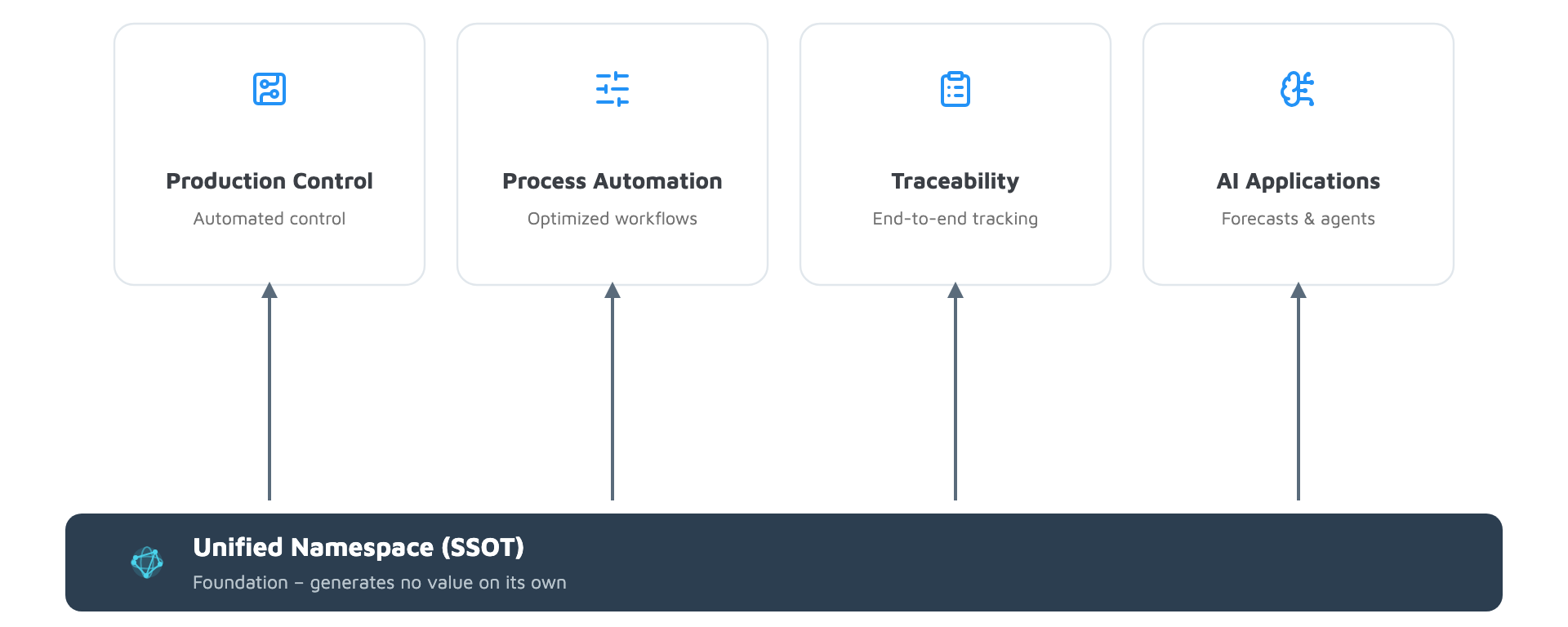
The same logic applies to the Unified Namespace. As a Single Source of Truth (SSOT), the UNS forms the architecture of the data layer. On top of it sit the use cases: automated production control, process automation, traceability, AI-driven applications. These applications correspond to the building’s lettable space – they generate revenue, reduce cost or mitigate risk.
An isolated ROI calculation for the architecture layer therefore produces a negative or uninterpretable result. That holds regardless of how sound the investment is strategically. The error lies not in the calculation itself but in how the unit of analysis is drawn. Architecture and the applications running on it form a single economic unit, and they pay off together.
The UNS as the foundation, use cases as the value drivers
Structurally, the UNS delivers three things that every use case would otherwise have to provide for itself. First, a harmonized data basis. Second, consistent context: asset, unit, timestamp, ISA-95 path. Third, a single point of access to all data.
This brings into focus the architectural decision that actually warrants evaluation: Unified Namespace versus point-to-point integration. With point-to-point integration, every application connects directly and individually to every data source it requires. On the shop floor these are the PLC (programmable logic controller) and the SCADA system (supervisory control and data acquisition). On the IT side they are the MES (manufacturing execution system) and the ERP system (enterprise resource planning). Every additional use case therefore calls for its own, mostly proprietary connections all over again.
The UNS inverts this pattern. Once connected and harmonized, a data point is available to every authorized consumer. That includes use cases which are not yet specified at the time of connection.
The right evaluation framework for the ROI of a Unified Namespace
Instead of assessing the architecture in isolation, a sound decision requires three steps:
- Consider the entire data stack: UNS, applications and use cases belong in one joint investment case, not in separate ones.
- Evaluate and test the architecture options: compare UNS and point-to-point integration in a pilot, not solely on estimates.
- Calculate ROI end to end: the calculation covers the architecture layer and every use case running on it.
The decisive effect only materializes over time. The harmonization layer is built once and then serves every further use case. Marginal cost per additional use case falls – and an isolated view of the architecture leaves out precisely this lever.
Practical example: Unified Namespace ROI across multiple use cases
A simplified sample calculation quantifies this effect. It uses reference values from mid-sized manufacturing environments and illustrates the mechanism. It is not a cost commitment for a specific project. Actual effort depends on the number of assets, protocol diversity and legacy systems.
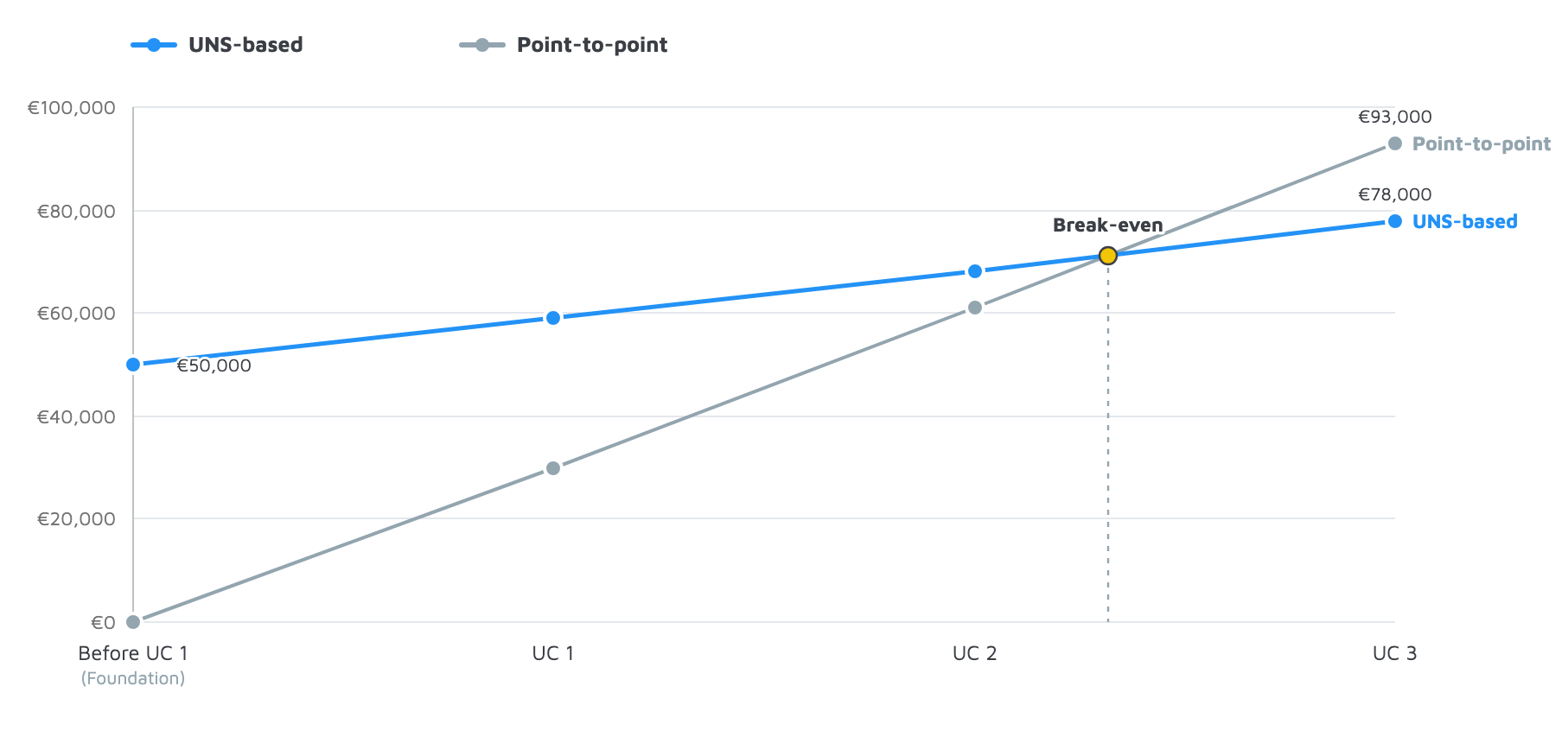
The basis is a plant with around 100 connected systems: PLCs, SCADA, sensors and test benches. Over two years it plans three use cases – production monitoring, traceability and predictive maintenance. The two approaches differ in the order in which the integration work occurs. With point-to-point integration, each use case connects only the systems it needs itself. That work then repeats with every further use case. In the UNS-based approach, the 100 systems are connected and harmonized once. This upfront work is booked as a foundation investment before the first use case. Every later use case draws on it.
| Use case | Point-to-point (cumulative) | UNS-based (cumulative) |
|---|---|---|
| Foundation (one-off, before UC 1) | – | €50,000 |
| UC 1 – Production monitoring | €30,000 | €59,000 |
| UC 2 – Traceability | €61,000 | €68,000 |
| UC 3 – Predictive maintenance | €93,000 | €78,000 |
The difference lies in the marginal cost. With point-to-point, every further use case adds another €30,000–32,000. Its connections are built entirely from scratch, and the number of connections to maintain in parallel grows with every step. In the UNS-based approach, the effort per use case falls to €9,000–10,000 after the foundation investment. Connecting and harmonizing the 100 systems has already been done.
The break-even in this example lies between the second and the third use case. After UC 2 the point-to-point solution is still cheaper: €61,000 against €68,000. After UC 3 the relationship reverses: €93,000 against €78,000. The gap then widens with every further use case on the roadmap.
i-flow as the foundation for the full data stack
The falling marginal cost only materializes if the architecture layer is designed for reuse rather than rebuilding. i-flow implements this through three components. At the source, the i-flow Edge connects directly to PLCs, sensors and SCADA systems. It speaks native protocols such as OPC UA, Modbus or Siemens S7 and normalizes the raw data there. Centrally, the i-flow Hub manages the UNS semantics, so that semantics defined once are reused for every further use case. From there, the i-flow Broker provides the harmonized data to every authorized consumer via MQTT or NATS.
For the sample calculation this means: a new use case deals with neither PLC protocols nor data modeling again. It subscribes to topics already harmonized in the UNS. This reusability lowers the marginal cost per use case. Unified namespace ROI grows with every new one.
Conclusion
Unified namespace ROI is not generated in the architecture itself, but in the use cases running on it. Assessing the architecture layer in isolation measures the wrong object. The question is as odd as asking for the ROI of a hotel’s building architecture. Three key takeaways:
- Architecture has no standalone ROI: value is generated in the use cases on the UNS foundation, not in the foundation.
- Calculate ROI end to end: UNS, applications and use cases belong in one joint calculation. In the example, break-even comes with the third use case.
- Draw the unit of analysis correctly. What counts is not the ROI of the UNS, but that of the application landscape it enables.