
Anyone designing an architecture for the industrial IoT runs into a fundamental question early on. Should machines and systems actively poll for data, or should they simply report events? This is where two protocols and two mindsets diverge. MQTT vs HTTP is therefore not a matter of taste, but an architecture decision. HTTP follows the request/response model: a client asks, a server answers. MQTT follows the publish/subscribe model: a sender reports an event, a broker distributes it.
The good news up front: it is not an either-or. In modern Unified Namespace (UNS) architectures, both protocols take on clearly separated roles. MQTT forms the event-driven backbone for continuous data. HTTP forms the bridge for targeted queries between systems. This article explains the core differences, frames the MQTT vs HTTP comparison for OT and IT architects, and shows where each protocol plays to its strengths.
MQTT vs HTTP: Core Differences at a Glance
The MQTT vs HTTP comparison breaks down into a few clearly distinguishable dimensions. They concern the communication model, the connection, the overhead, the reliability and the scaling. Each of these dimensions affects an architecture differently. Looking at them one by one leads to a well-founded decision. The following graphic shows the basic difference between active polling and event-driven distribution.
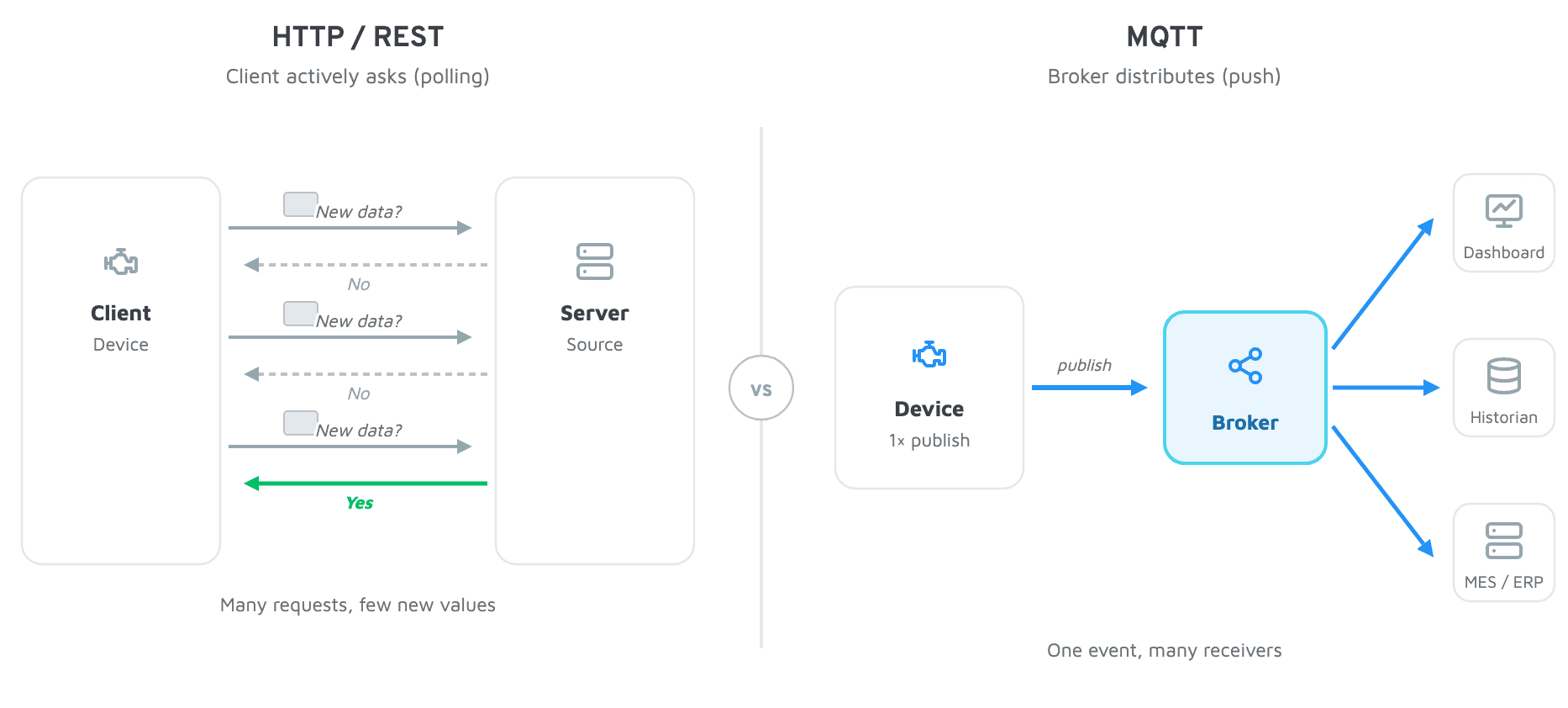
Communication model: request/response vs. publish/subscribe
HTTP works on the request/response pattern. The client sends a request, the server returns a response. Without a request, nothing happens. A server cannot send data on its own. Anyone who needs current values continuously has to ask again and again. This active querying is called polling.
MQTT works on the publish/subscribe pattern. A sender publishes a message to a topic. A broker distributes it to all interested receivers. Sender and receiver do not know each other and are decoupled in time. The broker can actively push data to consumers as soon as an event occurs.
This difference has direct consequences for the architecture. With polling, the client keeps asking, even when nothing has changed. Many of these requests return no new content. With push, only real events flow. The source speaks once, the broker distributes to many. For the MQTT vs HTTP question, this is the decisive shift in thinking.
Connection model: persistent connection vs. connection per request
MQTT keeps a single persistent TCP connection open. Small keep-alive pings keep it alive. New values travel over the same channel without a new connection setup. That saves time and resources for frequent messages.
HTTP/1.1 traditionally sets up and tears down a connection per request. Keep-alive and HTTP/2 mitigate this, but do not match the efficiency of a permanently open channel. With thousands of small telemetry values per minute, this effort adds up noticeably.
Overhead and efficiency: 2 bytes vs. hundreds of bytes
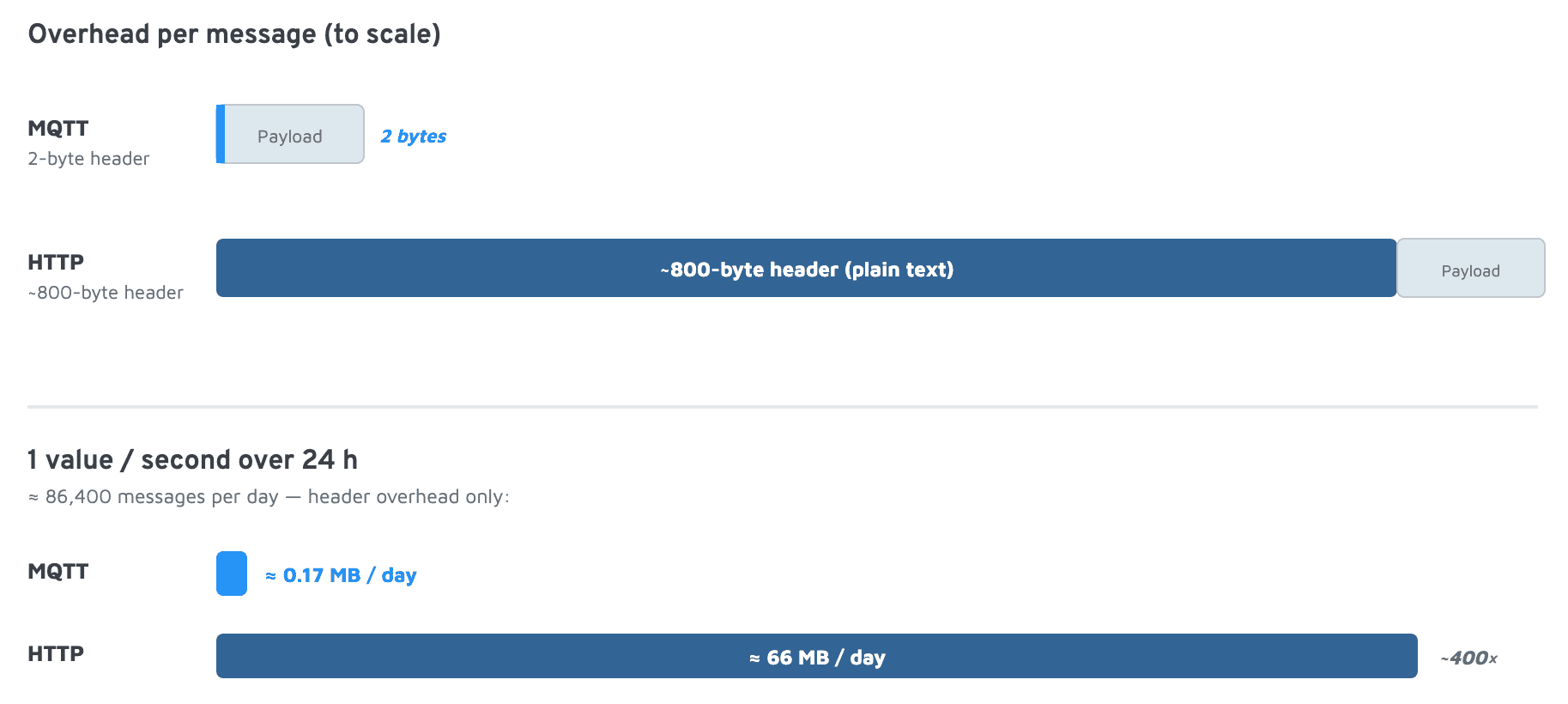
The clearest difference in the MQTT vs HTTP duel lies in the overhead. The fixed MQTT header is minimal. It starts at just 2 bytes. HTTP, by contrast, carries extensive headers as plain text. A full request plus response quickly reaches 800 to over 1,000 bytes.
For small telemetry packets, this means a reduction in overhead of more than 90 percent. In cellular networks, with battery-powered sensors or with usage-based costs, this has a direct impact.
A simple calculation illustrates the scale. A sensor sends one measured value per second over 24 hours. That amounts to around 86,400 messages per day. With MQTT, the resulting header overhead is minimal. With HTTP, the headers add up to a multiple of that. Across many sensors and many days, this becomes a substantial cost and bandwidth difference. The following graphic makes the ratio tangible.
Reliability: MQTT QoS vs. HTTP status codes
MQTT offers three delivery guarantees, the so-called QoS levels. QoS 0 delivers at most once. With QoS 1, the broker delivers at least once. QoS 2 delivers exactly once via a four-step handshake. The developer picks the guarantee to fit the use case. Our article on MQTT Quality of Service (QoS) explains more.
HTTP has no such delivery levels. It returns status codes such as 200 or 503. Whether a message arrives depends on the application. Retries and error handling have to be implemented by the application itself. In practice, this is enough for many queries. For continuous data streams with clear guarantees, however, MQTT’s tiered QoS logic is the more robust approach.
Real-time and scaling: push vs. polling
MQTT distributes each event exactly once to any number of subscribers. A new consumer does not add load to the source. The broker handles the distribution. This is how the model scales to many receivers.
HTTP has no server push. Anyone who needs current data has to poll. Each consumer generates its own requests to the source. With many consumers and short intervals, the load grows disproportionately. Workarounds such as long polling, WebSockets or Server-Sent Events exist, but do not replace the native push model.
The following table summarizes the MQTT vs HTTP comparison compactly:
| Criterion | MQTT | HTTP |
|---|---|---|
| Communication model | publish/subscribe via broker | request/response, client-initiated |
| Connection | one persistent TCP connection | connection per request (keep-alive helps) |
| Header overhead | from 2 bytes | often 800 to 1,000+ bytes |
| Server push | yes, native | no (only via polling/WebSockets) |
| Delivery guarantee | QoS 0, 1, 2 | no levels, only status codes |
| State | sessions, Last Will, retained messages | stateless |
| Strength | distributing events (1:n) | targeted queries (1:1) |
MQTT also offers features that HTTP lacks. These include persistent sessions, the Last Will and Testament for an unexpected connection drop, and retained messages for the last known value. HTTP deliberately stays stateless. This choice simplifies scaling web services, but fits continuous machine data less well.
When HTTP/REST is Still the Right Choice
The MQTT vs HTTP comparison must not talk HTTP down. For many tasks, HTTP is the better tool. Its stateless request/response model fits wherever a system requests a specific value on purpose. This is exactly the domain of REST.
RESTful APIs map resources through clear CRUD operations. They are easy to understand and universally supported. Nearly every programming language, tool and firewall speaks HTTP. Proxies and load balancers are built for it. This firewall and proxy friendliness makes HTTP the pragmatic choice for integrations across network boundaries.
Statelessness is an advantage here too. Each request stands on its own and carries its full context. That simplifies caching and the horizontal scaling of services. For one-off or rare queries, this model is lean and robust. MQTT would add unnecessary complexity here.
Typical use cases for HTTP in an industrial setting are:
- ERP and MES queries: A system fetches a specific order or a material master. The response comes once and correlated.
- Analytics pulls: An analytics service queries aggregated metrics through an API.
- RESTful CRUD: Configurations and master data are created, read, updated and deleted.
- File transfer: Larger files are easy to transfer over HTTP.
How far HTTP carries in the industrial IoT and where its limits lie is explored in our article on the REST interface in the industrial IoT. How such queries fit cleanly into a UNS architecture is shown in the piece on industrial APIs in the Unified Namespace. The underlying question of synchronous vs. asynchronous is also covered in our article on synchronous vs. asynchronous communication in the UNS.
Conclusion: MQTT as the Backbone, HTTP as the Bridge
The MQTT vs HTTP comparison does not produce a winner. It produces a clear division of roles. Both protocols solve different problems and complement each other in a layered architecture. Anyone who combines them deliberately builds a robust and scalable foundation for the industrial IoT. The following overview summarizes when each protocol is the right choice. Three key takeaways:
- Two mindsets: HTTP follows request/response, MQTT follows publish/subscribe. The choice is an architecture decision, not a matter of taste.
- MQTT as the backbone: For continuous event data to many consumers, MQTT is efficient, scalable and decoupled.
- HTTP as the bridge: For targeted, stateless queries between systems, HTTP/REST remains the pragmatic choice.
Frequently Asked Questions (FAQ)
Is MQTT faster than HTTP? For small, frequent messages, MQTT is usually more efficient. The low overhead and the persistent connection reduce latency and load. For a single large query, HTTP can be equal or better. The MQTT vs HTTP question therefore depends on the communication pattern.
MQTT or REST: which should I choose? Use MQTT for continuous events and distribution to many consumers. Use REST for targeted queries and CRUD operations between systems. In practice, many architectures combine both. The MQTT vs REST decision follows the use case, not a blanket rule.
Does MQTT replace HTTP completely? No. MQTT does not replace HTTP, it complements it. HTTP stays relevant for request/response, RESTful APIs and file transfer. MQTT takes on the event-driven backbone. Both protocols coexist in modern UNS architectures.
Is MQTT or HTTP more secure? Both protocols rely on TLS for encryption. MQTT adds authentication at the broker and fine-grained access control per topic. HTTP uses established mechanisms such as OAuth and API keys. Both are secure, provided they are configured correctly.