
Anyone comparing message systems for the industrial IoT quickly runs into a misleading matchup. MQTT vs RabbitMQ sounds like two comparable rivals. Yet the two belong to different categories. MQTT is a lightweight publish/subscribe protocol. RabbitMQ is a message broker that natively speaks the AMQP protocol. Comparing a protocol directly with a broker therefore means comparing apples with oranges.
This category confusion is the most common mistake in the discussion. It can be resolved cleanly, though. This article frames the MQTT vs RabbitMQ comparison correctly. It contrasts the routing model, the delivery guarantees, the footprint and the design intent. And it shows: in many industrial architectures, it is not an either-or. MQTT and RabbitMQ take on separate roles and work together.
MQTT vs RabbitMQ: Protocol versus Broker
The first step is a clear separation of terms. MQTT (Message Queuing Telemetry Transport) is a protocol. It defines how messages flow between a sender and a broker. MQTT says nothing about which broker software is used. Well-known MQTT brokers include Mosquitto, EMQX or HiveMQ.
RabbitMQ, by contrast, is a concrete piece of broker software. It speaks AMQP 0-9-1 (Advanced Message Queuing Protocol) out of the box. AMQP is therefore the native protocol of RabbitMQ. RabbitMQ supports MQTT only through an additional plugin. The clean comparison is thus not MQTT versus RabbitMQ, but MQTT versus AMQP. Protocol against protocol.
This distinction is more than nitpicking. It determines what you are even talking about. A protocol defines the rules of communication. A broker is the product that implements those rules. For that reason, the rest of this article compares the two protocols MQTT and AMQP. RabbitMQ stands in for the AMQP world as the most widespread AMQP broker.
Where does the confusion come from? Precisely from the fact that RabbitMQ can also speak MQTT. Through the MQTT plugin, the broker accepts MQTT clients. That makes the two look like alternatives at first glance. Technically, though, MQTT remains a protocol and RabbitMQ a piece of software. Keeping that in mind leads you to the right questions from the start.
The Routing Model Compared
The clearest technical difference in the MQTT vs RabbitMQ duel lies in the routing. Both protocols get a message from a sender to a receiver. Yet the path there is fundamentally different. AMQP routes explicitly through configured building blocks. MQTT routes implicitly through a topic tree. The following graphic places both models side by side.
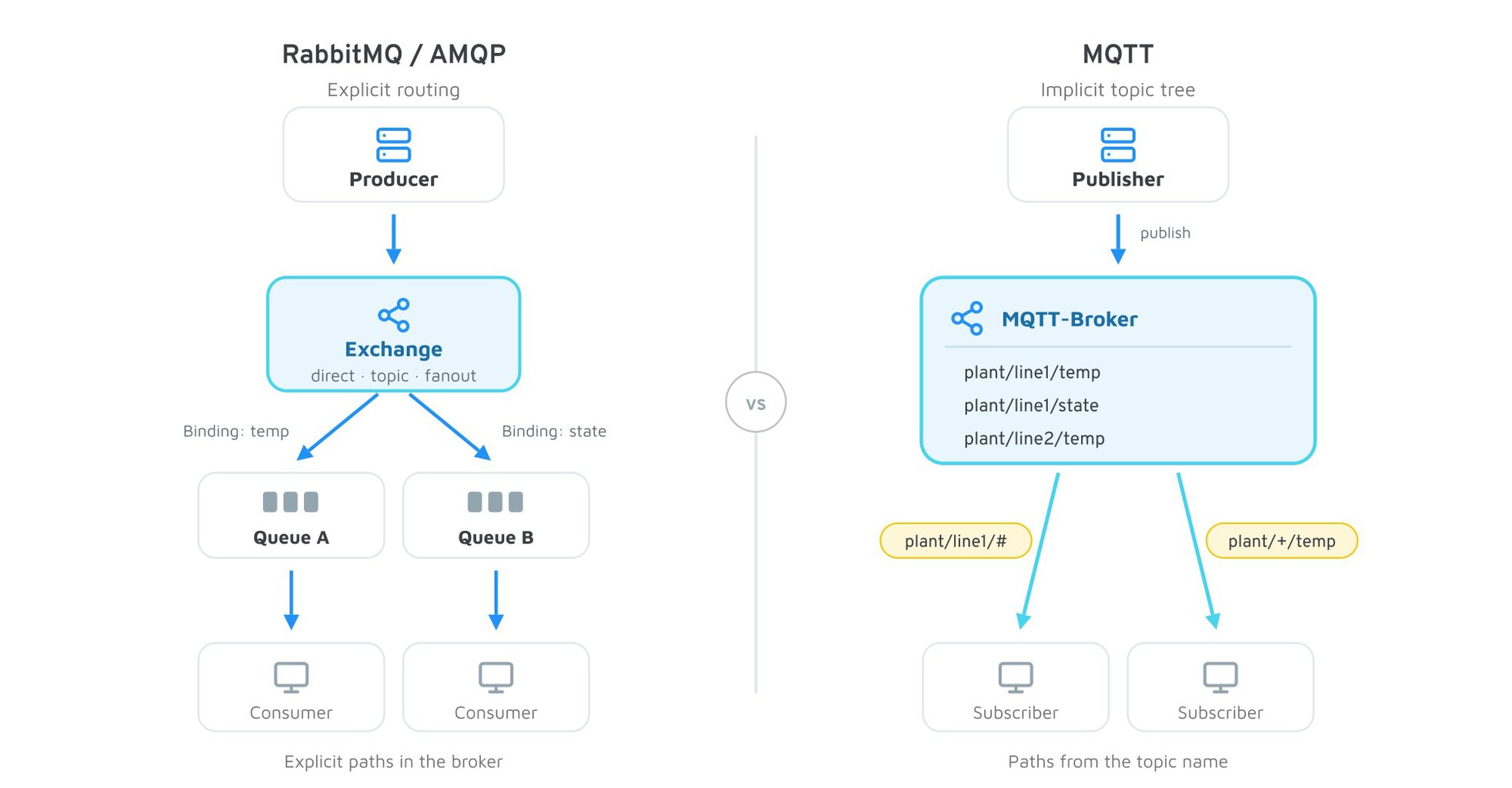
AMQP: exchanges, bindings and queues
AMQP knows three central building blocks. A producer does not send a message directly to a queue. It sends it to an exchange. The exchange distributes the message according to rules, the bindings, to one or more queues. Consumers then read from the queues.
The behavior depends on the exchange type. A direct exchange forwards by exact routing key. Patterns with wildcards, by contrast, are handled by the topic exchange. A fanout exchange copies the message to all bound queues, while the headers exchange routes by message attributes. This structure is powerful. It allows complex distribution logic directly in the broker. But it is also more work to plan and operate.
MQTT: topics and wildcards
MQTT takes a leaner approach. There are no exchanges and no bindings. A publisher sends to a topic, for example plant/line1/temp. The broker manages a hierarchical topic tree. Subscribers subscribe to topics directly or through wildcards.
MQTT knows two wildcards. The + stands for exactly one level. The # stands for all levels below. A subscriber on plant/line1/# receives everything for line 1. A subscriber on plant/+/temp receives all temperatures across all lines. The routing follows from the topic structure alone. It needs no pre-configured distribution logic. That is exactly what makes MQTT light and flexible.
The contrast fits into one sentence. With AMQP, the operator defines the distribution inside the broker. They create exchanges, wire up bindings and bind queues. With MQTT, the distribution follows from how the topics are named. Anyone answering the RabbitMQ or MQTT question is therefore also choosing between explicit and implicit routing control. Explicit routing offers more control. Implicit routing offers less configuration effort.
Reliability, QoS and Message Semantics
The paths part ways on delivery guarantees too. MQTT defines three QoS levels (Quality of Service). Level 0 (QoS 0) delivers at most once. With QoS 1, the broker delivers at least once. QoS 2 delivers exactly once via a four-step handshake. The developer picks the level to fit the use case. Our article on MQTT Quality of Service (QoS) explains the details.
AMQP takes a different approach. It knows two basic delivery levels for messages. On top of that, it offers publisher confirms, consumer acknowledgements and transactions. This lets you secure transactional flows inside the broker. A message counts as processed only once the consumer explicitly confirms it. This focus on transactional safety is a clear strength of RabbitMQ.
The state features differ too. MQTT brings persistent sessions, the Last Will and Testament, and retained messages. The Last Will reports an unexpected connection drop. A retained message gives new subscribers the last known value immediately. RabbitMQ relies instead on durable queues, message TTL, dead-letter queues and priorities. Both approaches solve similar problems, but with a different philosophy.
Footprint and Design Intent
In the end, the MQTT vs AMQP comparison traces back to the original design intent. The protocols were designed for different worlds. That explains most of the differences in routing, QoS and state.
MQTT was created for constrained environments. The fixed header starts at just 2 bytes. The protocol is ideal for sensors, edge devices and cellular networks. Its strength is distributing many small telemetry values to many receivers. This high fan-out capability is exactly what makes MQTT the backbone of the Unified Namespace (UNS).
AMQP and RabbitMQ target enterprise messaging. They were designed for complex routing, task queues and business-critical workflows. The footprint is heavier, the feature set broader. A bank distributes transactions with it. A backend distributes background jobs to workers with it. The following matrix summarizes the differences compactly.
| Criteria | MQTT | RabbitMQ / AMQP |
|---|---|---|
| Category | protocol | broker (speaks AMQP) |
| Routing | topics and wildcards (+, #) | exchanges, bindings, queues |
| QoS / delivery | 3 levels (0, 1, 2) | 2 levels plus transactions |
| Footprint | lightweight (from 2 bytes) | heavier, feature-rich |
| State features | retained, Last Will, sessions | queues, TTL, dead-letter |
| Design intent | IoT, edge, high fan-out | enterprise, routing, transactional |
| Typical use | telemetry in the UNS | task queues, workflows, ERP |
A broader overview of other brokers helps to place all this. How MQTT, Kafka, AMQP and NATS differ overall is shown in our comparison of message brokers. For the pure protocol question in the UNS, it is also worth looking at NATS vs. MQTT and at Kafka in the industrial IoT versus MQTT.
Combining MQTT & RabbitMQ: Not Either-or
The most interesting insight in the MQTT vs RabbitMQ comparison is the combination. In many industrial architectures, the two do not compete. They complement each other. Each protocol plays to its strength in the zone it was built for.
At the edge and in the UNS, MQTT dominates. Sensors, PLCs and machines publish their data in a lightweight way to a central MQTT broker. This broker forms the telemetry backbone of the plant. Our article on MQTT in the Unified Namespace explains more.
In the enterprise backend, RabbitMQ takes over. That is where complex workflows, task queues and transactional processes run. AMQP is built for exactly this. Between the two worlds sits a bridge. It forwards selected data from the UNS into RabbitMQ on purpose. That way, only what is needed lands in the enterprise system. The following graphic shows this division of roles.
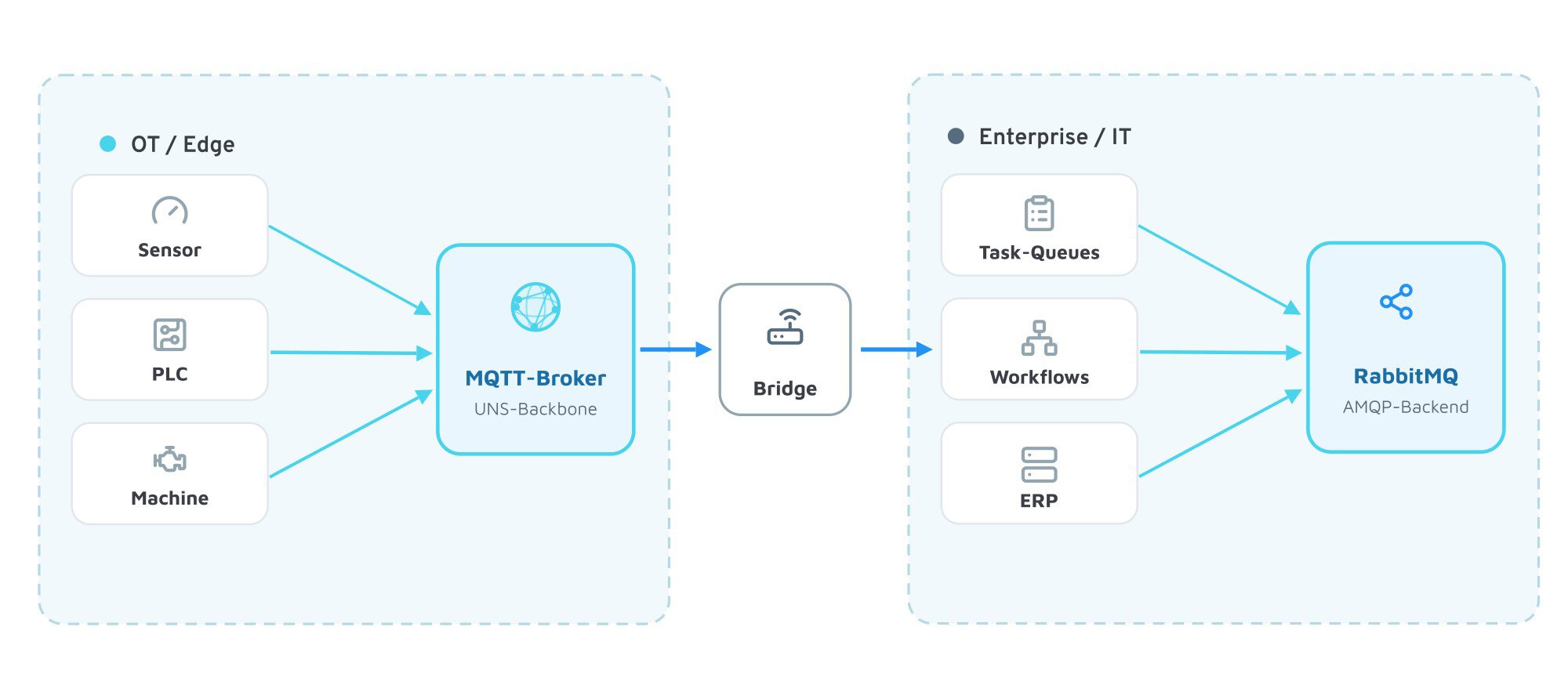 This pattern is proven. MQTT collects and distributes machine data close to the process. RabbitMQ handles the business processes derived from it in the IT backend. The bridge decouples both zones cleanly. Neither does the OT have to carry the enterprise load, nor does the IT have to see every telemetry packet. This is exactly how a layered, scalable architecture emerges.
An example makes it tangible. A machine continuously reports its state to the UNS over MQTT. Dashboards and a historian read this data along the way. When the machine switches to a fault state, a bridge detects this event. It turns the event into an order and places it in a RabbitMQ queue. A worker in the backend picks up the order and starts the maintenance process. MQTT delivers the event, RabbitMQ orchestrates the workflow. Both protocols play to their respective strengths.
Conclusion: when MQTT, when RabbitMQ
The MQTT vs RabbitMQ comparison does not produce a winner. It produces a clear assignment. MQTT is a protocol for lightweight telemetry with high fan-out. RabbitMQ is a broker for complex enterprise routing and transactional workflows. Both solve different problems. In a layered architecture, they even complement each other. Three key takeaways:
- Separate the categories: MQTT is a protocol, RabbitMQ a broker. The clean comparison is MQTT vs AMQP.
- Routing is decisive: MQTT routes implicitly through topics and wildcards, AMQP explicitly through exchanges, bindings and queues.
- Not either-or: MQTT at the edge and in the UNS, RabbitMQ in the enterprise backend, connected through a bridge.
Frequently asked questions (FAQ)
Is RabbitMQ an MQTT broker? RabbitMQ is primarily an AMQP broker. It supports MQTT only through an additional plugin. Anyone who needs MQTT as the core protocol usually reaches for dedicated brokers such as Mosquitto, EMQX or HiveMQ. These are built for MQTT from the ground up.
Is MQTT vs RabbitMQ even a fair comparison? Not directly. MQTT is a protocol, RabbitMQ a broker. The fair comparison is MQTT against AMQP, protocol against protocol. RabbitMQ serves as the best-known representative of the AMQP world here.
When should I choose MQTT instead of RabbitMQ? MQTT fits lightweight telemetry with many sensors and receivers. It is the right choice at the edge and in the Unified Namespace. RabbitMQ fits complex routing, task queues and transactional workflows in the IT backend.
Can I use MQTT and RabbitMQ together? Yes, and often that is exactly the best solution. MQTT collects the machine data at the edge. RabbitMQ processes the business events in the backend. A bridge connects both zones and forwards only relevant data.