
Unplanned machine downtime is among the most expensive events in manufacturing: it halts entire production lines, triggers rush orders for spare parts and forces maintenance teams into a permanent reactive mode of unplanned emergency call-outs. Predictive maintenance takes a different approach: instead of reacting to a defect or replacing components on rigid intervals, it predicts an impending failure from operational data – before it occurs. As part of the industrial AI movement, this approach combines sensor technology, continuous data acquisition and machine learning. This article explains what predictive maintenance is, how to implement it in the Unified Namespace (UNS) and what benefits and drawbacks data-driven maintenance brings.
What is Predictive Maintenance?
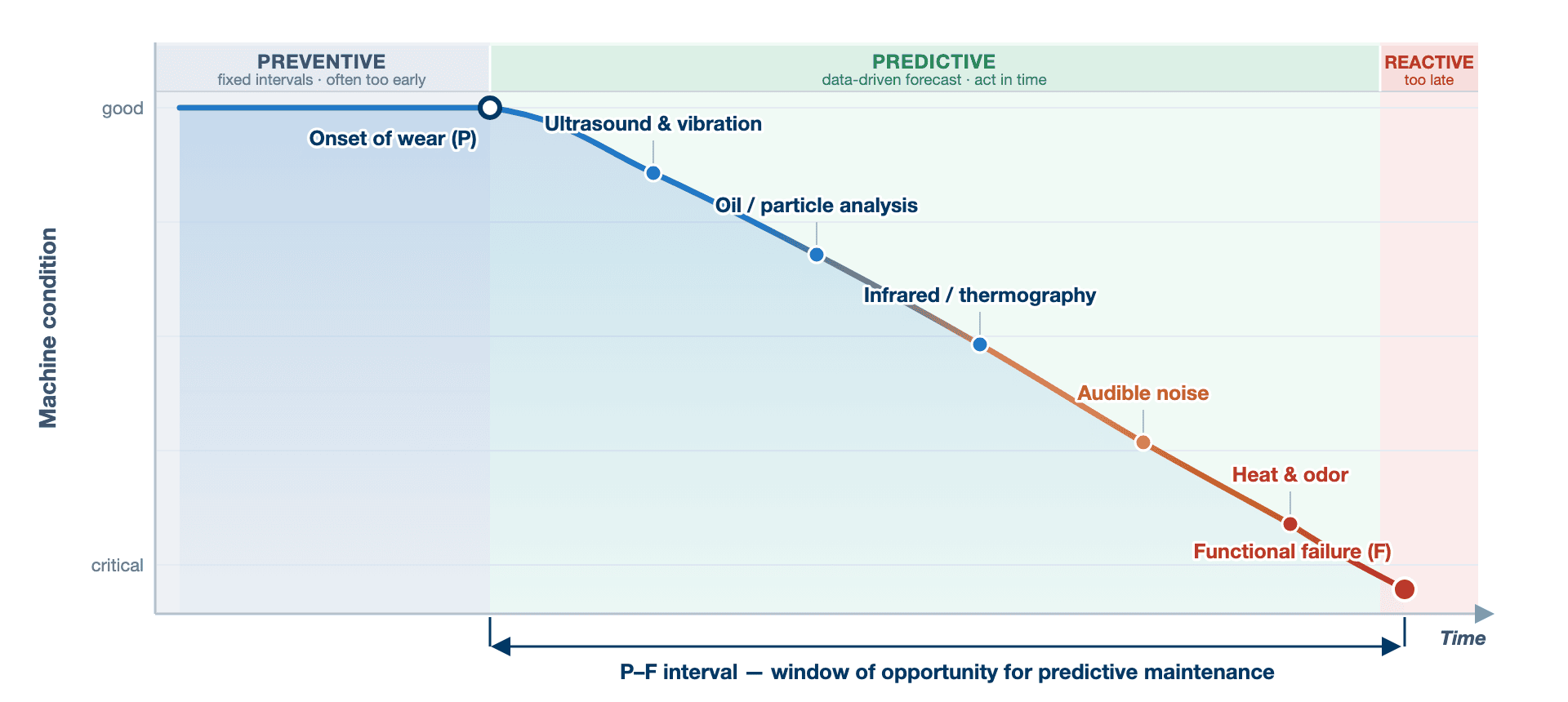
Predictive maintenance is a maintenance strategy that continuously monitors the condition of machines and, from that, predicts the optimal moment to intervene. It is based on real operational data – such as vibration, temperature, current draw, pressure or operating hours – which is evaluated using analytical models and machine learning. The goal: replace a component exactly when a failure is imminent, but not earlier.
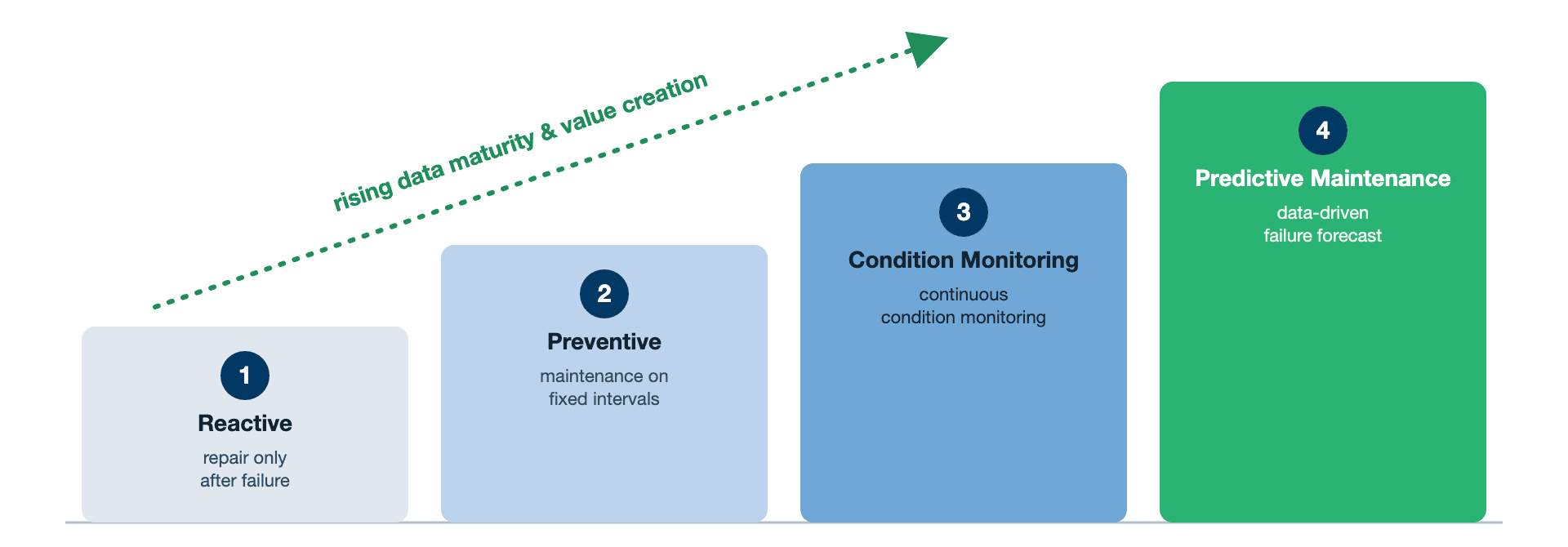
To put predictive maintenance in context, a comparison with the classic maintenance strategies helps (see graphic above). Reactive maintenance waits until something breaks. Preventive maintenance replaces parts on a calendar or operating-hours basis – regardless of actual condition. Predictive maintenance closes the gap between the two by measuring real wear and deriving a forecast from it.
The role of AI and machine learning
The leap from preventive to predictive maintenance is achieved through data-based models. In practice, several levels of sophistication are used:
- Threshold monitoring: The simplest level – an alarm is triggered when a measured value (e.g. bearing temperature) exceeds a fixed limit.
- Anomaly detection: A model learns the normal operating behavior of a machine and reports deviations, even without a predefined limit.
- Remaining useful life (RUL) forecasting: Advanced models estimate how many operating hours a component is likely to run without failure.
The key point: AI is not an end in itself here. A model is only as good as the data it is trained and operated on. That puts data acquisition at the center of every such initiative.
Prerequisite: Data as the Foundation
Predictive maintenance stands or falls with data quality. A predictive model needs continuous, clean and contextualized operational data – over weeks and months, from different sources and in a consistent format. This is exactly where the real hurdle lies in many factories: the data exists, but it is trapped in isolated systems (PLC, SCADA, historian) and inconsistently structured.
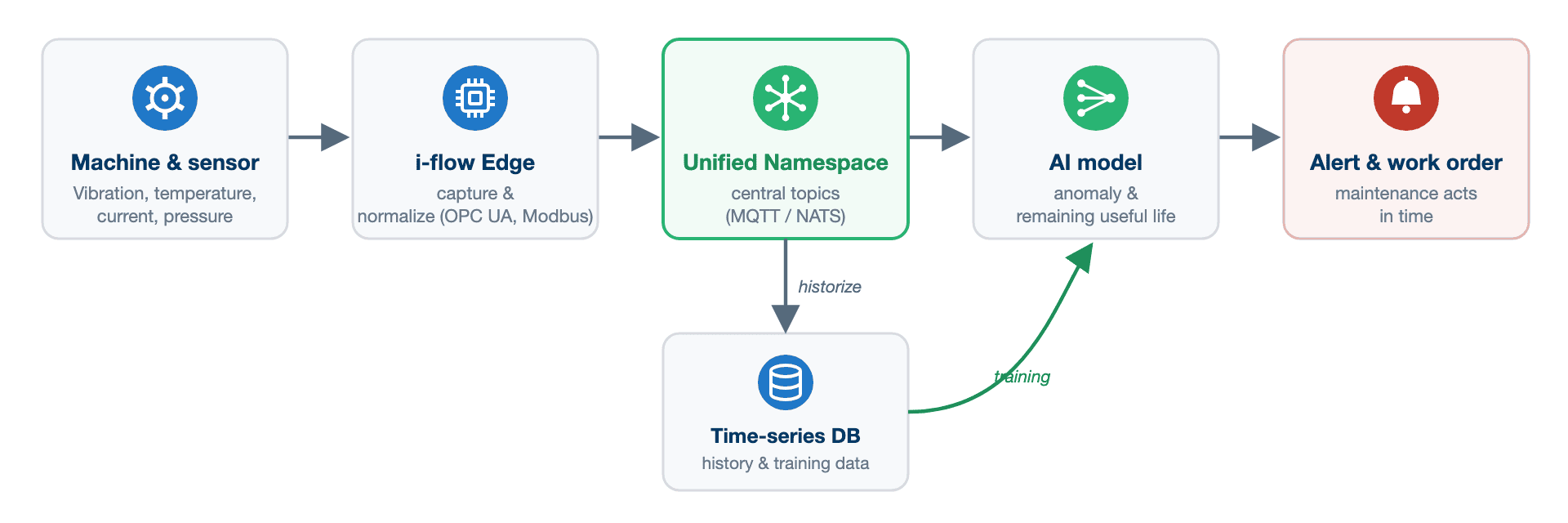
The Unified Namespace (UNS) addresses this problem. It forms a central, hierarchically organized data layer in which all systems publish and consume data through a shared message broker – such as MQTT or NATS. This makes machine data available – normalized and in real time – as a Single Source of Truth (SSOT). In practice this means: an AI model does not have to connect to a dozen proprietary interfaces, but simply subscribes to the relevant topics in the UNS.
Historization is equally important. Models are trained on historical data, especially on the periods around past failures. A time-series database stores these trends long term and provides the training basis. The UNS and historization thus form the foundation on which every predictive approach is built.
Implementing Predictive Maintenance
Rather than a factory-wide big-bang project, the best way to start is step by step, on a clearly defined, critical use case. The following five steps form a proven path to building predictive maintenance ready for production.
- Identify critical assets and failure modes: Not every machine justifies the effort. Start with assets whose failure is particularly expensive or frequent. Also clarify: which specific failure modes (e.g. bearing damage, belt wear) should be predicted – and which physical variables announce them?
- Set up sensors and data acquisition: Connect the relevant data sources. Many signals are already provided by existing controllers via native protocols such as
OPC UA,ModbusorSiemens S7. Where vibration or structure-borne noise is missing, additional sensors complete the data basis. - Normalize the data and publish it to the UNS: Standardize units, timestamps and naming conventions and publish the data to a consistent topic structure following ISA-95, for example
plant01/assembly/line01/motor01/vibration. This harmonization is the prerequisite for a model to use the data reliably at all. - Historize and select a model: Write the UNS data to a time-series database and start with the simplest viable model. Often a threshold or anomaly detection is enough at first; complex RUL models follow only once sufficient failure data is available.
- Feed predictions back into processes: A forecast only takes effect when it triggers an action. Feed the model results back – as an alarm in the control room, as an automatically generated work order in the maintenance system, or as a KPI on the dashboard.
The iterative character is essential: a first model will rarely be perfect. Gather operational experience, refine the models, and only then extend the approach to further assets.
Benefits and Drawbacks of Predictive Maintenance
Predictive maintenance is not a cure-all. Like any strategy, it brings clear benefits, but also real limits. An honest assessment is the prerequisite for an economically sound rollout.
Benefits
- Fewer unplanned failures: Emerging defects are detected before they lead to a standstill. This reduces expensive emergency call-outs and consequential damage to adjacent components.
- Optimized maintenance and spare-parts planning: Interventions can be scheduled into planned downtime and spare parts stocked as needed – instead of expensive rush orders or overfilled warehouses.
- Longer asset lifetime: Components are used according to their actual condition, not replaced prematurely. At the same time, monitoring prevents operation until total failure.
- Data-driven decisions: Maintenance relies on objective measurements rather than experience or rigid intervals.
Drawbacks and limits
- High initial effort: Sensors, data acquisition, UNS connection and historization have to be built up first. Without this foundation, a reliable failure prediction is not possible.
- Dependence on historical failure data: Failure-prediction models need examples of past faults. For very reliable or new assets these are often missing – anomaly detection is then the more pragmatic starting point.
- Ongoing model maintenance: Processes, materials and machines change. Models must be monitored and retrained, otherwise their accuracy declines („model drift“).
- Not economical for every asset: For non-critical or inexpensive components, preventive or even reactive maintenance can remain the more cost-effective choice.
The consequence of this assessment: it pays off most where failures are expensive, announce themselves and enough data is available. A targeted start on such use cases is therefore economically more sensible than a factory-wide rollout.
i-flow as the Data Foundation for Predictive Maintenance
Because predictive maintenance is first a data problem, the lever lies in a reliable data basis. The i-flow platform provides exactly this foundation and follows a clear principle: central configuration in the i-flow Hub, decentralized execution via i-flow Edges close to the machine.
The i-flow Edge connects directly to PLCs, sensors and SCADA systems via native protocols such as OPC UA, Modbus or Siemens S7. It normalizes the raw data locally – close to the source, with minimal latency – and publishes it in structured form to the UNS. The i-flow Hub manages data models and connections centrally and rolls out changes consistently to all Edges. The i-flow Broker provides the central message broker and ensures reliable delivery of all data points.
In concrete terms: the harmonized data is available in the UNS, and any analytics or AI system can subscribe to it as a consumer – without worrying about protocol details or proprietary interfaces. Maintenance can thus focus on the models instead of on data acquisition.
Conclusion
Predictive maintenance shifts maintenance from reacting to predicting. It detects impending failures from real operational data and enables interventions exactly when they are needed – neither too late nor too early. The benefit is real: fewer unplanned stoppages, better planning and a longer asset lifetime.
What matters, however, is the right order. Predictive maintenance is not a pure AI topic, but first a data topic. Without continuous, harmonized and historized data, even the best model remains ineffective. Three key takeaways:
- Data before models: A solid data foundation – ideally a Unified Namespace – is the prerequisite, not an afterthought.
- Step by step instead of factory-wide: Start on a critical asset, gather experience and extend the approach afterwards.
- Honest economics: It pays off where failures are expensive, announce themselves and data is available.
Whoever lays the data foundation today creates the basis not only for predictive maintenance, but for further industrial AI applications across the entire plant.