
Automation has shaped manufacturing for decades – yet it almost always follows fixed rules. A PLC (Programmable Logic Controller) switches when a threshold is exceeded; SCADA systems visualize and acknowledge according to clearly defined logic. This deterministic foundation is reliable, but it reaches its limits as soon as tasks become too variable for rigid rules. This is exactly where AI automation comes in: it adds perception, prediction and learned decisions to classic control. Instead of programming every exception in advance, AI models recognize patterns in real-time data and act on them. This article explains what AI automation is, how it differs from classic automation and how you can use it to automate concrete tasks on the shopfloor.
What is AI automation?
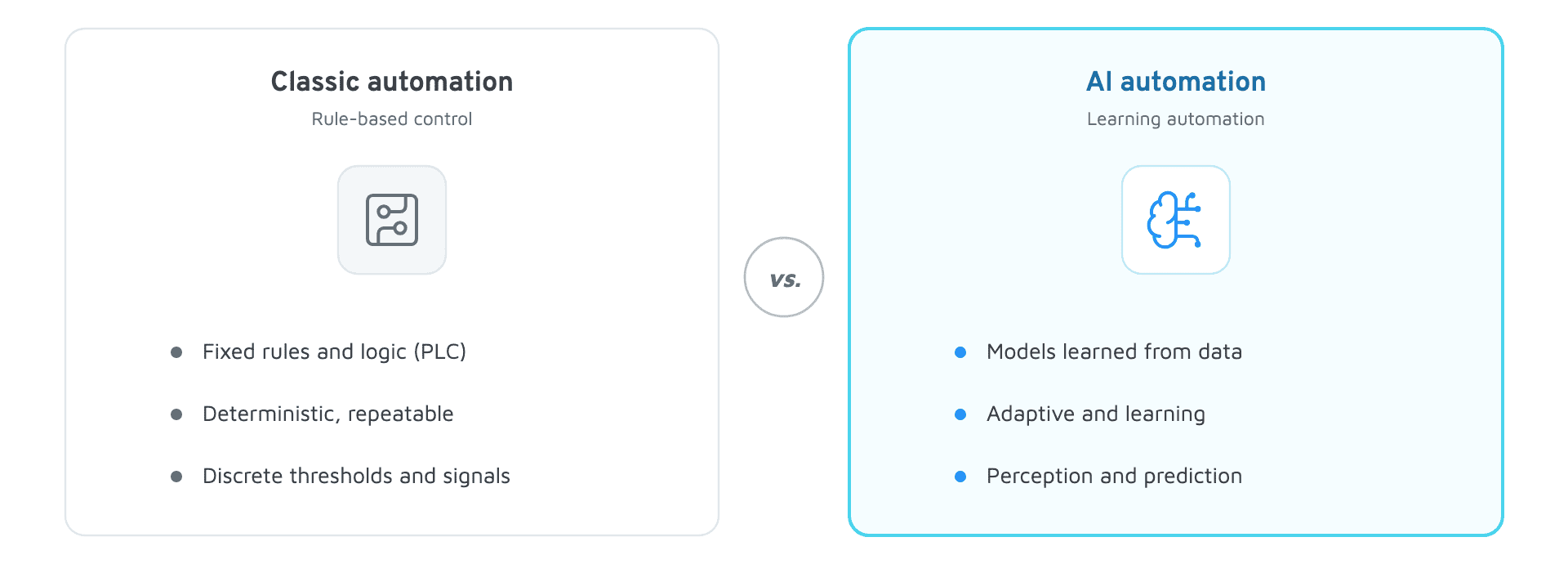
AI automation describes the combination of artificial intelligence with classic automation to handle tasks that are too variable for fixed rules. Classic automation executes predefined logic. AI automation adds three capabilities to that logic, all derived from data:
- Perception: Models interpret images, sounds or complex signal patterns – such as a camera image of a weld seam that no simple threshold rule can describe.
- Prediction: From historical and current trends, models forecast future states, for example an impending bearing failure or the scrap rate of a batch.
- Decision: Based on these assessments, the system selects an action – from a parameter adjustment to an automatically generated work order.
The decisive difference lies in the origin of the behavior. A PLC does what an engineer explicitly programmed. An AI model, by contrast, learns its behavior from examples. As a result, AI automation tolerates the variation and new patterns that constantly occur in reality – changing material batches, wear or fluctuating ambient conditions. Consequently, the approach fits everywhere that reality is too complex to capture fully in rules.
Classic automation vs. AI automation
Both approaches pursue the same goal: running processes without constant manual intervention. However, they differ fundamentally in how they work. The following table contrasts the most important characteristics.
| Criterion | Classic automation | AI automation |
|---|---|---|
| Basis | Fixed rules and logic (PLC, SCADA) | Models learned from data |
| Behavior | Deterministic, exactly repeatable | Adaptive, probability-based |
| Handling variance | Low – every exception needs a new rule | High – tolerates variation and new patterns |
| Perception | Discrete signals and thresholds | Images, sounds, complex patterns |
| Adaptation | Manual reprogramming | Retraining with new data |
| Traceability | Fully transparent | Explainability varies by model |
One point matters here that the table cannot express: AI automation does not replace deterministic control, it complements it. Safety-critical control loops – an emergency stop, a speed control, an interlock – stay with the classic, fully traceable logic. AI works above that layer: perception, prediction and optimization. In practice, therefore, both levels work together. The PLC guarantees safe basic operation, while the AI model delivers the decisions that fixed rules cannot represent.
Automating shopfloor tasks with AI
The path from idea to productive AI automation follows a recurring pattern. First, the system captures data from the process. Then a model interprets that data. Finally, the result triggers an action – a hint in the simplest case, an automatic intervention in the full build-out. On the shopfloor, this principle applies to very different tasks.
Concrete use cases
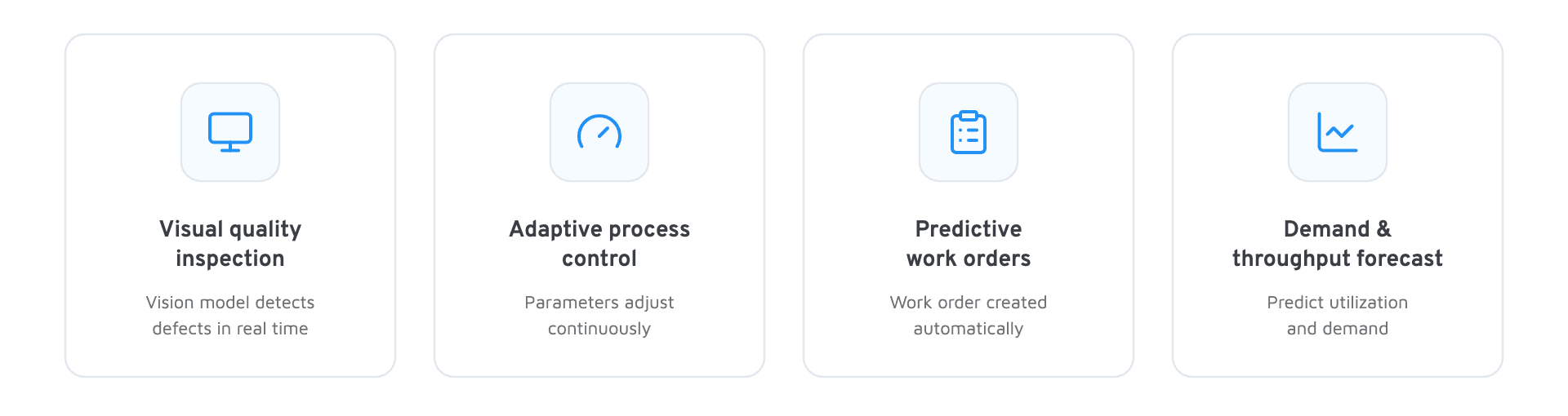
- Visual quality inspection: A vision model inspects parts in real time and detects scratches, cracks or missing components – defects that no fixed rule can describe. The system sorts out defective parts automatically.
- Adaptive process control: Instead of rigid setpoints, a model continuously adjusts parameters such as temperature, pressure or feed to the material batch and tool wear, keeping quality stable.
- Predictive work orders: When a model detects a wear pattern, AI automation automatically creates a work order in the maintenance system – including the fault signature and a recommended date.
- Autonomous agents: AI agents monitor live data continuously and act independently within defined limits, for example by reconfiguring a line or reordering material.
- Demand and throughput forecasting: Models predict utilization, material demand or bottlenecks and trigger planning and replenishment processes accordingly.
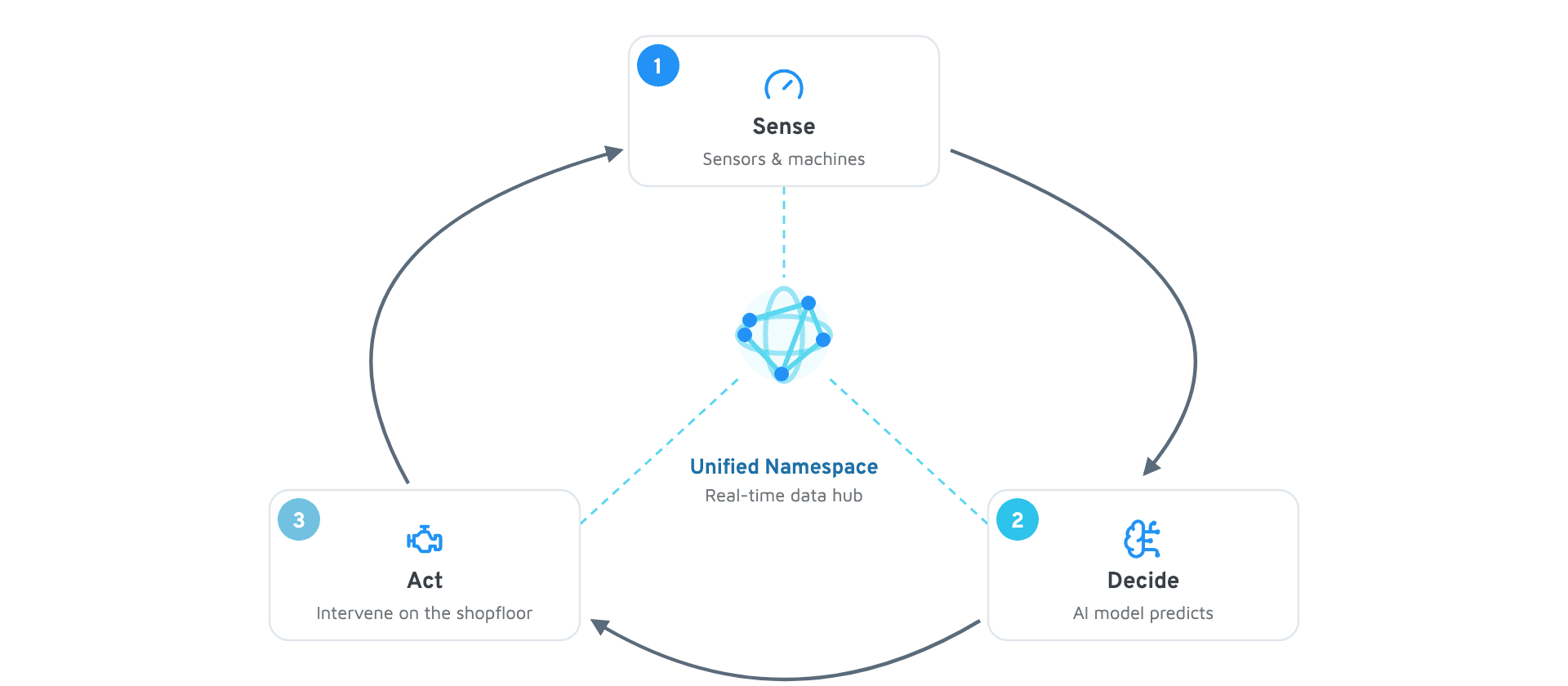
These examples differ in data source and model, but they follow the same loop of sensing, deciding and acting. What matters, however, is that each of these applications requires reliable, contextualized data. Without this foundation, even the best model remains ineffective.
The foundation: data and the Unified Namespace
AI automation is first a data topic and only then a model topic. A model can only decide what it can read from the data. Therefore, every AI automation needs a unified, contextualized and real-time data basis. In many factories, this is exactly where the hurdle lies: the data exists, but it is trapped in isolated systems such as PLC, SCADA or historian and inconsistently structured.
The Unified Namespace (UNS) solves this problem. It forms a central, hierarchically organized data layer in which all systems publish and consume data through a shared message broker – such as MQTT or NATS. This makes machine data available – normalized and in real time – as a Single Source of Truth (SSOT). An AI model therefore does not have to connect to a dozen proprietary interfaces, but simply subscribes to the relevant topics.
The closed loop: sense, decide, act
AI automation only unfolds its value when a decision flows back into the process. This creates a closed loop: sensors and machines capture the state, the UNS provides the harmonized data, an AI model decides, and the action feeds back onto the shopfloor. The UNS acts as the hub that connects perception and action.
i-flow as the data foundation for AI automation
Because AI automation is above all a data problem, the lever lies in a reliable data basis. The i-flow platform provides exactly this foundation and follows a clear principle: central configuration in the i-flow Hub, decentralized execution via i-flow Edges close to the machine.
The i-flow Edge connects directly to PLCs, sensors and SCADA systems via native protocols such as OPC UA, Modbus or Siemens S7. It normalizes the raw data locally and publishes it in structured form to the UNS. The i-flow Hub manages data models and connections centrally and rolls out changes consistently to all Edges. The i-flow Broker provides the central message broker and ensures reliable delivery of all data points.
For AI automation this means, in concrete terms: the harmonized data is available in the UNS, and any AI system can subscribe to it as a consumer – and write an action back into the plant along the same path. AI development can thus focus on the models instead of on data acquisition.
Best practices and limits
AI automation is not a sure thing. Like any data-driven approach, it delivers value only under the right conditions. The following recommendations have proven themselves in practice.
Recommendations
- Start narrow: Begin with a clearly defined use case and a measurable goal, rather than automating the entire factory at once.
- Keep humans in the loop: Keep the human in the loop at first. The model suggests, the human decides – only with proven reliability does the degree of automation rise.
- Separate safety: Leave safety-critical functions to deterministic control. AI acts above it, not beneath it.
- Secure data quality: Invest in clean, contextualized data first. A UNS is the most solid basis here.
Limits
- Dependence on data: Where sufficient or representative data is missing, every prediction remains unreliable.
- Explainability: Not every model can be fully traced – a drawback in heavily regulated processes.
- Model drift: As processes or materials change, a model loses accuracy and must be retrained.
- Economics: For simple, stable tasks, a classic rule can be cheaper and more robust than AI automation.
Conclusion
AI automation extends classic automation with perception, prediction and learned decisions. It does not replace deterministic control, but builds on top of it and takes over the tasks that are too variable for fixed rules. Its value emerges in the closed loop of sensing, deciding and acting – and this loop only closes over a reliable data basis. Three key takeaways:
- Complement, not replacement: AI automation works above deterministic control, which continues to safeguard safety-critical loops.
- Data before models: A unified data foundation – ideally a Unified Namespace – is the prerequisite, not an afterthought.
- Step by step instead of factory-wide: Start narrow, keep the human in the loop and extend the approach as reliability grows.
Whoever lays the data foundation today creates the basis not only for individual AI applications, but for end-to-end AI automation across the entire plant.