
Classic AI answers questions. An AI agent goes one step further: it acts. Instead of only producing text, an agent calls tools, reads live data, makes decisions and carries out tasks on its own – from reading a machine to creating a work order. That shifts the value from “retrieving knowledge” to “getting tasks done”. For industrial companies, a new class of applications emerges that acts directly on operational data. This article shows what building AI agents involves: it explains their anatomy, the core building blocks, the Model Context Protocol (MCP), the framework landscape and the best practices for productive use in manufacturing.
What is an AI agent?
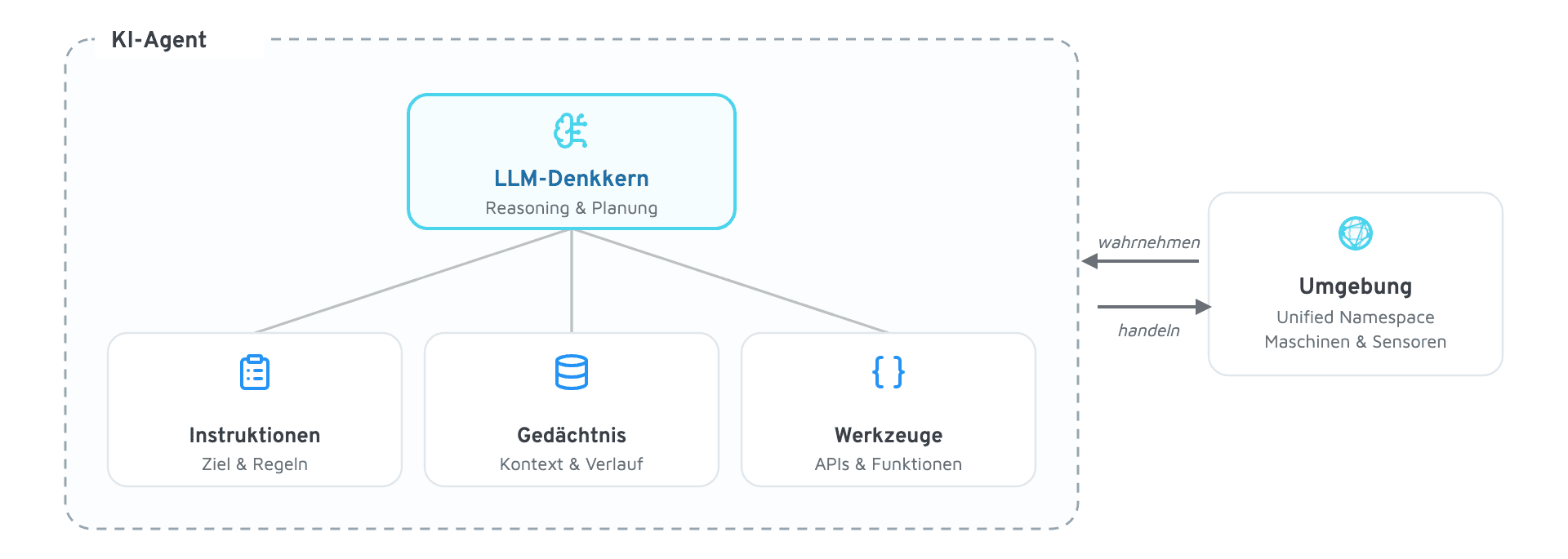
An AI agent is a system that uses a large language model (LLM) as its reasoning core to solve tasks autonomously. The model plans, makes decisions and calls external tools along the way. Unlike a plain chatbot, the agent does not stop at the answer. It acts, observes the result and adjusts its approach. Three components define an agent.
- Reasoning core (LLM): The language model interprets the task, breaks it into steps and decides which tool makes sense next.
- Tools: Through function calls, the agent accesses APIs, databases or machines. Only this lets it actually affect the real world.
- Memory: The agent stores intermediate results, earlier steps and context, so it stays consistent across several actions.
The agent loop: perceive, reason, act, observe
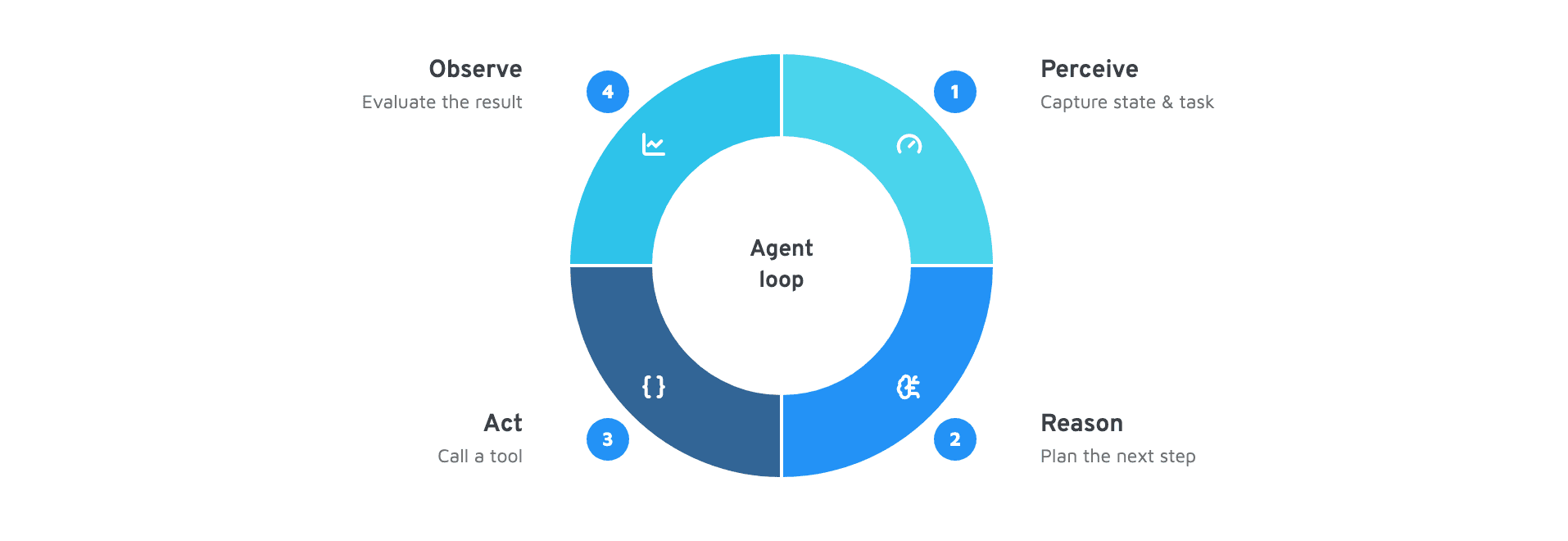
Agent loops drive the core principle. The agent runs through it repeatedly until the task is done. First it perceives the current state and the task. Then the LLM reasons about the next step. Next the agent acts by calling a tool. Finally it observes the result and starts the loop again. Exactly this feedback separates an agent from a chatbot: a chatbot answers once, an agent works iteratively toward a goal.
How to build an AI agent
Building an AI agent means assembling several building blocks. Each block solves one clearly bounded job. The following order has proven itself in practice when building AI agents.
- Choose a model: Pick a language model that plans reliably and supports function calling. Larger models reason better, smaller ones are faster and cheaper. For many tasks a mid-sized model is enough.
- Connect tools (function calling): Describe each tool as a function with a name, purpose and parameters. The model then decides on its own when to call which function with which arguments.
- Memory and state: Define what the agent stores. Short-term memory holds the running dialogue; long-term memory – often in a vector database – preserves knowledge across sessions.
- Orchestration loop: Implement the loop of perceive, reason, act and observe. It calls the model, executes tools and feeds the results back until a stop condition is reached.
- Guardrails: Limit what the agent may do. This includes allowed tools, value ranges, a maximum number of steps and human approval for critical actions.
The Model Context Protocol (MCP)
A problem shows up quickly: every tool speaks its own interface. Whoever wants to connect many systems ends up writing a separate integration for each. This is exactly where the Model Context Protocol (MCP) comes in. MCP is an open standard that connects agents and external tools through a single, uniform interface. An agent therefore only speaks MCP, and each system provides an MCP server that exposes its data and functions.
The benefit is reusability. Instead of programming every connection from scratch, the agent uses standardized MCP servers – for a database, a file system or an industrial platform, for example. MCP is therefore emerging as the connecting standard between AI agents and the outside world. Anyone building AI agents today should plan for MCP from the start.
AI agent builders and frameworks
You do not have to start from scratch. A broad tool landscape for building agents now exists. It splits into three groups that differ mainly in the trade-off between control and speed.
The three categories at a glance
- Code frameworks: Libraries such as
LangChainorLlamaIndexand the vendor agent SDKs give full control over logic, tools and the loop. They do, however, require development effort. - No-code and low-code builders: Visual tools let you assemble agents from building blocks. They speed up first results considerably, but limit customization.
- Managed agent platforms: Hosted services take over operation, scaling and monitoring. They lower the effort, but tie you more closely to a vendor.
The choice depends on the goal. A code framework fits when you need maximum control and integration depth, a no-code builder suits fast prototypes and simple workflows, and a managed platform pays off when operation is the priority. In practice, many teams combine the approaches: a prototype in the builder, the production version in a code framework. Regardless of the tool, however, the decisive question stays the same – where does the agent get reliable data?
AI agents on factory data: UNS and MCP
In manufacturing, an agent only takes effect once it accesses real machine data. This is where the typical hurdle lies: operational data sits in PLCs, SCADA systems and historian databases – distributed, inconsistent and hard to reach. An agent that had to connect to each of these sources individually would barely be maintainable.
The Unified Namespace (UNS) solves this problem. It forms a central, hierarchically organized data layer in which all systems publish their data through a shared message broker – such as MQTT. This makes machine data available – normalized, contextualized and in real time – as a Single Source of Truth (SSOT). The agent therefore does not have to collect the data laboriously, but finds it in one place and in a uniform form.

Best practices and limits
An agent that acts on its own needs clear rules. Without guardrails, it can scale mistakes instead of creating value. The following recommendations have proven themselves when building AI agents and running them in production.
Recommendations
- Human in the loop: Have a person approve critical or irreversible actions, especially when the agent intervenes in production processes.
- Define guardrails: Limit allowed tools, value ranges and the number of steps. This prevents endless loops and unwanted actions.
- Contain hallucinations: Ground answers in real data from the UNS and let the agent check sources instead of inventing values.
- Keep an eye on cost: Every step triggers model calls. Cap the step count and pick the smallest sufficient model.
- Start small: Begin with a tightly scoped use case rather than a universal agent, then extend from there.
The main limit is reliability. An LLM can make mistakes, so agents today suit supporting tasks better than safety-critical ones. The effort is real too: without a clean data foundation, every agent stays ineffective. Therefore the same order applies in manufacturing as in any industrial AI initiative – data first, then the model.
Conclusion
AI agents shift the value of artificial intelligence from answering to acting. An LLM core plans, tools intervene, memory secures context, and the agent loop keeps everything moving. The path there leads through clearly separated building blocks, the Model Context Protocol as the connecting standard, and a deliberate choice between frameworks, builders and platforms. Three key takeaways:
- Acting instead of answering: An agent combines an LLM, tools and memory in a loop and carries out tasks autonomously.
- MCP as the standard: The Model Context Protocol connects agents uniformly with tools and data – including the Unified Namespace.
- Data before autonomy: In manufacturing, the UNS provides the contextualized data foundation without which no agent acts reliably.
Whoever lays the data foundation today and plans for MCP can build AI agents that not only impress, but create real value in the plant.