
Few terms in Industry 4.0 are used as often – and defined as loosely – as the digital twin. For some it is a slick 3D visualization in the control room. For others it is a physics-based simulation that mirrors an entire plant in real time. Both capture something true – and both miss the core: a digital twin is first a question of data, not graphics. As a building block of the Industrial AI movement, it links a virtual model with continuous real-time data from production. That turns it into a living, synchronized image of the real world. This article explains what a digital twin is, which forms it takes, and how to build one step by step in the Unified Namespace (UNS).
What is a Digital Twin?
A digital twin is a virtual representation of a physical object, process, or system. A continuous stream of data keeps it in sync with its real-world counterpart. Unlike a static design drawing or a one-off simulation model, the twin changes continuously. It mirrors the machine’s current state and grows with it across the entire lifecycle.
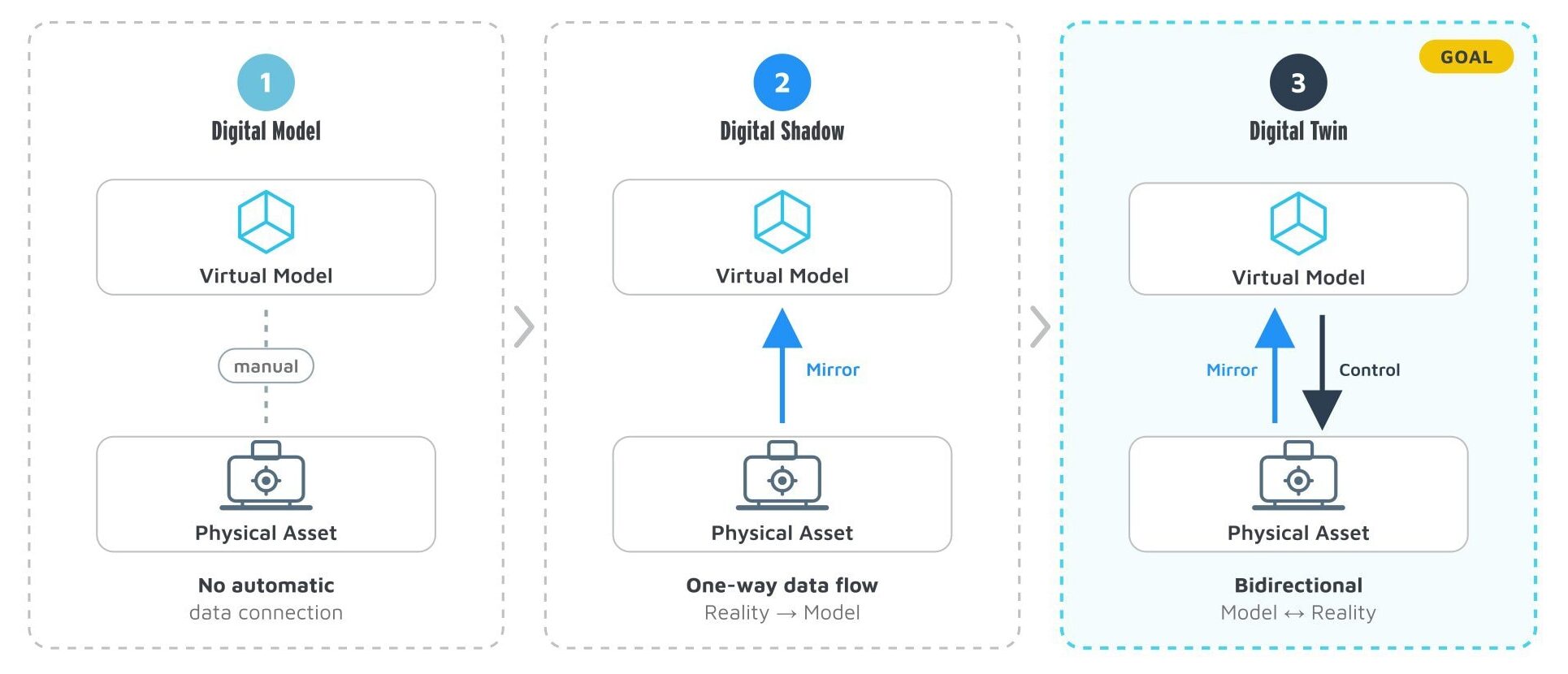
The concept traces back to Michael Grieves (2002) and its later formalization in the NASA context. It distinguishes three stages that are often confused in practice and differ above all in the direction of the data flow (see the figure above):
- Digital model: A purely virtual representation with no automatic data connection – a CAD or simulation model, for example. Changes to the real asset have to be maintained manually.
- Digital shadow: A one-way data flow from the physical world into the model. The model follows the real state automatically but does not act back.
- Digital twin: A bidirectional data flow. The model not only follows reality but can act back on it through insights, predictions, or control commands.
This distinction is more than academic: it determines how much effort a project actually requires. Many initiatives launched as a “digital twin” are initially a digital shadow – and that is perfectly legitimate, as long as expectations match.
From component to plant: the levels of the twin
A digital twin is not tied to a single granularity. It can emerge at different levels that build on one another:
- Component: A single part such as a bearing, a motor, or a valve.
- Machine: A complete asset, such as a press or a robot, with all its sensors and controls.
- Production line: Several machines working together, including material and cycle flow.
- Plant or system: The interplay of entire lines, logistics, and energy flows as a system twin.
The higher the level, the greater the value – but also the data required. That is precisely why the data architecture decides whether a twin stays at machine level or scales up to the entire plant.
What is a Digital Twin used for?
The value of a digital twin comes from combining current state, historical trend, and model knowledge. On this basis, several fields of application have become established in manufacturing:
- Monitoring and condition monitoring: The twin consolidates distributed signals into a consistent live picture of an asset – including states that no single sensor measures directly.
- Simulation and “what-if” analysis: Parameters, recipes, or load scenarios can be played through on the model before they affect real production.
- Virtual commissioning: Control logic is tested against the twin long before the physical plant exists – shortening commissioning and lowering risk.
- Optimization: The twin identifies bottlenecks, energy consumption, or quality drivers and provides the basis for targeted improvements.
The digital twin is closely intertwined with other Industrial AI applications. It provides the contextualized data foundation for them. On that basis, Predictive Maintenance detects looming failures and Predictive Analytics computes reliable forecasts.
Unified Namespace (UNS): Data as the Foundation for a Digital Twin
A digital twin stands or falls with the data that feeds it. It needs continuous, clean, contextualized operational data from many sources – PLC, SCADA, historian, additional sensors – in a consistent format and in real time. This is exactly where the real hurdle lies in most factories: the data exists but is trapped in isolated systems and inconsistently structured. A twin that has to connect individually to a dozen proprietary interfaces quickly becomes expensive and brittle.
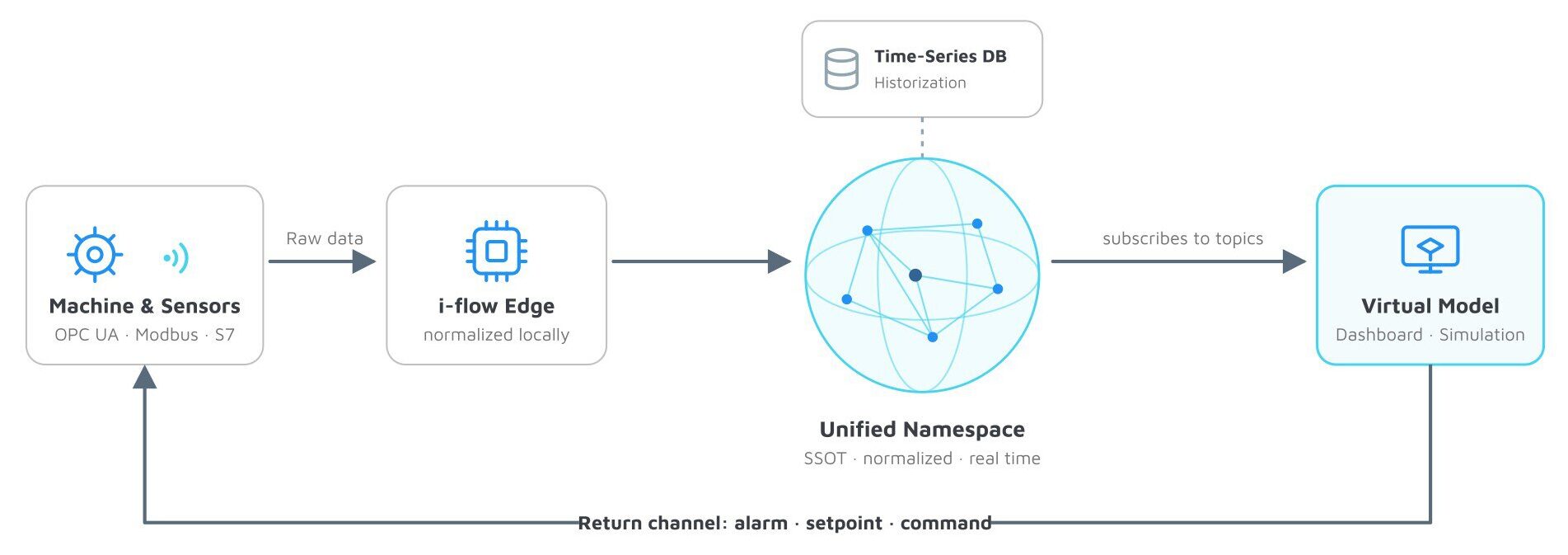
The Unified Namespace (UNS) addresses this problem. The Unified Namespace (UNS) addresses this problem. It forms a central, hierarchically organized data layer. In it, all systems publish and consume their data through a shared message broker such as NATS or MQTT. This makes machine data available normalized and in real time as a Single Source of Truth (SSOT). For the digital twin, this is a radical simplification: instead of dealing with protocol details, the model simply subscribes to the relevant topics in the UNS.
Historization is just as important. A twin is fed not only the current state but also measured and calibrated against the trend of the past. A time-series database stores these histories long term and provides the basis for simulation and model calibration. Together, the UNS and historization form the foundation on which every digital twin rests.
Building a Digital Twin in the UNS
The build works best step by step – not as a large-scale project across the entire factory, but on a clearly defined asset with a concrete question.
- Define purpose and scope: First clarify which questions the twin should answer – condition monitoring, simulation, optimization? The answer determines the asset, the granularity, and the data points required. A sharply defined purpose prevents the most common failure: trying to model everything at once.
- Connect data sources: Connect the relevant signals. Many are already delivered by existing controllers via native protocols such as
OPC UA,Modbus, orSiemens S7. Where quantities such as vibration or noise are missing, additional sensors complete the data basis. - Harmonize the data and publish it to the UNS: Standardize units, timestamps, and naming conventions. Then publish the data into a consistent topic structure per ISA-95, for example
plant01/line01/press01/temperature. This harmonized information model is the twin’s real “blueprint” – it gives the raw data the semantic meaning a model needs. - Build and couple the virtual model: Build the virtual representation – from a simple dashboard through a data model to a physics-based simulation or 3D view. The coupling is decisive: the model subscribes to the UNS topics and stays automatically in sync with reality.
- Close the return channel and iterate: A digital shadow only becomes a digital twin once the insights flow back. They return as an alarm, an optimized setpoint, or a control command. Start with the one-way data flow, deliberately close the return channel, and only then extend the twin to further assets.
The iterative character matters: a first twin rarely models everything. Gather operational experience, refine the model, and increase detail only when the value justifies the effort.
Challenges and Limits
A digital twin is not a sure-fire success. Like every data-driven initiative, it comes with real limits that should be planned for from the start.
- Data quality and integration: The most demanding part is rarely the model but the path the data takes to get there. Inconsistent formats, missing timestamps, and data silos are the most common cause of failed projects.
- Effort versus value: Model fidelity costs. A physically accurate simulation is orders of magnitude more demanding than a data-based dashboard – not every use case justifies the highest level.
- Sync and model drift: A twin is only as valuable as its agreement with reality. If the asset, material, or process changes, the model has to be updated, otherwise it drifts away from reality.
- Interoperability and standards: For twins to interact across asset and vendor boundaries, shared semantics are needed. Standards like the Asset Administration Shell (AAS) or i3X by CESMII point the way. But they are not yet mature or widely established.
The consequence of these limits: a digital twin pays off most where a clear question, high value, and a solid data basis come together. A targeted start on such an asset makes more economic sense than trying to mirror the entire factory at once.
i-flow as the Data Foundation for the Digital Twin
Because a digital twin is first a data problem, the decisive lever is a reliable data basis. The i-flow platform provides exactly this foundation and follows a clear principle: central configuration in the i-flow Hub, decentralized execution via i-flow Edges close to the source.
The i-flow Edge connects directly to PLCs, sensors, and SCADA systems via native protocols such as OPC UA, Modbus, or Siemens S7. It normalizes the raw data locally – close to the source, with minimal latency – and publishes it in structured form to the UNS. The i-flow Hub manages data models and connections centrally and rolls out changes consistently to all edges. The i-flow Broker provides the central message broker and ensures the reliable delivery of every data point.
For the digital twin, this means one thing in concrete terms: the harmonized information model is available in the UNS. Any twin, analytics, or simulation system can subscribe to it as a consumer, without worrying about proprietary interfaces. The team can thus focus on the model instead of on data acquisition.
Conclusion
A digital twin is a virtual image of a physical asset – from component to entire plant – kept in sync through real-time data. Its value comes not from the visualization but from connecting current state, history, and model knowledge. And that connection is first a question of data.
That is why the sequence decides success. Start with the 3D graphics and you build a pretty digital model; start with the data and you build a solid foundation that grows with the requirements. Three key takeaways:
- Data before model: A continuous, harmonized, and historized data basis – ideally a Unified Namespace – is the prerequisite, not an add-on.
- Start small and purpose-bound: Begin on one asset with a clear question, deliberately close the return channel, and scale afterward.
- Foundation, not island: The same UNS carries not only the digital twin but also Predictive Maintenance, Analytics, and further Industrial AI applications.