
In manufacturing, AI is usually framed as a cloud story: collect data, send it to a data center, run a model there. For many use cases, that path breaks down on the factory floor. Latency, bandwidth, and data-privacy limits get in the way. AI on the Edge turns this around: it moves the decision to where it is needed — at the machine. Instead of streaming raw data to the cloud, AI inference runs locally on hardware close to the process.
This article explains what AI on the Edge is and when it beats the cloud. It also shows the architecture within the Unified Namespace (UNS). Then it walks through the rollout step by step, with concrete manufacturing examples.
What is AI on the Edge?
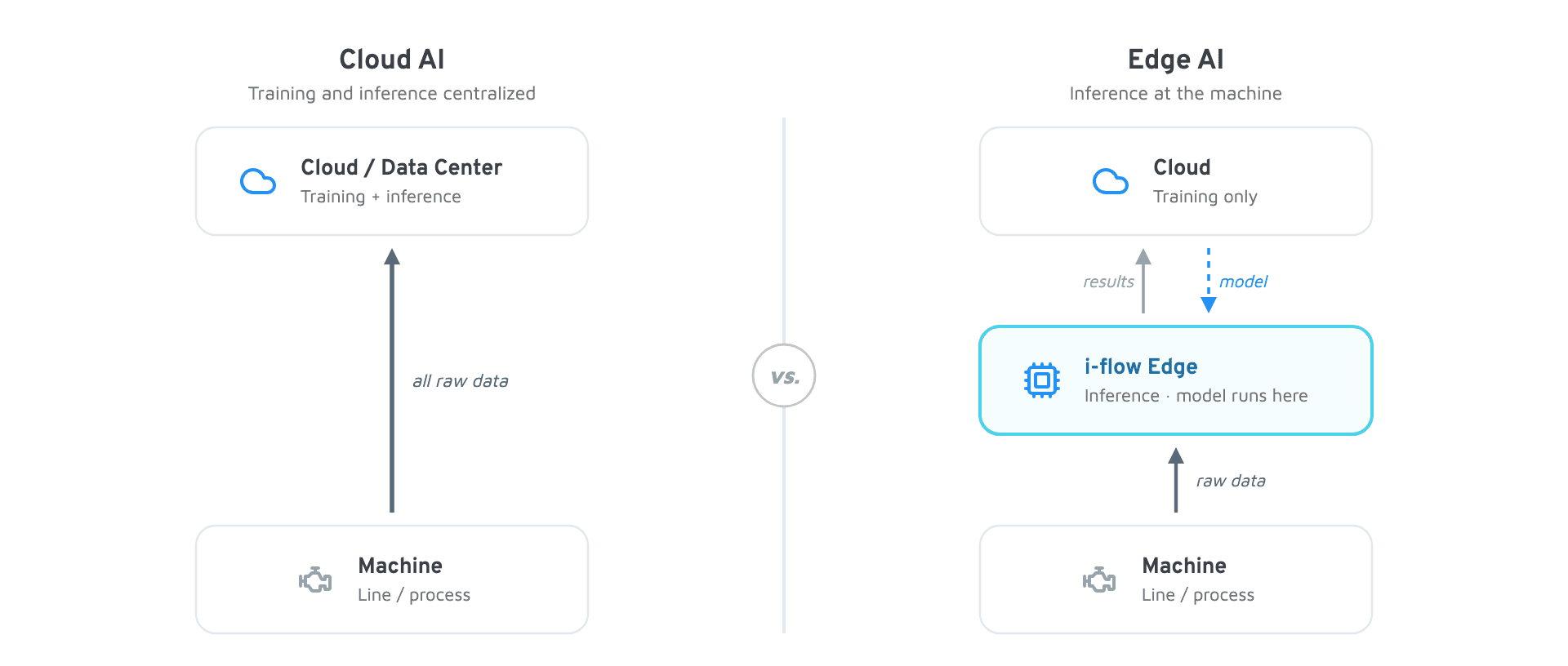
AI on the Edge refers to running AI models directly on local hardware, close to the data source. That can be an industrial PC at the line, a gateway in the cabinet, or a sensor with its own processor. The term combines two fields. Edge computing means decentralized data processing near the source, not in a central data center. Machine learning adds the models, as part of the Industrial AI movement.
The key to understanding it is separating two phases in a model’s lifecycle:
- Training: The compute-intensive creation of a model from large amounts of historical data. Training needs a lot of computing power and usually happens centrally – in the cloud or on a powerful server.
- Inference: Applying the finished, trained model to new, current data to deliver a prediction or classification. Inference is far less resource-hungry and latency-critical.
Edge AI concerns inference first and foremost. The model is trained centrally, but then shipped to the machine and operated there. This division of labor – central training, decentralized inference – is the core of the approach. It sets AI on the Edge apart from pure cloud AI, where both phases run in the data center.
Why run AI on the Edge? Edge vs. cloud
The cloud remains the right place for many AI tasks – above all for training and for analytics across many sites. For inference at the process, however, four solid reasons speak in favor of the edge.
The four drivers for AI on the Edge
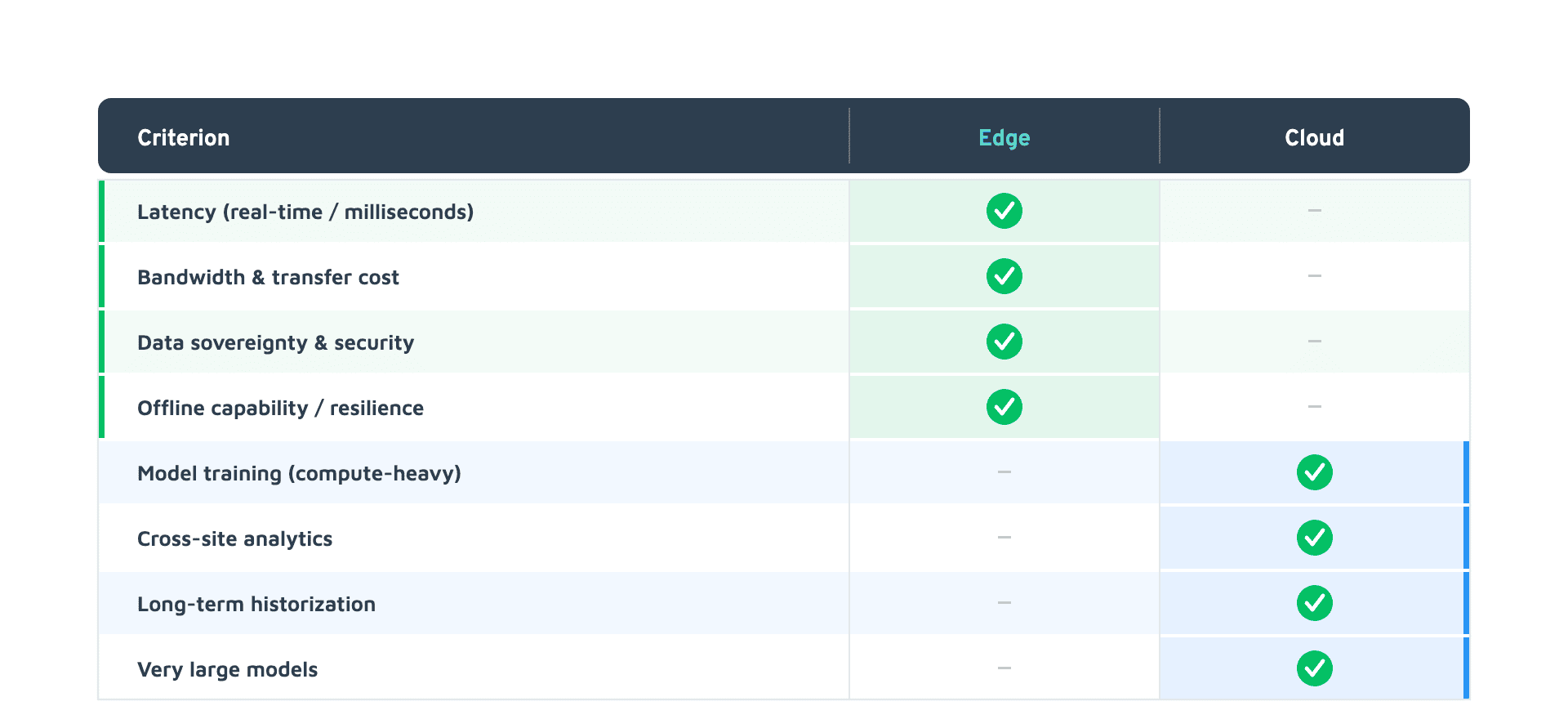
- Latency: A decision that controls the process has to be made within milliseconds. The detour via a data center costs too much time. For a sorting gate or an ejector on the conveyor line, it is simply not practical.
- Bandwidth and cost: Streaming high-frequency raw data such as images or vibration signals to the cloud is expensive and often technically impossible. Edge AI evaluates locally and transmits only the result.
- Data sovereignty and security: Sensitive production data stays inside the plant. That reduces the attack surface and makes it easier to comply with internal and regulatory requirements.
- Offline capability: Inference keeps running even when the internet connection drops. For plants that must not stand still, this independence is decisive.
The limits of the edge
Edge AI is not a replacement for the cloud, however, but a complement. Decentralized execution comes with real constraints that need honest weighing:
- Limited computing power: Edge hardware is resource-constrained. Very large models do not run there without further work and must be shrunk first.
- Distributed management: Updating a model across a hundred edge devices is more effort than one update in the cloud. Without central management, this quickly becomes unwieldy.
- No training on site: The actual learning stays central. The edge executes; it does not train.
The consequence: latency-critical, bandwidth-intensive, or privacy-sensitive inference belongs at the edge. Training, cross-site analytics, and long-term historization stay central. The following graphic maps the typical criteria to the two locations.
Architecture: Edge AI in the Unified Namespace
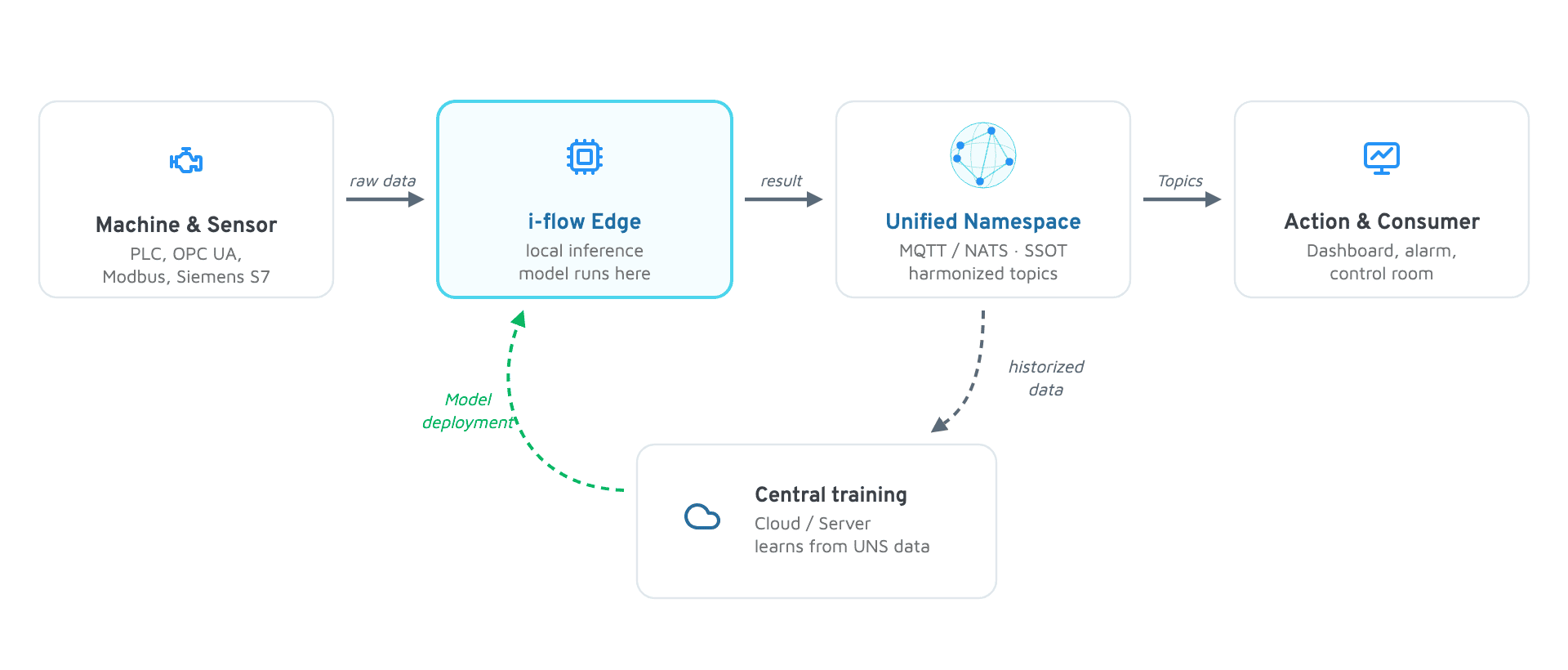
AI on the Edge only works in operation with a clear division of labor between the central and decentralized levels. It also needs a reliable data layer that connects the two. This is where the Unified Namespace (UNS) comes in. It is a central, hierarchically organized data layer. Systems publish and consume data there via a shared broker like MQTT or NATS — the Single Source of Truth (SSOT).
The typical cycle of an Edge AI solution passes through four stations:
- Data acquisition at the source: The i-flow Edge connects to PLCs, sensors, and SCADA systems via native protocols such as
OPC UA,Modbus, orSiemens S7. It normalizes the raw data locally. - Local inference: The trained model runs directly on the edge and evaluates the data in real time – with no detour through the cloud.
- Results into the UNS: The prediction – say a quality verdict or an anomaly score – is published into the UNS. It is then available to every system.
- Central training as a feedback loop: Historized data from the UNS flows back into central training. Improved models are then rolled out to the edges again.
This creates a closed loop: the edge delivers inference in real time, and the center delivers steadily better models. The UNS is both the data source for inference and the destination for its results.
Examples from manufacturing
The approach is not an abstract concept – it solves concrete problems on the factory floor. Three use cases show why inference belongs right there at the machine.
Optical quality inspection
A camera checks parts directly at the line for scratches, dimensional deviations, or assembly faults. An image-classification model decides within milliseconds whether a part is good or scrap. This is where the bandwidth advantage becomes obvious: sending every image stream to the cloud would be uneconomical. The model runs on the edge, and only the inspection result – not the image – travels into the UNS.
Anomaly and condition detection on drives
Vibration and temperature sensors on a drive motor deliver high-frequency signals. A model on the edge detects deviating patterns that point to incipient bearing damage – the classic basis for predictive maintenance. Because the evaluation happens locally, it stays active even when the cloud connection is disrupted.
Real-time process optimization
In a continuous process – such as a furnace or an extrusion line – a model supports the control loop. It suggests the optimal setpoint adjustment from current process variables. Because the control intervention has to happen almost instantly, the low latency of the edge is the decisive prerequisite here.
Implementing AI on the Edge
The best way in is step by step – on a clearly defined use case rather than as a plant-wide mega-project. The following five steps form a proven path to building Edge AI up to production readiness.
- Define the use case and latency requirement: First clarify what the model should decide, and how fast. This latency requirement is exactly what decides whether the inference belongs at the edge or can stay in the cloud.
- Connect the data and harmonize it in the UNS: Connect the relevant signals via native protocols. Then standardize units, timestamps, and naming into a consistent ISA-95 topic structure, for example
plant01/assembly/line01/motor01/vibration. - Train the model centrally: Train the model on historized UNS data – in the cloud or on a server with sufficient computing power. Start with the simplest viable model and increase complexity only when needed.
- Optimize the model for the edge: Shrink the model so it runs on resource-constrained hardware. Techniques such as quantization – reducing the numerical precision within the model – lower memory footprint and compute load without significantly hurting accuracy.
- Deploy, publish, and monitor: Roll the model out to the i-flow Edge, run the inference locally, and publish the results into the UNS. Watch for model drift along the way – when processes, materials, or machines change, a model loses accuracy and has to be retrained.
What matters is the iterative character: a first model will rarely be perfect. Gather operational experience, refine the models in central training, and only then extend the approach to further machines and use cases.
i-flow as the foundation for AI on the Edge
Because Edge AI is first of all a question of placing data and inference correctly, the leverage lies in a platform that cleanly separates central control from decentralized execution. The i-flow platform follows exactly this principle: central configuration in the i-flow Hub, decentralized execution via i-flow Edges close to the machine.
The i-flow Edge is the natural place for local inference. It connects directly to PLCs, sensors, and SCADA systems. It normalizes the raw data with minimal latency and hands it to a locally running model. The i-flow Hub manages data models, connections, and configurations centrally. It rolls out changes consistently to all edges – the answer to the management challenge of distributed AI on the Edge. The i-flow Broker provides the central message broker and ensures that both the incoming data and the inference results arrive reliably in the UNS.
For AI on the Edge this means, concretely: the harmonized data is available both locally and centrally. The model runs where the decision is made. Results are usable via the UNS for every other system, without proprietary point-to-point connections.
Conclusion
AI on the Edge is not a competitor to the cloud, but the correct placement of AI inference. It brings the decision to where it is needed – at the machine, in real time, independent of the network connection. Training stays central; execution moves to the edge. What is decisive here, as with every Industrial AI initiative, is the data foundation. Without continuous, harmonized data, even the best model has no effect. Three key takeaways:
- Inference belongs where the decision is made: latency, bandwidth, data sovereignty, and offline capability all argue for local execution at the machine.
- Training stays central: Edge AI executes, it does not learn. The feedback loop of central training and decentralized inference keeps the models current.
- The data foundation is decisive: a Unified Namespace supplies the harmonized data – as the source for inference and the destination for its results.
Whoever lays the data foundation today creates the basis not only for AI on the Edge. It also underpins every further Industrial AI application across the plant.