
Artificial intelligence has reached the factory floor – yet industrial AI is more than a language model dropped onto the shopfloor. It is AI tailored to the specific reality of manufacturing: to machine and sensor data from Operational Technology (OT), to hard real-time constraints and to processes where a wrong decision has immediate physical consequences. Consumer AI, trained on vast amounts of text from the internet, therefore cannot simply be transferred onto the plant. This article explains what defines industrial AI, how it relates to data analytics, which applications it enables today and why it is first and foremost a data topic.
What is industrial AI?
Industrial AI describes the use of artificial intelligence for the tasks of industrial manufacturing – such as maintenance, quality assurance, process optimization and planning. The approach uses machine learning and other AI methods to detect patterns in operational data, predict events and support decisions. The decisive difference lies not in the algorithm, but in the context: a factory imposes completely different requirements than a chatbot or an image search.
Four characteristics distinguish industrial AI from general consumer AI:
- Data sources: The data comes from machines, sensors, PLCs and SCADA systems – not from text or images on the internet. It is numeric, time-stamped and close to the machine.
- Real-time: Many applications have to react at the pace of production. A prediction that arrives too late is worthless.
- Reliability: A model makes decisions on real assets. Traceability and robustness therefore weigh more heavily than in a consumer application.
- Physical consequences: An error can cause scrap, downtime or safety risks. That is why determinism outranks pure creativity.
These characteristics imply a close link to data analysis. At its core, industrial AI is data-driven analytics: it turns continuous operational data into predictions and recommendations. Anyone who wants to understand industrial AI must therefore first understand how data analytics works in manufacturing.
Industrial AI and data analytics
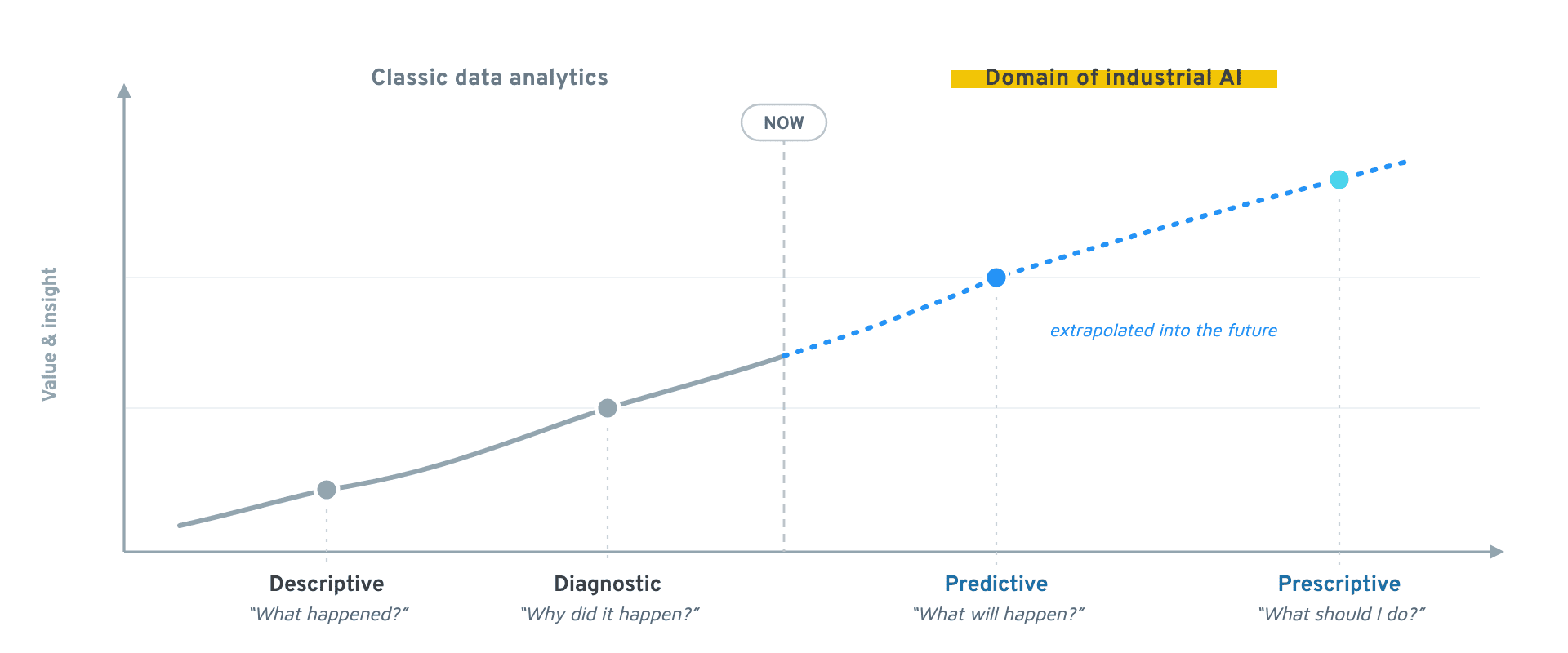
Data analytics describes four building stages of data evaluation. Each stage answers a different question, delivers greater value and at the same time demands more data and maturity. Industrial AI comes in at the upper end of this model – where hindsight becomes foresight.
- Descriptive analytics – “What happened?” Retrospective evaluation through reports and dashboards that describe past states.
- Diagnostic analytics – “Why did it happen?” Root-cause analysis that reveals the correlations and triggers behind an event.
- Predictive analytics – “What will happen?” Prediction of future events and metrics from historical patterns.
- Prescriptive analytics – “What should I do?” Derivation of concrete, often automated recommendations for action from the forecast.
Classic evaluations are sufficient for the first two stages. The predictive and prescriptive stages, in contrast, are the true domain of industrial AI: here models learn from historical trends and deliver reliable forecasts and recommendations. The transition is fluid – a good prediction is almost always the prerequisite for a meaningful recommendation.
Examples of industrial AI
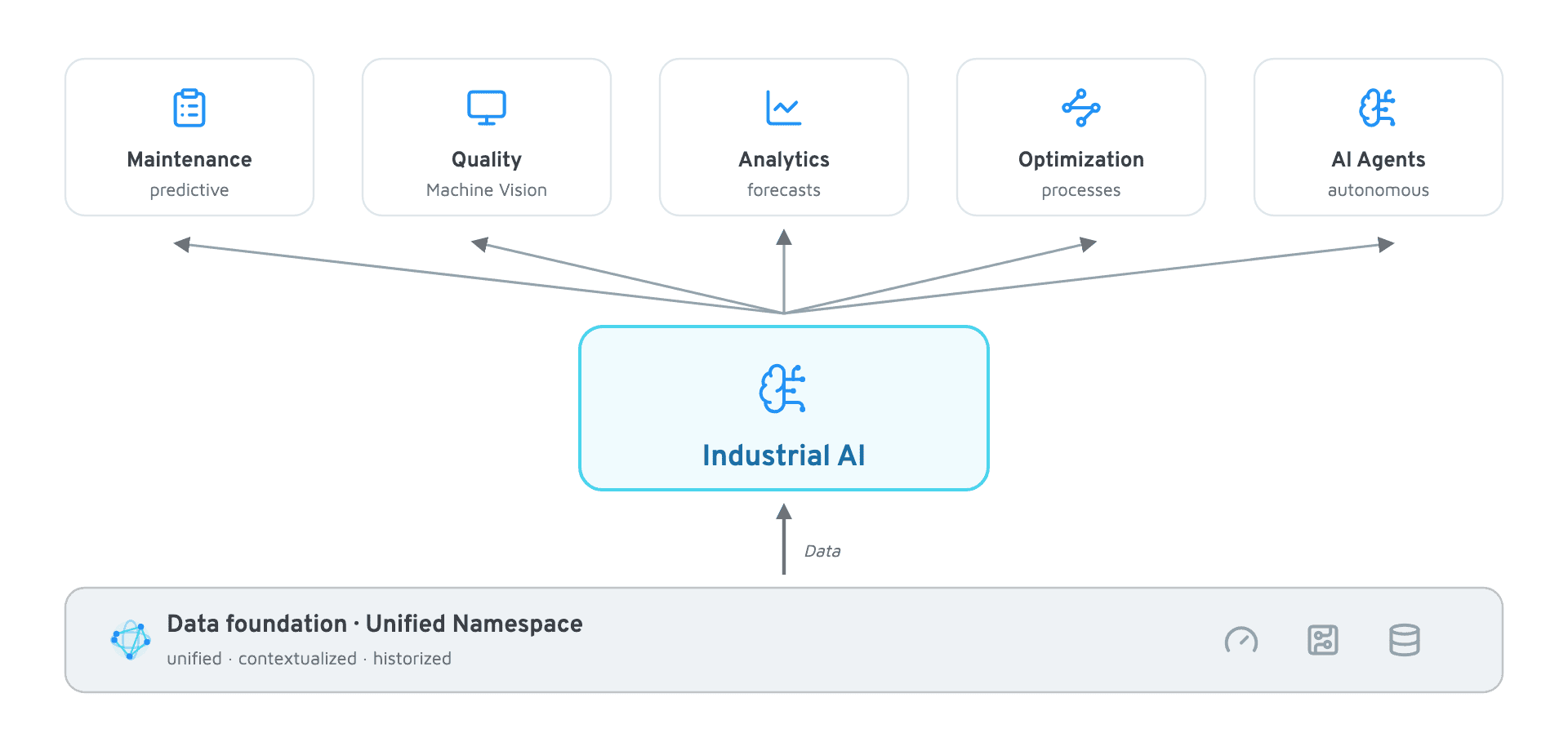
Industrial AI is not an abstract topic for the future, but is in use today in concrete applications. The following examples show the range – from maintenance to the autonomous assistant on the shopfloor.
- Predictive maintenance: Models predict machine failures from vibration, temperature or current draw, so maintenance happens as planned rather than reactively. This is the best-known use case of industrial AI.
- Quality inspection: Image processing with machine vision detects defects on components more reliably and faster than a manual visual inspection.
- Predictive analytics: Forecasts of throughput, utilization or energy demand improve the scheduling of shifts, inventory and load peaks.
- Process optimization: Models find optimal parameters for temperature, pressure or speed and thereby stabilize yield and cycle time.
- Generative AI and AI agents: Language models answer questions about asset states, summarize shift reports or, as AI agents, autonomously trigger simple tasks – such as creating a work order.
As different as these applications appear, they share the same foundation. Each of them continuously consumes data from production. Without reliable data, even the best model remains ineffective – and this is exactly where the success of any industrial AI initiative is decided.
The data foundation of industrial AI
Industrial AI is first a data problem and only then a model problem. A model is only ever as good as the data it is trained and operated on. In many factories the real hurdle therefore lies not in the algorithm, but in the data basis: the data exists, but it is trapped in isolated systems such as PLC, SCADA and historian, and inconsistently structured.
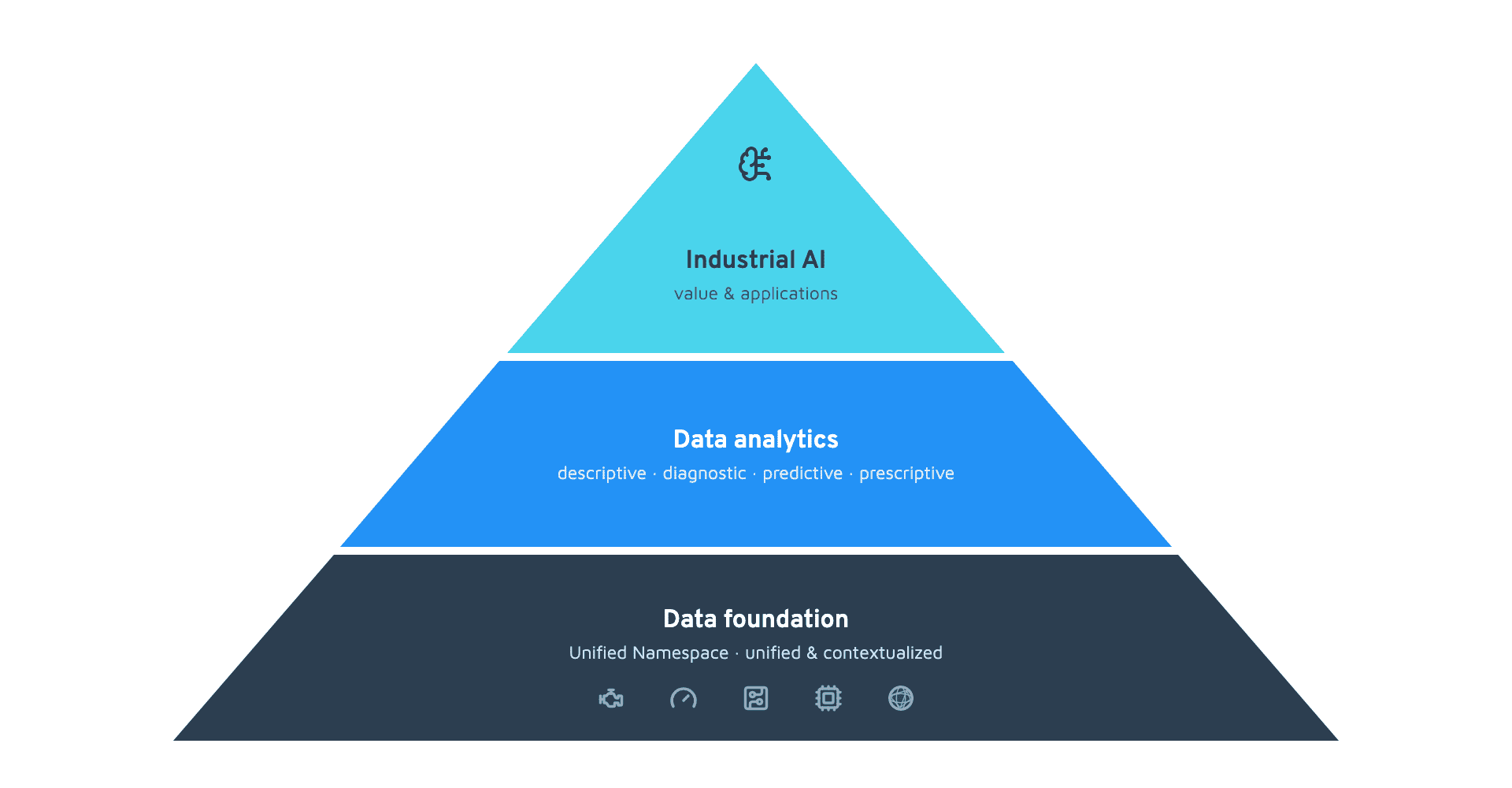
For industrial AI to work, the data needs three properties. It must be unified so that every system can use it without a proprietary interface. It must be contextualized so that a measured value is unambiguously assigned to its machine, line and unit. And it must be historized so that models can learn from past trends.
The Unified Namespace as prerequisite
These are exactly the properties the Unified Namespace (UNS) provides. It forms a central, hierarchically organized data layer in which all systems publish and consume data through a shared message broker – such as MQTT or NATS. This makes machine data available – normalized and in real time – as a Single Source of Truth (SSOT). For every industrial AI application this means: the model simply subscribes to the relevant topics in the UNS instead of connecting to a dozen proprietary interfaces. The path from raw data to value can thus be understood as a clear, layered build-up.
i-flow as the data foundation for industrial AI
Because industrial AI is first a data problem, the lever lies in a reliable data basis. I-flow provides exactly this foundation and follows a clear principle: central configuration in the i-flow Hub, decentralized execution via i-flow Edges close to the machine.
I-flow Edge connects directly to PLCs, sensors and SCADA systems via native protocols such as OPC UA, Modbus or Siemens S7. It normalizes the raw data locally – close to the source, with minimal latency – and publishes it in structured form to the UNS. The i-flow Hub manages data models and connections centrally and rolls out changes consistently to all Edges. The i-flow Broker provides the central message broker and ensures reliable delivery of all data points.
For industrial AI this means, in concrete terms: the harmonized data is available in the UNS, and any analytics or AI system can subscribe to it as a consumer – without worrying about protocol details. Data analysis can thus focus on the models instead of on data acquisition.
Conclusion
Industrial AI carries the strengths of artificial intelligence over to the reality of manufacturing – with its machine-level data sources, real-time constraints and physical consequences. At its core it is data-driven analytics that comes in at the predictive and prescriptive end of the four analytics stages, gaining predictions and recommendations from operational data. The use cases range from predictive maintenance through visual quality inspection to AI agents on the shopfloor.
What matters, however, is the right order. Industrial AI is not a pure model topic, but first a data topic. Without unified, contextualized and historized data, even the best model remains ineffective. Three key takeaways
- Context before algorithm: Industrial AI differs from consumer AI through its data sources, its real-time constraints and its physical consequences.
- Data before models: A solid data foundation – ideally a Unified Namespace – is the prerequisite, not an afterthought.
- One foundation, many applications: The same harmonized data basis carries predictive maintenance, quality inspection, analytics and AI agents alike.
Whoever lays the data foundation today creates the basis for the full range of industrial AI across the plant – from the first prediction to autonomous automation.